Trouble

“Trouble” by Gary D. Schmidt

No matter what a person does to avoid it, trouble can find him. That’s what Henry Smith learns although his father has always said that staying away from Trouble was easy enough.

The Smiths are a much untroubled family as the story opens—wealthy, they live in a New England mansion that has been in the family for over 300 years, situated in a perfect town called Blythbury-by-the-Sea. Henry’s older brother, Franklin, is a superstar high school athlete and rugby player. Life is good.

One night while he is out running, Franklin is struck by a truck and lands in the hospital in a coma. Life for the Smiths changes overnight as they wait to see if Franklin will live or die. When the alleged driver of the vehicle, Chay Chouan, a Cambodian immigrant, comes forward, the town anti-immigrant sentiments run high. But at the pre-trial hearing, Henry finds out things that he had never known about his brother, including that he had often made fun of Chay and beat him while his friends held Chay down. Franklin’s true character appears to be that of an arrogant, privileged jerk.

Chay is not convicted of a crime, but his family disowns him because they are ashamed of him. Confused and angry, Henry decides that he is going to climb the most rugged mountain in the area, Mount Katahdin, partly because Franklin had told him he wouldn’t be able to do it. Henry’s friend Sanborn, comes along, fearing that Henry will be hurt if he goes alone.

Although it’s a coincidence that the two boys are hitchhiking and Chay picks them up—in the very truck that hit Franklin—as the reader, I believed the story because I understood that Chay was stopping for ‘black dog’—a dog that had been his until his father starved and then threw the dog in the ocean. The three boys then hike the mountain together and we learn more about each of their lives. Chay is the product of a rape in a Cambodian re-education camp and he’s also a protector of Henry’s sister.

The trip results in danger, revelation, a new understanding of the characters, and the opportunity for forgiveness. It brings up issues such as immigration, a bad economy and even the repercussions of slavery. This was a great book and A Junior Library Guild pick. I hope you’ll enjoy it as much as I did.
Posted in Adventure Stories, Fiction, Multicultural, Young Adult Literature | Leave a comment

Out of War

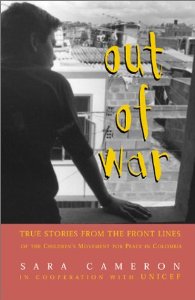
out of war“Out of War: True Stories from the Front Lines of the Children’s Movement for Peace in Columbia” by Sara Cameron

Nine chapters of “Out of War’ each discuss one of the child leaders of the Children’s Movement for Peace in Columbia. For many years, Columbia has been torn apart by political factions, drug lords that wrestle for control over regions, gangs and extreme poverty, both rural and urban. In the mid-1990s, UNICEF (a United Nations children’s organization), the Catholic Church and others helped to create the Children’s Peace Movement. The children who tell their stories not only give us a picture of the peace movement, but of the terrible lives they have survived.

Juan Elias’ father and cousin are assassinated one day in the father’s dental office. Juan had hoped to go to work with his father that day, but was late getting ready. Maritza comes from a violent home and although she tries to make peace, she lives a dual life and is caught up in street gangs. Johemir lived alone for eight months when he was only ten years old because his mother had to take a job in another area just to survive. He and others volunteer in the “Return to Happiness” program help small children who are victims of violence—one seven-year-old boy reported having seen his father murdered, cut up, put in a bag and thrown in a river. Unfortunately, stories like this are quite common.

For me, one of the most interesting things about what the teens said about their experiences was how they had learned that revenge didn’t work. Ultimately, many talk about forgiveness and the need to be the ones to end the violence. This idea can relate to violence in other ways—what students might be experiencing here in Southern California—in cities, schools, and in their homes. I hope COHS student will comment on this. What did you think of the ‘children’s referendum’ in which millions of children ages 7-18 voted for the rights to life and peace as their most important rights? How does this help—or does it?

If you enjoyed the book, the author also wrote ‘Natural Enemies,” which is an eco-novel. If you are interested in more information about the Children’s Movement, check the list of websites and resources at the back of the book.

Posted in Biography/Memoir, Hi-Low/Quick Read, Multicultural, Non-fiction, Young Adult Literature | Leave a comment

“The Glass Castle”

“The Glass Castle” by Jeannette Walls  glass castle

Yes, memoirs of dysfunctional families and abused children are quite popular among adults now as they are among teens. “The Glass Castle” could be grouped into this genre, but it is set apart by the fact that Walls’ parents are not overtly abusive—they seem to love their children—but they are so neglectful that it defies imagination. How the Walls children managed to grow up and escape a life of poverty is a great read.

Walls’ father was an alcoholic and her mother was an (unsuccessful) artist. Both are completely impractical and have no parenting skills. They allow the kids to do as they please and to raise themselves. Jeannette severely burns herself when she is three because she catches fire trying to make herself a hotdog. The dangerous mix of children and fire still doesn’t sink in for the parents, and there are several close encounters throughout the book.

Mrs. Walls has a teaching certificate, but is rarely employed because she doesn’t like the routine or getting up in the morning. She has an excuse for everything about her life and nothing seems to bother her too much. If the family doesn’t have the money to feed its pets, then all the better—the pets are learning survival skills. Rex Walls is very intelligent, but he always has pie-in-the-sky schemes and resorts to alcohol and arguing on the job, which routinely get him fired. He seems to make more money playing poker than he does working. Thus the kids have to learn survival skills just as the pets do. They sleep on cardboard boxes and cover themselves with a plastic raft to keep the rain off when the roof leaks. They scrounge for food and eat out of the schoolyard trashcans. If the family accumulates too much debt—or just gets the itch to move—they ‘skedaddle.’ They don’t pay to have the garbage collected, and it ends up in a large hole the kids had dug in the yard—a hole that was supposed to be for the fountain of the ‘glass castle,’ a dream house that Rex is always modifying plans for and never building.

While the kids are young, they are able to believe in the glass castle of their future. Their father has sometimes delightful ways of disguising his negligence—such as the Christmas when the kids will get no presents, but he takes each of them outside to name a one of the stars in the night sky as their own. However, ultimately, the children must place themselves in reality.

Posted in Biography/Memoir | 1 Comment

“Running with Scissors” and “A Wolf at the Table”

“Running with Scissors” and “A Wolf at the Table: A Memoir of My Father” by Augustine Burroughs

As I watch students pick out biographies for class assignments, it always occurs to me that there are books you’d like better if you just knew what they were about. It seems that the same few subjects are always selected—Marilyn Monroe, Princess Diana. Even when students choose Martin Luther King, Jr., I know it is because they already know a lot about his life from reading about him every year from fourth grade on.

I’ve asked your teachers if you can read memoirs when assigned biographies and, happily, the answer is yes. The hard thing about finding a memoir is that it won’t be cataloged with the biographies. It will be found wherever its subject is found. So a good book about a boy soldier in modern-day Sierra Leone is cataloged with books on Africa—and you’ll probably never find it. To get some of these good books into your hands, I thought I’d review some of my favorites. So I’ll start with one I just read, “A Wolf at the Table.”

Augustine Burroughs has written several memoirs, the most famous of which is “Running with Scissors,” which was made into a movie. “Running” is one of those crazy books that should make you weep for the terrible life of an emotionally and psychologically abused child, but that makes you laugh out loud as well. In it Burroughs discusses his childhood. His mentally ill mother hands him over to her (rather crazy) psychiatrist who adopts Burroughs. He describes his life in the doctor’s home as a mad house. The family never cleans anything and keeps a Christmas tree up all year. The wife of the psychiatrist is also a psychologically beaten woman who eats dog food as a snack. Though Burroughs is only thirteen years old, he is encouraged in a relationship with a man in his mid-thirties—a relationship that any normal person would regard as child abuse. The psychiatrist arbitrarily offers medication (drugs) to Augustine and makes predictions about the future through ‘Bible dipping” and reading the angles of his stool in the toilet.

Burroughs emerges worse for the wear. He has a second memoir “Dry” in which he discusses his alcoholism. “A Wolf at the Table” is Burroughs’ most recent best seller. Here he goes back in time from his other memoirs to remember his father, a philosophy professor at the University of Massachusetts. Professor Robison is psychologically cruel. He will never show Augustine affection, and in fact, seems to enjoy watching others suffer. Burroughs makes a ‘father’ out of clothes and pillows. His real father kills Augustine’s guinea pig and turns his dog into a violent attack animal that must be euthanized. He calls his son and tells him that he is going to kill him. The fact that Burroughs survived and remained sane, even funny, is a testimony to the human spirit.

Posted in Biography/Memoir | Leave a comment

Year of Impossible Goodbyes

“Year of Impossible Goodbyes” by Sook Nyul Choi

I guess August was the ‘month of impossibly short reads’ for me because here’s another little book that I thought was deeply moving. It’s shelved with children’s fiction in the library, but I hope that won’t keep you away from it. It’s a beautifully told, heartbreaking story with at least some happiness at the end. I know your teachers are often asking you to think about what life is like in other parts of the world—and this is a great account.

The narrator is ten-year-old Sookan. She relates the experiences of her Korean family near the end of World War II. She—and all of Korea—is under Japanese occupation—and this has been going on a lot longer than WWII—more like thirty years. The Japanese occupiers are cruel just for the sake of cruelty and use the war effort as an excuse for all of their behaviors.

Sookan’s family runs a ‘sock factory’ which employs young women and older teen girls. They must work long, grueling hours for low wages (sometimes they are not paid at all) to make socks for the Japanese war effort. Sookan’s mother and gruff aunt care deeply for the girls and try to keep them fed and protected. When Sookan’s grandfather extends some kindness to one of the girls, the Japanese military come to the house and cut down his beloved pine tree. After this, grandfather is tired of life, and Sookan learns of the physical torture he had endured by the Japanese. The sock-factory girls are later taken away to be ‘spirit girls’ for the Japanese troops. They cry out “I’d rather be dead!” and I wondered if younger readers would understand that this meant the girls were being taken into forced/enslaved prostitution.

Just as we hope things will get better with the end of WWII, North Korea is occupied by the USSR (Russia), and Sookan’s family must escape to get beyond the 38th parallel. Their efforts—guided by a double agent—are both exciting and heartbreaking. A wonderful read!

Posted in Fiction, Hi-Low/Quick Read, Multicultural, Young Adult Literature | Leave a comment

“Bad Boy: A Memoir”

Bad Boy: A Memoir by Walter Dean Myers

Another quick book that I read this summer was “Bad Boy: A Memoir” by Walter Dean Myers. Myers is a well-known (and well-loved) author of young adult fiction and has written several books that are popular here at COHS including “Monster,” “Fallen Angels,” and “Slam!” “Bad Boy” is the story of Meyers’ childhood and young adult years. It’s a good, quick read for anyone with a biography assignment or anyone just interested in the author of some of their favorite books.

Myers grew up in Harlem in the 1940s. His memoir gives us a sense of place and how much Harlem meant to Myers as a boy. His upbringing is unusual: though his parents are alive, he is adopted by the ex-wife of his father and her husband—the Deans—when he is just a small child. “Mama” read to him daily, and this was the seed of Myers’ love of reading and writing.

Though his experiences as a child are limited, as Myers grows and sees more of the world outside Harlem, he experiences racism. In addition, he has a speech impediment, and because he is often teased, he fights on a regular basis. His friendship with a white boy falls apart as they grow old enough to go to clubs where Myers is not allowed because of his race. Though Myers is a gifted child and attends an accelerated junior high, by high school he is frequently truant. He cannot reconcile himself the fact that he is receiving a good education just to be a manual laborer. Some of his classmates are applying to colleges that, again, are closed to Myers because of his race.

Thank goodness Myers finally found his writing voice and listened to an English teacher who told him, “Whatever happens, don’t stop writing.”

Posted in Biography/Memoir, Hi-Low/Quick Read, Multicultural, Young Adult Literature | Leave a comment

Jip: His Story

Jip: His Story by Katherine Paterson

Jip is a quick novel that packs, if not a punch, at least quite a few surprises at the end. I read it this summer and think that it could work for some Junior Projects—but get the teacher’s OK first as s/he may tell you that the book is too short or easy. Outside of the length of the book, the theme is perfect as a fictional starter for research into this period of American history.

The novel takes place in Vermont in the 1850s. As far as Jip knows, he fell off a wagon as a baby in 1847 and was found on the road and taken to the town poor farm as an orphan. He has swarthy (dark) skin which reminds the town folk of a gypsy—thus the name Jip. Though the caretaker of the poor farm and his wife are too lazy to make the farm work, they have Jip who is hardworking, has an unusual ability to deal with animals (an animal ‘whisperer,’ if your will), and is very nearly running the farm himself. Nevertheless, his life is a sad one; he wonders always how someone could have a baby fall off a wagon and not notice, not return to claim it. His secret longing is to be claimed by loving parents.

Jip finds a friend in Put (Putnam Nelson), a ‘lunatic’ for whom Jip builds a cage. Put is an intelligent man and helpful on the farm when he isn’t experiencing a spell of delirium. Eventually, Jip also has the opportunity to attend school, where he discovers that he’s an avid reader. When the truth of Jip’s parentage begins to surface, it is his teacher and her sweetheart who try to help him.

Posted in Fiction, Hi-Low/Quick Read, Junior Project | Leave a comment

Armageddon Summer

“Armageddon Summer” by Jane Yolen and Bruce Coville

I’ve been reading many books lately that touch on religious themes—fiction, non-fiction, Christian, Buddhist, religion in politics, and more. “Armageddon Summer” is one that I think COHS students will enjoy—and one that will make readers think about the result of religious fanaticism.

The novel takes place in the year 2000 and is narrated by two teen characters—Marina and Jed. The female voice was written by Jane Yolen and the male by Bruce Coville (both very popular writers if young adult fiction). Marina and Jed meet at a camp on the peak of Mount Weeupcut in western Massachusetts where their parents have dragged them to await the end of the world. According to The Believers—followers of Reverend Beelson—the Book of Revelations as well as the reverend’s own revelation are interpreted to mean that on July 27, 2000 the world will end with only 144 true believers left to live.

From the action and conversation between the teens, we get the back story. Marina’s mother has jumped into weird religious sects before (and is now ignoring her kids to tune in to the reverend’s every word). Now that she is on Mount Weeupcut with all her children, Marina is trying hard to believe as well, but the fact that her father has been left behind haunts her. Does he—and all of her other family members and friends—deserve to die? Jed, who doesn’t believe for a minute, is only there to watch over his father, whom Jed believes has a few screws loose since his wife ran away with a photographer from Colorado.

On the mountaintop, working to prepare the community of 144 for the end of the world, Marian and Jed sort out their own versions of reality. Many of The Believers whom they work and talk with are kind and sometimes quite reasonable. Even Reverend Beelson is decent and rational in his treatment of the unbelieving Jed. But amidst the amiable conversations, Believers are fortifying their camp with barbed wire and electric fencing so that non-believers can’t make their way in when the world ends. Unfortunately, people outside the community of Believers also start believing that they need to be on the mountaintop in order to be saved—and the results are a sort of Armageddon “made by man. Not by God.”

Students who are asked to read and make a connection to real situations in history could look up David Koresh (Waco, Texas) and Jim Jones in Guyana.

Posted in Fiction, Young Adult Literature | Leave a comment

Reading Lolita in Tehran


Reading Lolita in Tehran by Azar Nafisi

The subtitle of this work—“A Memoir in Books”—shows us that Nafisi plans to discuss not only her life in post-revolutionary Iran under Islamic rule and the Ayatollah Khomeini, but also the books that she read during this period of her life and how and why they mattered.

As a young woman, Nafisi had lived in the United States. When she returns to Iran after the revolution, she finds it utterly changed. Her love of literature, her reading, has become a subversive activity. A professor at the University of Tehran, she loses her post because she refuses to wear the veil. She decides to hand select a group of young women who also love literature and to hold clandestine meetings at her house to discuss “immoral” books such as those by Jane Austin, F. Scott Fitzgerald, Henry James, and of course, Nabokov, the author of “Lolita.”

The memoir weaves the discussion of these books with the lives of the young women attending the class at Nafisi’s house. I know that some of you are reading this book as a summer requirement for English 4 Honors. It is a great read about the power of corrupt government over the lives of freedom-loving individuals, and I think you’ll have a lot to discuss on this subject. But it’s also a fun analysis of many great books, and I realize that you will not have read most of these. I loved Nafisi’s class’s discussions of “Washington Square” by Henry James and of its female protagonist who is neither very smart nor very pretty—and who is manipulated by everyone important in her life. But then, I think it’s unlikely that you will have read this book. Again, when I see one of the women in the class say, “It is a truth universally acknowledged that a Muslim man, regardless of his fortune, must be in want of a nine-year-old virgin wife,” I wonder if you’ll know that she is paraphrasing the opening of Jane Austen’s “Pride and Prejudice”—and to great effect.

There is much in this book for those who haven’t read the literature Nafisi discusses. There is so much more for those who have. If you have the opportunity in any of your classes here at COHS to select a novel for analysis, you could have a great time with one of the works discussed in “Reading Lolita in Tehran” and comparing Nafisi’s class’s analysis of the book to your own.

The following are ideas from “Reading Lolita” that I think will make good discussion points about your summer reading:

“That room, for all of us, became a place of transgression.”

“‘Reality has become so intolerable. . . that all I can paint now are the colors of my dreams.’ . . . I like that. How many people get a chance to paint the colors of their dreams? . . . This class was the color of my dreams. It entailed an active withdrawal from a reality that had turned hostile.”

“I remember reading to my girls Nabokov’s claim that ‘readers were born free and ought to remain free.’”

“If she gets into a bus, the seating is segregated. She must enter through the rear door and sit in the back seats, allocated to women.”

“Much later, when I read a sentence by Nabokov—‘curiosity is insubordination in its purest form’—the verdict against my father came to mind. . . . Every great work of art . . .is a celebration, an act of insubordination against betrayals, horrors and infidelities of life.”

“We must thank the Islamic Republic for making us rediscover and even covet all these things we took for granted: one could write a paper on the pleasure of eating a ham sandwich.”

“The only way to leave the circle, to stop dancing with the jailer, is to find a way to preserve one’s individuality, that unique quality which evades description but differentiates one human being from the other. That is why, in their world, ritual—empty rituals—become so central. There was not much difference between our jailers and Cincinnatus’s executioners. They invaded all private spaces and tried to shape every gesture, to force us to become one of them, and that in itself was another form of execution.”

Posted in Biography/Memoir, Multicultural | 1 Comment

“The Secret Life of Bees”

The Secret Life of Bees by Sue Monk Kidd

Well, normally I write up a little review of the book, but since I know that this entry is primarily for those of you who are reading “The Secret Life of Bees” for a freshman honors’ requirement, maybe I can try a different tactic. As I don’t have to convince you to read the book (you are reading anyway), let me just mention that there’s a nice little summary of the book at the end under the title “Introduction to ‘The Secret Life of Bees.’” It’s much like what I would have to say in summary. There are also questions meant for a discussion group and you might want to ask and answer one of those here. So far I’ve noticed that the comments from incoming freshmen on summer reading have a great deal to do with whether you can relate to the character—put yourself in his or her mindset—and that’s important because the author has probably failed if you can’t. However, as you engage in the honors program in high school, you’re going to find that you’ll be asked for analysis of the books you read, and that requires deeper thought. Answering some of the discussion questions such as “Who is the queen bee in this story?” will be a good start on your analytical journey.

I first read “The Secret Life of Bees” when it came out. I was thinking that was a couple of years ago, but times flies, as they say, and it has been more like six years. So I needed to reread the entire book rather than take a quick glance. And although I think that this is a good book—and a perfect choice for ninth grade summer reading—I don’t think it’s a great book. The same things bothered me on the second reading as bothered me on the first. The story sewed up too neatly. I got a bit tired of the quotes about the lives of bees and then seeing how Lily’s life and the lives of those around her matched the bees. I also got tired of being knocked over the head with the ‘deep’ spiritual and emotional lives of the bee women and Lily’s connection to the power of all that earth mothering. It was just too heavy-handed for me.

I’ve always felt that the best discussion centered on this book would be a comparison to Mark Twain’s “The Adventures of Huckleberry Finn.” Unfortunately, I doubt that any of you have read that book—and now that reading it is out of fashion (not very PC), you probably won’t read it in eleventh grade as students did at one time. But “The Secret Life of Bees,” either purposefully or on an unconscious level, is modeled after “Huck Finn” and I don’t doubt that some PhD candidate is writing about this at this very moment.

If you do get the chance to select a great work of American fiction and are asked to compare it to something contemporary, picking” HF” and “TSLoB” would be a blast. Lily and Rosaleen could be compared to Huck and Jim. Jim, the Black outcast (slave) on the run from a Southern society that takes away his human rights. Huck, the motherless child of a horrific father who physically and emotionally abuses him. Their dependence on one another to escape. Huck’s fluid lying to help himself and Jim. Jim’s need, even as the adult, to depend on Huck because the society gives more value to the child than the man who is black. Jim as a surrogate father and his love for Huck.

Obviously, I think that “HF” is a much better book—this is because the characters are more real to me; they are more deeply flawed. Huck helps Jim in the same way that Lily helps Rosaleen, but because of his upbringing in a racist society, he doubts that he is doing the right thing and believes he’ll go to hell for it. This is ironic, and irony abounds in the novel. It’s what could have made “TSLoB” great, too, but it’s missing.

As just a little sidebar, let me talk about the discussion question “Have you ever heard of ‘kneeling on grits?’” I was thinking as I read the book that, being Southern California kids, you may not even know what grits are. It’s grain (usually corn–hominy) that’s only coarsely ground. When boiled, it makes a sort of cereal. But when it’s still dry, it’s sharp and rock hard. I’ve only ever known one person who as a child was punished by kneeling, not on grits, but on split peas. The result was that when she grew up, she moved away from her parents and would NEVER allow them to see their grandchildren. I think that gives us a pretty good idea of the harshness of such a punishment.

Another of the discussion questions asks you to project into the future. I kept thinking about Rosaleen voting. The book ends on a happy note with Rosaleen registering, but at that time, and in that place, trying to vote might have cost her her life.

A penny for your thoughts.

(Earlier Entry)

Borders (the bookstore) is doing some promotional stuff that you might be interested in if you have chosen to read the novel for Frosh Honors.

Excerpt from the book:

http://www.borders.com/online/store/ArticleView_secretlifeofbees?cmpid=SL_20080617_REW

Super quick interview with the author (Sue Monk Kidd) on making the book into a movie:

http://www.bordersmedia.com/features/video/kidd.asp?cmpid=SL_20080617_REW

Video clip of the upcoming movie:

http://www.bordersmedia.com/features/video/secretlifeofbees.asp?cmpid=SL_20080617_REW

Ms. W.

Posted in Fiction, Junior Project, Literary Read Alike, Multicultural | 434 Comments