I’ve got to see the movie–for those of you who haven’t read the book yet, here’s my original review comparing it to The Boy in the Striped Pajamas. The Book Thief is one you need to make time to read. It’ll stay with you for a long time to come.
Adult Books for Teens: “The Round House”
The Round House by Louise Erdrich 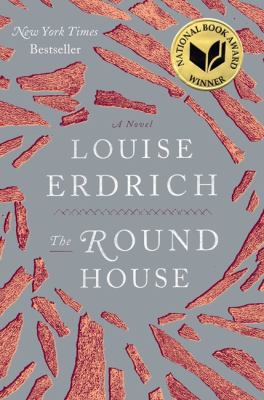
Joe and his dad Bazil are a bit worried about Joe’s mom. She isn’t home on time and there’s no indication of where she’s gone off to. Worried enough that they borrow a car—she has theirs—and drive toward her office in the hope that she is working late.
So it’s a relief—so early in the novel!—when they see her driving in the opposite direction, on the road home. Oddly, she doesn’t see them, but they figure she is just in a hurry after realizing how late it is.
Relief turns to horror when Joe and Bazil arrive home to find Geraldine sitting in the car, white knuckling the steering wheel. Joe is thirteen and doesn’t immediately understand what’s happened to his mother. She has vomited all over herself and, in addition to the smell of the vomit, reeks of gasoline.
At the hospital, Joe learns what he has begun to suspect. His mother has been brutally raped. Her attacker then hoped to kill her by dousing her with gasoline and lighting her on fire.
Bazil is a tribal judge. He seeks to bring his wife’s attacker to justice. But in a perverse twist, we learn that this may not happen. This is 1988, and whether this crime will be prosecuted and by what branch of government depends on whether it occurred on tribal, state or federal property—and whether the rapist was Indian or white.
As justice is thwarted, Geraldine is more and more withdrawn, even refusing to leave her room. Her depression is deep, and its effects on Joe, her only child, are serious. The family’s life has been ruined. Joe wants some normalcy again. He decides to do his own investigating and brings some of his friends in on it, unable to understand the risks he is taking.
High school housekeeping: I recently read an article about how reading literary fiction can do wonders for the readers—improving character traits that non-literary fiction may not. It reminded me of this beautiful novel because The Round House was used in the study as the literary fiction that subjects read from. And I realized that I never reviewed it although I read it about a year ago and loved it. (The truth is, I love all of Erdrich’s books. Many have the same Ojibwa characters. If you want to read one of the most excellent books of your life, try The Last Report on the Miracles at Little No Horse.)
This book will interest teens who are fairly good readers. You’ll be engrossed by the story and the bit-of-a-shocker ending. You’ll delight your English teacher who also knows what this sort of book can do for you. If you need to read something and compare it to class/school required reading, you could do a bang up job putting this side-by-side with To Kill a Mockingbird. If you have an assignment that asks you to read fiction and then research factual events from the story, looking into the prosecution of rape cases on reservations would also make a great paper or project/report. In an afterword to the novel, Erdrich notes that the problem still exists—that “1 in 3 Native women will be raped in her lifetime . . .; 86% of rapes and sexual assaults upon Native women are perpetrated by non-Native men; few are prosecuted.”
Posted in Family Problems, Fiction, Historical Fiction/Historical Element, Horror/Mystery/Suspense, Human Rights Issues, Literary Read Alike, Multicultural
Tagged Adult books for teens, American Indians, attempted murder, book reviews, coming of age, family problems, fiction, First Peoples, Indian reservations, Indian women, justice, mystery, National Book Award winner, Native Americans, Ojibwa Indians, race relations, rape, sexual assault
Leave a comment
“Bang”
Bang by Norah McClintock 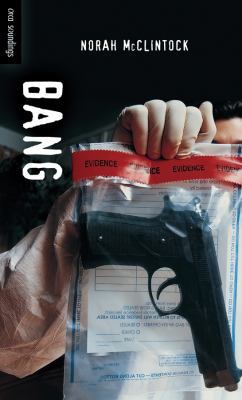
“Act normal? The guy died, and JD wants me to act normal?”
Quentin—‘Q’—thinks he’s going to have the usual day with his friend JD. Q thinks about asking JD’s sister Leah out. He thinks about hanging out, nothing unusual. But when one of their typical petty crimes goes wrong, JD and Q have a terrible secret to hide.
Is JD telling the truth when he says he destroyed the evidence? Should Q be worried about being framed?
High school housekeeping: I really wanted to read a few books over the holiday weekend in anticipation of the READ 180 class visits this week. Bang was one. The Lexile level for Bang is 600, which runs in the 4th-5th grade reading levels. It’s a very short, quick read that deals with a senseless crime, having the courage to tell the truth, loyalty, and betrayal. The author is one of my favorites for teens working on their reading skills. Everything I’ve read by Norah McClintock works well, Bang included.
“Picture This”
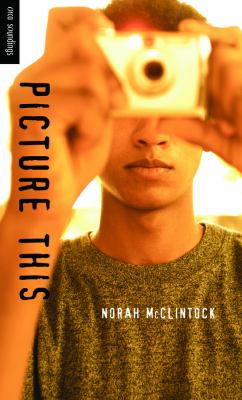 Picture This by Norah McClintock
Ethan is living in his second foster home when he is enrolled in Picture This is a program for troubled teens. He’s learning photography skills and he’s good at it—creative and serious.
So when someone follows Ethan down a dark alley and tells him to hand over his backpack or be shot, Ethan doesn’t want to give up his backpack. There’s nothing of value in it except his camera. And that camera has all the pictures for his project on freedom.
Ethan thinks that the mugger doesn’t really have a gun. Who would hold up a teen with just a backpack? No one but a drug addict looking for a few bucks. So he’s surprised when he makes a break for it and is shot at.
Ethan has enemies, sure. The gang the Nine-Eights are after him since he defended his friend against them. But the guy who keeps following him isn’t really one of them, even if he shows up with them. Why does he want to kill Ethan? And how will this affect Ethan’s new life, with parents that actually care for him?
High school housekeeping: I really wanted to read a few books over the holiday weekend in anticipation of the READ 180 class visits this week. Picture This was one and Game was the other. The Lexile level for Picture This is 610, which runs in the 4th-5th grade reading levels. It’s a very short, quick read that deals with an at-risk main character and has a good mystery. The author is one of my favorites for teens working on their reading skills. Everything I’ve read by Norah McClintock works well. Picture This is no exception.
Sports: “Game”
Game by Walter Dean Myers 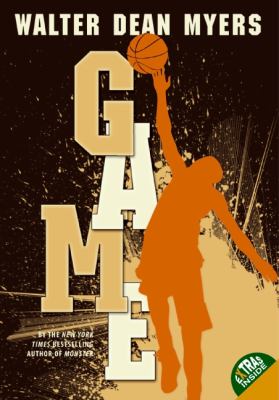
“In a way it was like a bunch of guys in a game. They were falling behind every minute that passed, but they had lost interest in the score. It was as if they were just a ton behind and had given up on the win. And maybe deep inside they didn’t want to peep the score, maybe they knew what was happening but just didn’t want to think about it anymore. I could understand that. I had played enough ball in my life, and was deep enough into my game to know I had to be in the hunt for a win or I could lose who I was. And once I lost who I was, my inner me, then all the CDs and all the iPods and all the bling in the world wasn’t going to make it right.”
Drew Lawson is a very good basketball player. In fact, as a high school player, he’s way above the average. He knows that if he can work hard and stay out of trouble, he has a very good shot at a college scholarship. He hopes for a Division I school and the opportunity to prove that he’s NBA material.
Drew is thoughtful and when he read Shakespeare’s Othello in English class, he tries to relate it to his own life—is his basketball coach like Iago, the play’s villain? It seems so as he is giving a lot of attention to a new white player from Europe (the Czech Republic). Drew thinks this will decrease his own chances to get scouts interested in him—and thus to realize his dream. But if he’s going to make it in college, he needs to learn to be a team player.
Game has continual basketball action as the Chargers work toward the regionals. A great choice for fans.
High school housekeeping: I really wanted to read a few books over the holiday weekend in anticipation of the READ 180 class visits this week. Game was one and Picture This was the other. The Lexile level for Game is 800, which runs in the 6th-7th grade reading levels. The main character, Drew Lawson, is a high school senior, so the novel is certainly meant for teens. You don’t have to be a big basketball fan to enjoy it because it deals with coming-of-age issues—being a ‘team player’ in the larger sense, facing one’s future, having the strength not to get caught up in destructive behaviors. Nevertheless, if you like basketball, there are great games and great plays throughout the book—lots of action. I recommend Game for teens working on their reading skills. It’s quick and it’s fun, with plenty of action to keep you reading to the end.
Veterans’ Day Reading: “The Yellow Birds”
 The Yellow Birds by Kevin Powers
“The war tried to kill us in the spring.”
“Then, in summer, the war tried to kill us as the heat blanched all color from the plains.”
‘The war had killed thousands by September.”
These are the first sentences of the first three paragraphs of The Yellow Birds, an extraordinary war novel for its unlikely, shockingly poetic beauty.
The Yellow Birds is the story of 21-year-old John Bartle and his friend 18-year-old Daniel Murphy (Murph) during fighting in northern Iraq in 2004-5. Both are from Virginia and this seems to create a natural bond between them as they train for combat at Fort Dix, New Jersey, before deployment. But the reader learns very quickly that Murph will not make it back home. His death haunts the guilt-ridden Bartle long after he has returned home. In scenes that alternate between Bartle’s attempts to adjust to civilian life and his memories of the events of the war, we slowly learn what happened to Murph—the deep, crazy tragedy of it. And we learn why Bartle feels responsible for things outside his control.
Sterling, only 23 himself, is the tough sergeant of their platoon. He punches Bartle when Bartle promises Murph’s mom that he will watch over Murph and make sure that he comes home alive. This isn’t just because such a promise may be impossible (and in this case, is impossible) to keep; it’s because such a promise can take down the survivor as well as the war victim.
All of these characters are boys, not men, and this point is driven home time and again. They are not prepared for all they are going through—attacks by insurgents, unendurable fatigue and stress.
The story of Bartle’s life after his return home, his post-traumatic stress disorder (PTSD) as he attempts to piece together his friend’s fate and come to grips with it, is alternated with the details that lead up to Murph’s bizarre death and its aftermath. By the time Bartle comes home, he is not compulsively waving the flag, but rather questioning the purpose of his entire experience and his own motivation for joining up. He feels even worse when people call him a hero because he wishes he’d never gone through any of it.
Murph’s death and the fate of his body are merely a sketch, but are so powerfully drawn that they will live in the reader’s memory.
Thoughtful, deep and consistently engaging, The Yellow Birds will give readers a better understanding of the veterans who make it home.
High school housekeeping: Though short, this is one of the more powerful war novels I’ve read. The author, Kevin Powers is a veteran of the Iraq War and fought in Al Tafar where the novel is set. It will speak to adults as well as to teens. It may seem odd to also tell you that it is one of the most poetic YA books I’ve read, but Powers is simply an exceptional writer. In the same paragraph—in the same sentence—he can describe the beauty of the desert and its rhythms while cataloging the bodies and blood that litter its landscape.
I was afraid that the novel was too good—I know that sounds weird—but I worried that teen guys looking for a war book wouldn’t like Powers’ evocation of place, his ability to transform atmosphere into poetry. But we’ve handed it to several guys looking for war books, and each has come back with a positive review. They enjoyed and recommend it.
Caveat: As in any good war book, there is death—horrifying death, including dismemberment, people blown apart by bombs/suicide bombers, and the murder of civilians.
Posted in Adventure Stories, Controversial Issue/Debate, Family Problems, Fiction, Historical Fiction/Historical Element, Young Adult Literature
Tagged book reviews, death, death and dying, Iraq, Iraq War, post traumatic stress disorder, PTSD, U.S. army, veterans, Veterans' Day, war, YA fiction, YA literature
Leave a comment
Tough Teen Topics: “Such a Pretty Girl”
Such a Pretty Girl by Laura Wiess 
Fifteen-year-old Meredith (“Chirp”) is coming undone because her father, who sexually molested and raped her when she was twelve, is coming home from prison.
It’s clear from the outset of Such a Pretty Girl that Meredith’s mother will not protect her. She’s just way too excited about her husband’s homecoming and can’t understand why Meredith isn’t showing enthusiasm. This even though she knows that her husband raped her daughter. Three years earlier, at the hospital, she told the bleeding Meredith not to tell anyone, that dad, like all people, makes mistakes.
The whole neighborhood knows that a sexual predator is coming home and almost everyone resents his presence, fears what he will do to their children, and—in the ‘blame the victim’ model—stays clear of Meredith. However, she does have some supporters—Nigel, the cop who arrested Charles on the night of the rape, and Andy and his mom Mrs. Mues. Andy has also been raped by Charles. After a later accident, Andy is inexplicably paralyzed from the waist down. He and Meredith are boyfriend and girlfriend.
The entire story takes place over the course of a few days with Meredith having lots of italicized flashbacks to scenes of her father both being a good dad (when she was very young) and a sexual predator. No matter how she tries to sort out what is happening to her, she feels that she will have to be victimized again in order to put her dad back in jail, and that no one will be able to help her.
Is she right?
High school housekeeping: Such a Pretty Girl is a tight little novel—both short and physically compact, it’s very portable. It’s an easy read, somewhere in the sixth grade level, although its content is clearly meant for older teens. I recommend it for most high school students, but I think it will have particular appeal to reluctant readers.
I’m not sure how students will reaction to Meredith’s mom. By anyone’s measure, she is one dimensional—entirely shallow, worried about keeping up with the Joneses (without recognizing how all the Joneses hate her), concerned about her fading good looks, and completely out of touch with the damage child sexual abuse does to her daughter. She serves as a mouthpiece for details of setting, so her unnatural conversation may be disconcerting. The reader doesn’t know why she is so oblivious when her own mother (Meredith’s grandmother) is much more centered. I attributed it to the fact that her husband brainwashed her so early. (They began dating when she was twelve.) However, she’s a good villain—showing her own evil is banal and entirely unlike her husband’s. She does tremendous damage just by not stepping up as a mom. She the kind of person we love to hate.
Movie Tie-In: Ender’s Game (Twentieth Anniversary Edition audiobook)
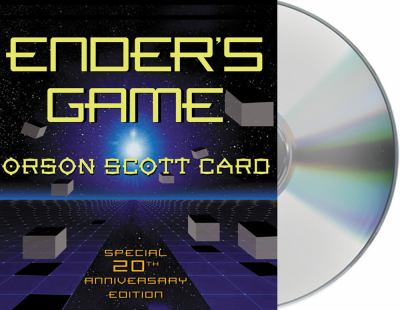
Ender’s Game by Orson Scott Card (Twentieth Anniversary Edition Audiobook)
Ender Wiggins is a rare genius who may save the world from alien ‘buggers’ if he can prove himself in Battle School, and rise to the top command post. Of course, he’s only six years old.
Ender has battles on many fronts at school. Not only is he the youngest student to ever be admitted to Battle School, the fact that he’s also the most successful—quickly rising in rank—makes him the target of envy, resentment, and bullying. He would be a lonesome child anyway because no one thinks quite as well as he does. But Ender must overcome the social hurdles stacked against him if he is to make a few friends and have others willing to be led by him into battle. Rather than help him, the adults who run the Battle School (military men in high command) continue to set him up for tormenting by older boys and for impossible battles in the battle room. While they sometimes question the ethics of their treatment of Ender, they believe it’s necessary to test his mettle in the harshest ways possible.
These military rulers believe that Ender might have the right stuff because he was bred to have it. He’s a ‘third’ in a world where families are only allowed to have two children. Ender’s older brother and sister, Peter and Valentine, are also brilliant, but don’t have the right personality traits to be the commander of an epic interplanetary battle. Peter is sadistically violent, torturing small animals and Ender as well. Val is too feeling. In Ender, the military hopes to get it just right.
The author of Ender’s Game, Orson Scott Card, won both the Hugo and Nebula Awards for the novel. I’m not a fan of hard-core science fiction and for me, the Nebula Award signaled a book that, while fabulous, wouldn’t suit my taste. I was wrong on that account—Ender’s Game is quite character driven. Much of it is an exploration of Ender’s thoughts as he works through battles and social challenges. He, too, questions his own actions, especially concerning his violence toward bullies. (He reasons that if he doesn’t destroy them in a single showdown, they will brutalize him continually. Think of Ralph in Lord of the Flies if he had decided it was necessary to take Jack down instead of trying to reason with him.)
While we get lots of Ender’s thoughts, we get lots of battle action and mounting tension among the characters as well. This is a fun, fast-paced story that I recommend for anyone.
High school housekeeping: The reason I decided I needed to try Ender’s Game is that the movie is coming out next week (November 1). I was busy and decided to listen to the twentieth anniversary edition audiobook. I’m really glad I did, and I’m recommending this to you as well. At the end of the novel, Card says in an interview that he wishes all of his novels had been published in audio format. He began his career as a playwright, and he values the production of a full cast. The audiobook has many narrators and they do a great job.
This is another book that can be compared to a required classic if a teacher gives you such an assignment. Obviously, you’d have no problem comparing and contrasting it to Lord of the Flies, but I think you’ll see connections to other required reading as well.
Bullying Books: “The Beckoners”
The Beckoners by Carrie Mac 
Everyone calls April “Dog.” She’s been bullied all through high school. From being forced to eat a whole box of dog biscuits and retching in the hallway to being beaten within an inch of her life, April has endured the unendurable quietly, hoping to disappear from the Beckoners’ radar. The only good thing in her life is her real dog, Shadow, who follows her everywhere (‘shadows’ her) and loves her without reserve.
Zoe is the daughter of an alcoholic mother (Alice) who jumps into and out of relationships with various men. She spends a lot of time listening to self-help tapes and uses the jargon not to help herself, but rather to point out how others can help her and themselves at the same time. Along with Zoe’s baby sister Cassy, the family of three is always on the move. Zoe is primarily responsible for Cassy as Alice is usually off with a man, hung over, or at work.
When Alice moves her family of three to Abbotsford, Zoe is picked by the Beckoners, headed by Rebecca “Beck” Wilson, to be one of their gang. The fact that Zoe falls in with them is a matter of circumstances. She never wanted to be a part of a gang, and she is sickened by some of the vicious things they do, particularly to April. But she’s afraid not to join, and, once in, she doesn’t know how to get out without risking her life. The last girl to try had her head shaved and tattooed, after which she disappeared.
Zoe is able to make a few real friends. There are Simon and Teo, a gay couple who have their own set of problems fighting prejudice, but who understand just how much trouble Zoe is in. And there’s also Leaf, the editor of the school newspaper. When Mrs. Henley, the English teacher, has an anonymous essay contest to pick the next editor of the paper, April wins. This throws Zoe and April together, even though Zoe has helped to antagonize April in order to stay in Beck’s and the other Beckoners favor.
Mac does a great job of building the tension in The Beckoners. What happens to Zoe and April continues to build in danger as Beck appears to be something of a psychopath. The final torment of the girls, particularly April, is tragic. This is a true bullying book and very realistic. I recommend it for all teens.
High school housekeeping: Carrie Mac is the author of several books in the Orca Soundings series for reluctant readers. The Beckoners is a step up in difficulty from these books. For teens working to improve their reading skills (Read 180, etc.), reading this novel is a great opportunity because you’ll have an author that you know and like, a subject that is riveting, and you’ll see how well a character can be developed in a work that’s a bit longer. This is a great read for all teens, but I’m particularly going to talk it up to those working on improving their reading skills.
One minor criticism (and it is minor): I think that two of the main characters have names that are too much alike—Alice and April. Sometimes I was reading and then realized I had the wrong character in my mind’s eye. My reading of the book would have been smoother with different character names.
Horror! “Monstrumologist”
The Monstrumologist by Rick Yancey 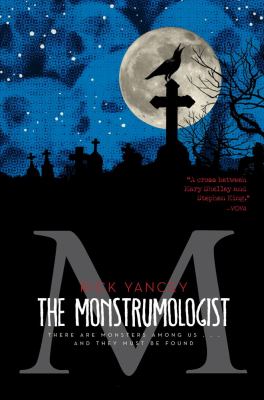
Another entry in the true horror category, The Monstrumologist starts with the gruesome discovery by a grave robber of a partially-eaten corpse around which is wrapped another corpse of a human-like creature.
The grave robber, Erasmus Gray takes the young female—whose face is half-eaten and whose throat is slashed—to Dr. Warthrop, the montrumologist. That’s right, the good doctor studies monsters. Warthrop identifies the headless creature that was consuming the corpse as an Anthropophagus, one of the headless creatures from Africa so often mentioned in myth and literature. Though the doctor believes only a few could be in New England—so very far from their place of origin—he does find an Anthropophagi fetus implanted in the girl’s corpse and knows that there is at least a breeding pair.
Anthropophagi only feed about once a month, and only on corpses when no living human is available. Armed with this knowledge, the doctor will return to the grave with Erasmus and with his twelve-year-old assistant, Will Henry, to explore the mystery. The group is in for true terror when tens of Anthropophagi come up out of the grave and pursue them. This is only the first of many times when the doctor’s reliance on his scientific knowledge will fail him and cause tragedy. It also begins the question that is addressed throughout the book. “Is there such a thing as ‘morality of the moment’?” How do we decide, in any given circumstance, who lives, who dies, who has more value than others and who is thrown to the wolves (or in this case, the Anthropophagi)?
Will Henry tells this monster tale through a journal that recounts these experiences, which he claims took place in the 1880s. (That this same Will Henry dies in the twenty-first century makes those who find the journal believe that it is fiction.)
Will Henry has come to be the monstumologist’s assistant when his parents were killed in a fire, for which Will blames Dr. Warthrop. Why he blames the doctor is one of the many mysteries explained in the story. Others are how the Anthropophagi came to be in New England and how it is possible that Will Henry could have had so long a life.
While these mysteries are being resolved, the carnage spreads wide, the spine-tingling suspense continues, and the blood, bones, and chunks of flesh fly. Like it? It’s the first in a trilogy. Keep reading.
High school housekeeping: I think a lot readers will enjoy the fast-paced devastation in this genuine monster tale. Unlike some first books in trilogies, this has a complete story and can be read alone or continued in The Curse of the Wendigo. It’s not for the folks with weak tummies—lots of gore finds its way into most scenes. The language is purposefully old-fashioned, so that the reader feels like s/he is back in the 1880s. There are some comic scenes to break up the relentless slaughter and gross-outs (flies and maggots, anyone?). Since the doctor is an absent-minded professor sort who isn’t known for his people skills, his conversations with Will Henry are quite amusing.

