“In My Hands: Memories of a Holocaust Rescuer”

Many of the books that are popular with young adults have a life crisis as their theme. All teenagers can relate to trauma and good novels and biographies often help the reader to see through the anguish. They can show us how others behave in difficult situations, how they manage to survive and grow stronger. One such book is In My Hands: Memories of a Holocaust Rescuer.

This memoir, written by Irene Gut Opdyke, discusses the author’s experience as a Holocaust rescuer in Poland. Opdyke, now a senior citizen living in Southern California, decided to write about her experiences during the Holocaust when she saw Southern Californian teenagers claiming to be ‘neo-Nazis.’

Irene Gut was a Polish Catholic who had been raised to ‘do the right thing.’ When she was seventeen, her country was invaded, first by Russians who rape and imprison her, and later by Germans who hold her as a slave laborer. When a German officer discovers that Irene speaks German fluently, he removes her from a factory and places her in a German officers’ hall. Here she befriends several Jews who work in the laundry and can view the Jewish ghetto, created by the Germans. She witnesses the murder of innocent people in the streets and learns that extermination camps are the German answer to “the Jewish problem.” From this day forward, Irene helps Jewish people whenever she can although she knows the penalty for doing so is death.

Beginning with small acts such as stealing food from the officers’ hall and taking it to the ghetto, Irene’s bravery becomes astounding as she saves all of her friends who work in the laundry from being removed to death camps, aids freedom fighters in the forest, and even hides Jews in the basement of a high-ranking German officer’s home. I think her story is so inspiring to teenagers because Irene was between seventeen and twenty-two years old when she did these things.

In My Hands is available in our library now.
Posted in Biography/Memoir, Multicultural, Non-fiction | 308 Comments

Born on a Blue Day

Born on a Blue Day by Daniel Tammet

Daniel Tammet has a unique brain. Although he has Asperger’s Syndrome, an autistic disorder, he is a savant as well. He lives independently and is capable of telling others what’s going on inside his head. And that’s just what he does in this memoir.

Being a savant, Tammet can perform mathematical calculation as quickly as someone else who is using a calculator. He has learned several languages, each in only a few weeks. Yet his austism lends a need for routine (he eats his porridge at the exact same time daily and brushes his teeth the same number of strokes), for quiet (too much stimulus overwhelms him), and causes him to be very literal (questions like “Don’t you want dessert?” confound him because the negative ‘don’t’ is used). The life of another austistic savant was fictionalized in the movie “Rainman” starring Dustin Hoffman. Perhaps Tammet’s nickname ‘Brainman’ is a play on this movie title. Unlike the Rainman, Tammet has been able to learn to be social, has attended school with other students, has found a life partner, became a Christian, and makes a living by creating web-based language-learning programs.

Tammet’s experiences are incredible—he’s been the subject of a film documentary and has memorized and recited the number pi up to the 22,514th digit to break a world’s record. His description of seeing numbers, as well as words, as shapes and colors—he doesn’t calculate the answers to math problems, but rather sees the answer as a specific color and shape that translates into a number—provides the reader with a rare insight into an incredible mind. A good choice for any number of reasons, including an assignment to read memoir (and a teacher may allow you to select it for a biography assignment since it covers Tammett’s life).

Posted in Biography/Memoir, Non-fiction | Leave a comment

A Long Way Gone

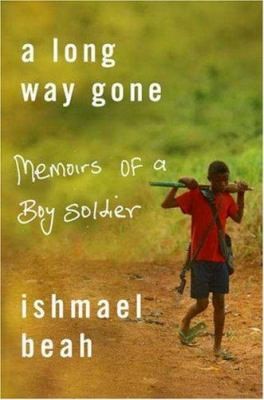
A Long Way Gone by Ishmael Beah  long way gone

Perhaps you saw the movie “Blood Diamond.” If so, you may recognize the place, the names and some of the action of this first-person account of the civil war in Sierra Leone, Africa. Although diamonds are not discussed in this memoir, the same rebel group—the RUF—is rampaging through 1990s Sierra Leone, destroying villages and killing the occupants, save the young boys that it forces to be soldiers.

Ishmael Beah miraculously lived through many such village takeovers. When his own village is attached, he escapes, but loses track of all but his older brother. They, along with some friends, journey from village to village, half-starved, hiding from the RUF. Often, they are cruelly treated, as the general population has grown afraid of groups of boys—and with good reason. However, there are brave or at least just souls who sometimes feed the boys and allow them a place to stay. Often these same people are killed by the rebels and the boys return to villages to find hacked bodies being eaten by dogs and vultures. Eventually, Ishmael is separated from his friends and finds another group. All these boys are under fifteen. They had been fun-loving, respectful of elders, and concerned for one another. Ishmael loves rap music and Shakespeare. He’s twelve. And he’s sleepless and experiencing migraines because of what he’s witnessed.


After a year of roaming the countryside, Ishmael and his friends are picked up by the government army. They are reminded that the RUF rebels killed their families and destroyed villages. They are brainwashed, given a constant supply of drugs—marijuana, cocaine mixed with gunpowder (brown-brown) and ‘white pills’ that give them energy and anesthetize them to killing. They have become ‘boy soldiers.’ For two years they fight, making use of their bayonets and AK-47s. Ishmael becomes so numb to death and killing that he is able to walk up to a man tied to post and slit his throat as part of a contest among the boys.


How one not only survives this life, but moves on to become whole and humane again is part of Beah’s story. He and some other boys are rescued by UNICEF workers, but cannot appreciate this fact until they have been rehabilitated in a home for boy soldiers. His story is a great reminder to all of us that violence and chaos can be overcome.

Posted in Biography/Memoir, Multicultural, Non-fiction | Leave a comment

PopCo

“PopCo” by Scarlett Thomas is a send-up of consumer-society and corporate marketing at the expense of young people. All the characters are ‘cool because they’re uncool,’ hip twenty-somethings. If you are a deep-thinking young person who doesn’t want to be ‘branded,’ I’m recommending this book for you.

Alice Butler is sent to company retreat by her British employer, PopCo. PopCo is a market-savvy, cutting edge toy company that employs young, talented folks to get into the minds of children (they even have a ‘daycare’ at the retreat where little ones are market tested). An odd girl and loner for most of her life, Alice is recruited by PopCo because she is good at mathematical puzzles, code-breaking and cryptanalysis. Her new assignment is to create a product for the teenage girl market that will enrich the company. As a ‘POW’ at ‘thought camp’—the title for the company retreat—Alice journals about her own youth, the death of her mother, the desertion of her father, and her odd upbringing by loving, eccentric and super-smart grandparents. She reflects on a locket given to her by her grandfather which seems to contain the clue to an old puzzle—which in turn will lead to lost treasures. More and more, Alice realizes how deeply unethical the practices of PopCo are—and how she can break from the spell of the commercially-driven workplace.

I recommend this book only to mature readers because it has, besides the great code-breaking puzzles and fun information on cryptanalysis, a budding romance, characters who drink wine, and a few who smoke marijuana. I’m recommending it to my own 16-year-old son because he hates being ‘branded,’ but other parents might think their own teens are not mature enough to sort through the twenty-something lifestyle. (I figure that if I could read all that Sidney Sheldon sort of trash like “The Other Side of Midnight” when I was sixteen and suffer no character loss, a good book like “PopCo” is just fine.)

By the way, this is a long book—about 500 pages. I mention this because so many of you look for books that are 400 or more pages long.

Posted in Fiction, Over 375 pages | Leave a comment

The Titan’s Curse

The Titan’s Curse by Rick Riordan

 Book three in the Percy Jackson and the Olympians series finds Percy, Thalia (daughter of Zeus), Grover and Annabeth discovering two new half-bloods or heroes. Unfortunately, Dr. Thorn of the school where the new orphaned heroes reside proves to be a monster. He kidnaps Annabeth. When the heroes team up with Artemis, goddess of the hunt, she too is kidnapped and her huntresses join forces with the heroes to effect a double rescue. Their search for Annabeth and the goddess takes them across the United States. Again this is fun with Greek mythology. Here we meet Apollo, whose sky chariot in now a red Maserati and who composes some really bad poetry. More adventure!

Posted in Adventure Stories, Fiction, Hi-Low/Quick Read, Literary Read Alike, Sci-Fi/Futuristic, Young Adult Literature | Leave a comment

Sea of Monsters

Sea of Monsters by Rick Riordan

I loved The Lightning Thief so much that I had to continue the series. This is the second book in Percy Jackson and the Olympians. This time, Percy is finishing seventh grade and hoping to go back to Camp Half-Blood Hill for the summer. On the last day of school, Percy’s PE class is attacked by Laistrygonians—giant cannibals in Greek mythology—and Percy and a homeless classmate are saved by Annabeth (Percy’s best friend from book one). Immediately, Percy learns that the sacred tree guarding the camp has been poisoned and the camp is under attack. Another surprise is that the homeless boy, Tyson, is a Cyclops and Percy’s half-brother (Poseidon is also Tyson’s dad). Finally, Percy is having nightmares that his friend, the satyr Grover, is in danger.

With the scene set, Hermes sends Percy off on a quest to find Grover, who is the prisoner of the Cyclops Polyphemus (yes, the one that Odysseus fought). To do so, he must cross the Sea of Monsters (now called the Bermuda Triangle) and survive Scylla and Charybdis. At the same time, Percy must retrieve the Golden Fleece, which will heal the sacred tree. Always lurking in the background is Luke, the former friend who betrayed Percy and who is trying to bring the Titan Kronos back to power so that Olmpus can be overthrown.

This second book in the series is another fast-paced adventure, with more hilarious takes on the Greek gods. Circe now turns men into guinea pigs (real pigs are too much like real men and messy) and Hermes wears track shorts and a ‘New York City Marathon’ t-shirt. Oh—and he invented the Internet as well (sorry Al Gore!)

Posted in Adventure Stories, Fiction, Hi-Low/Quick Read, Literary Read Alike, Sci-Fi/Futuristic, Young Adult Literature | Leave a comment

The Lightning Thief

The Lightning Thief by Rick Riordan

 The Lightning Thief is quick, easy, good fun. The protagonist, Percy Jackson, is a hero. No, not of the Rambo type. A hero in the Greek tradition—that is, he is the son of a Greek god and a human. Never mind that the story is contemporary. Mount Olympus has been relocated to the 600th floor of the Empire State Building in New York. The entrance to Hades is at DOA Recording Studios in Los Angeles. The gods and other immortals can be found interfering in daily human life, just as they did in Greece thousands of years ago. Of course, their look is up-to-date. Aeres looks like a Hell’s Angel and rides a Harley; Medusa runs a statuary shop (yes, her garden décor is so realistic that it is purchased from all over the world!). 

When Percy, aka, Perseus, is attacked by a monster in the form of his algebra teacher, his mom knows it’s time for him to go to Camp Half Blood Hill for safety and to find out his true identity—that Poseidon, god of the sea, is his father. Unfortunately, Poseidon has been accused of stealing Zeus’s lightning bolt and the fate of mankind rests in Percy’s ability to complete his quest and return the missing property. Check out the modern version of the Labors of Hercules and meet the new rendition of not only Aeres and Medusa, but Poseidon, Hades, Zeus, Procustes, Charon and the Eumenides (Furies). You don’t have to know much about Greek mythology to have fun with this book, but if you do, you’ll love the connections, both subtle and outrageous.

Posted in Adventure Stories, Fiction, Hi-Low/Quick Read, Literary Read Alike, Sci-Fi/Futuristic, Young Adult Literature | 1 Comment

The Curious Incident of the Dog in the Night-time

How does an author make us feel connected to a narrator who has Asperger’s Syndrome–who can’t understand others’ emotions, who can’t deal with anything out of his ordinary routine, who, as a part of his compulsive behavior, will eat red food, but hates the colors yellow and brown, and finally, who screams when touched?


It happens in The Curious Incident of the Dog in the Night-time. Christopher Boone is a fifteen-year-old English boy who finds his neighbor’s dog dead, stabbed through with a pitch fork. As he loves to solve puzzles and has incredible powers of recall, Christopher decides to use the methods of his hero, Sherlock Holmes, to solve the murder mystery. His wonderful teacher suggests that he write a book. Without understanding what he is doing, Christopher uncovers family secrets and emotional turmoil as well. He must be brave as well as analytical. 


Reading this book is very similar to reading about a culture different from your own. It will result in compassion and a better understanding of people who are ‘different’ from you. (Maybe you could get your English teacher to agree to let you read this as a ‘multicultural’ book!) You will sympathize with Christopher’s parents, who love him, but must not touch him, except in a fingertip ritual that lets him know they care. The narrator’s love of numbers is simple fun for those of us ‘math-anxiety’ folks (the chapter headings are prime numbers only). For people who love math, there is an appendix of math problems. The novel is an interesting use of point-of-view and its author, Mark Haddon, has done a great job of using a narrator who, while he can’t achieve emotional insights himself, leads the reader to them.

Posted in Fiction, Multicultural, Young Adult Literature | 295 Comments

Life of Pi

life of pi   Here’s another story that begins in India, but marches to a very different drummer. The main character, ‘Pi’ Patel is named after a swimming pool in Paris. His father, a zoo keeper, decides to immigrate to Canada, and sells the animals. Most of these stay in India, but a few are destined to cross the ocean and live in distant zoos. During the Pacific crossing, the ship capsizes and Pi is thrown overboard into a 26-foot-long lifeboat. Though his family all die, Pi finds himself floating with Richard Parker—a 450 pound Bengali tiger from his father’s zoo—as well as a zebra, a hyena, and an orangutan. The most rudimentary knowledge of the animal kingdom will tell you which of the animals survives. But Pi tells the reader that this is a story with a happy ending, so the reader wonders–how will Pi survive with Richard Parker on board?

Pi does survive with the tiger—for 227 days. And, yes, the journey is an epic one. Pi uses all his knowledge of the animal kingdom as he realizes that the tiger’s survival is necessary to his own. He expounds on faith and his understanding of Christianity and Islam as well as his native Hinduism. He makes an argument for the environmental value of zoos. Both his ill-fated meeting with another castaway and his salvation on a mystical island may be unbelievable, but who cares? The story is so weird and intriguing on so many levels, that the reader will follow Pi’s faith in the universe anywhere it takes him.

Posted in Adventure Stories, Environmental Issues, Faith-Based/Religious Element, Fiction, Movie Tie-In, Multicultural, Over 375 pages | Tagged , , , | Leave a comment

Interpreter of Maladies

This book of short stories concerns Indians who are new to the United States or are first-generation Americans. They deal with their sense of foreignness while coping with the problems that people endure all over the world—infidelity, betrayal, loss of cultural roots, stillborn babies and more. A good choice when the teacher asks you to read a “multicultural book,” this collection of short works is a winner of the Pulitzer Prize.

Posted in Fiction, Multicultural, Short Stories | Leave a comment