“Gods of Manhattan”

“Gods of Manhattan” by Scott Mebus

I’m on a crusade to read more ‘fantasy’ books that appeal to guys as well as girls. “Gods of Manhattan” is one. I had seen it recommended to readers who like the Percy Jackson and the Olympians series—that would be me! So I read “Gods.” While I found it much choppier than the Percy Jackson books—and sometimes lacking explanation for the hierarchy of the spirit world—it is a fast, fun book.

Thirteen-year-old Rory Hennessy, who doesn’t believe in magic, acts as a ‘volunteer’ for a magician who performs true magic at Rory’s sister’s ninth birthday party. Suddenly, much that appears to be magic comes to light. Rory sees weird stuff—a cockroach riding a rat, a Munsee Indian who appears to have come from an earlier century. How can this be?

Rory discovers that he is a “Light”—someone mortal who can see into the spirit world of Manhattan—known as ‘Mannahatta’ in the novel. Real historical folks from New York are alive in this spirit world as gods of many, often mundane, things. You could impress your teachers with a book report that mentions Peter Stuyvesant, John Jacob Astor, Walt Whitman, Alexander Hamilton, Horace Greeley, Babe Ruth, Zelda Fitzgerald and Dorothy Parker.

Basically the spirit world is in trouble and it’s up to Rory to help save Manhattan. There’s a murderer on the loose—one that is killing gods. A second problem is that the Munsee Indian spirits are locked in Central Park and cannot escape the curse that keeps them there. Rory wishes to free them. And he and his sister Bridget (who is a pretty tough little kid) have many cool adventures while trying.

Posted in Adventure Stories, Fable/Fairy Tale/Fantasy, Fiction, Young Adult Literature | Leave a comment

“The Alchemist”

“The Alchemist” by Paulo Coelho

I recently read “The Alchemist” and thought you might enjoy it when a teacher asks you to read a fable, fantasy or fairy tale. This book, published in Brazil in 1988, is not a traditional fable or fairytale, but it has all the elements your teacher may be looking for.

Although Santiago is a shepherd in Andalusia (in Spain), he is well educated and loves to read. His father had intended that Santiago becomes a priest, but the boy loves to travel; his father helps him purchase a flock so that he can live out this dream. It seems that traveling within Spain would have been enough for the happy young man, but he has a dream of treasure near the pyramids in Egypt. Once the dream takes hold in his life, many fantastic things take place.

Santiago meets ‘the king of Salem,’ who instructs him to follow his dream, sell his flock of sheep and head to Africa. He says, “To realize one’s destiny is a person’s only real obligation.” This, then, is the theme that propels the characters.

So Santiago decides to follow his “Personal Legend.” Not everything is easy for him. In Tangier, Africa, he is immediately swindled out of the money he earned by selling his flock. He must earn it over by working and through imaginative ways of creating business. Yet there are always omens for Santiago to follow, and the whole universe is conspiring to help him realize his dream. He meets gypsies, a king, an Englishman, a camel driver, desert men and women and finally the alchemist who helps him succeed. Santiago falls in love with a desert girl, Fatima. Because it is a fable, the only thing that really bothered me about the story—I accepted the universe helping Santiago, even to the point of his having to perform a miracle and coming through—was that Fatima’s “Personal Legend” seems to be to wait around for her man. As a girl, I related more to the adventure.

I know this book has been compared to A. Saint-Exupery’s “The Little Prince,” and I think you might like that as well. However, it’s been years since I read it, and when I did, I read it in Spanish (although it was originally published in French), a language I was less than proficient with. Ask your French teacher about “The Little Prince.” The author is much loved.

Posted in Adventure Stories, Fable/Fairy Tale/Fantasy, Fiction | Tagged | 8 Comments

“Escape” and “Stolen Innocence”

stolen innocence“Escape” by Carolyn Jessop and

“Stolen Innocence” by Elissa escapeWall
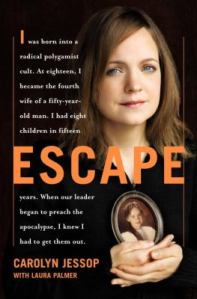
I have to admit that I’ve become somewhat fascinated with polygamists cults in the last few years. As I read headlines about kids being removed from polygamist parents—and given back—I can’t help but wonder what it would be like to live in such an alternative universe. The idea of living with a husband and several ‘sister wives’ really has an ick factor for me because of the sexual issues, but I also think I wouldn’t be able to live with ‘sister wives’ in my house even if they weren’t my husband’s concubines. Who wants some other woman telling her how to run her household?

In “Escape,” Carolyn Jessup affirms my suspicions about too many women in the home. When she’s only eighteen years old, Carolyn is forced to marry a man who is something of an enemy to her family—a man who already has three other wives and will go on to have at least two more (the six that are discussed in the book) and is more than thirty years Carolyn’s senior. OK, so this had more than an ick factor for me—it was just plain gross.

Carolyn’s husband plays his wives off of one another. It’s interesting because all but one can’t stand him, and yet they vie for his affection and are jealous of one another. He alternates sleeping with (and impregnating) them. Carolyn has baby after baby—eight in all—and one of her children is severely disabled. Yet none of the other ‘sister wives’ will help her when she is ill—at one point pregnancy and childbirth almost kill her—because they are envious. They tell her that her child’s disability is God’s judgment on her for being willful and disobedient. The “alpha wife”—the one that Jessop cares for—rules the roost, making the others cook and clean. She beats the children that are not her own. (Kids of the lesser wives have to watch out because life is precarious for them.) When Carolyn’s insides finally fall out and she has a hysterectomy, I thought she’d be saved from sleeping with the dirty old man because, according to the religious tenets of the Fundamentalist Church of Latter Day Saints (FLDS), the point in polygamy is to procreate. But no, Jessop stills demands sex, that is, when he isn’t sending Carolyn off to work in some hole-in-the-wall motel.

Elissa Wall of “Stolen Innocence” has a slightly different story. She is only fourteen when forced to marry. She tries everything she can to get out of it, but the church’s leader, Warren Jeffs, won’t listen. He arranges the marriages based on his visions from God. (He is the community’s prophet—he arranged Carolyn Jessop’s marriage as well.) Elissa’s husband is also young, and she is his first wife. However, the ick factor is there. He’s her first cousin, and one with whom she has never gotten along. He was always mean to her. At fourteen, having lived in a super-protective environment, Elissa knows nothing about sex. Her husband rapes her on a regular basis. She is so afraid of him that she takes to sleeping in a truck.

Elissa has several miscarriages and a still birth. I guessed that all her unborn and just-born babies had died from genetic deformities caused by being the products of first cousins. However, the book doesn’t discuss this. When Elissa does finally break away and marry the man she wants to marry, she has healthy children.

Both books have a lot of detail about the structure of the FLDS society and its leader, Warren Jeffs. I finally had my question about boys answered. (If each man is supposed to have so many wives, aren’t there extra boys, and then men, left over? Yes, there are—they call them lost boys and throw them out on the road to fend for themselves when they are young. This keeps the ratio of men to women low.) When Jeffs is arrested, Elissa is one of the primary witnesses against him in his trial. The situation of the women in the FLDS sect–-to submit to husbands in mind, body and soul—reminds me of the situation of women today in some third world countries. It also reminds me of the novel (so, yes, that means it’s fiction) “The Handmaid’s Tale” by Margaret Atwood. That book is about a not-too-distant future United States after some sort of nuclear event when a religious sect takes over the government and reduces all women to servants and concubines. “Escape” and “Stolen Innocence” remind us that sometimes such things actually happen—and right in our own backyard.

Posted in Biography/Memoir, Non-fiction | Leave a comment

“Before We Were Free”

“Before We Were Free” by Julia Alvarez

Life under a repressive dictator is hard for some of us to imagine. “Before We Were Free” shows us such a life—in the 1960s Dominican Republic—from the point-of-view of a twelve-year-old girl.

Anita de la Torre is the youngest child in an upper-middle class family. Although relatively safe and well-off, Anita’s family hungers for freedom, and both her father and her uncle are involved in a plot to overthrow “El Jefe”—General Trujillo, the dictator of the Dominican Republic. The influence of the dictator is seen in Anita’s daily routine at school as well as in the social and political fabric of the country.

At the same time that Anita tries to understand the situation in her country, she worries as do most twelve-year-old girls: how does she succeed in school, which boy does she love, when will her period arrive? Anita’s beautiful older sister, Lucinda, has been singled out by El Jefe as a future romantic interest. In order to avoid the fate of becoming his mistress, Lucinda must flee the country.

As Trujillo’s regime becomes more repressive, the secret police are watching the de la Torre family and their American diplomatic friends move into the family compound as a measure to protect them. Spies are everywhere and torture is routine for prisoners. The schools close and Anita’s father and uncle are arrested. Anita’s brother must hide in the Italian Embassy. She and her mother go into hiding in a friend’s bedroom closet, where Anita keeps a diary. (The situation will remind you of Anne Frank’s life if you’ve read her diary.)

“Before We Were Free” is realistic—and that means that the book does not close with ‘happily ever after.’ But it does help us appreciate our own freedom and right of free speech.

Posted in Fiction, Hi-Low/Quick Read, Multicultural, Read 180, Young Adult Literature | Tagged | Leave a comment

“The Body of Christopher Creed”

“The Body of Christopher Creed” by Carol Plum Ucci

“The Body of Christopher Creed” is the story of a guy who doesn’t fit in with any group. After a note is emailed to the school principal—it might be a run-away note, it might be a suicide note—and it might not be—various members of the community start accusing one another for causing Christopher’s disappearance. He was so strange and so irritating that everyone made fun of him or hurt him—and now no one wants to be blamed.

Torey, a popular and smart athlete, is mentioned in the note. Some people in the community start to believe that he is responsible for Christopher’s disappearance. In an effort to find out what really did happen to Christopher, Torey starts to connect with kids he’s thought of as outsiders. Ali has a reputation for sleeping around, but is it justified? Bo is a juvenile delinquent; how can he be so concerned and kind? Christopher’s mother is very strange; maybe she just wanted to rid herself of Chris. Torey becomes convinced that Christopher is dead and buried in the Indian burial ground behind his house.

This novel has a lot to entertain you and keep your interest: a mystery, a ghost, community members that seem to be good and are secretly immoral. It also has something that matters a good deal: a hard look at how important it is to treat others with respect and how serious the consequences can be when we don’t.

Posted in Fiction, Hi-Low/Quick Read, Horror/Mystery/Suspense, Young Adult Literature | Leave a comment

“The Wish List”

“The Wish List” by Eoin Colfer

“The Wish List” is a quick, fun read for anyone looking for fast fantasy fiction. You might recognize the name of the author. He also wrote the “Artemis Fowl” series.

Meg Finn is a not-so-good, but not-too-terribly-bad kid who dies when she agrees to help a local teen delinquent rob old Lowrie McCall. Belch Brennan decides to kill Lowrie during the robbery, and Meg objects, defending the old man. Both trespassers are killed through Belch’s dim-witted action. Belch zooms through the tunnel to the next world and goes straight to hell as his soul mixes with that of his pit bull. Meg, however, hits the wall where the tunnel branches off between heaven and hell. Her soul is up for grabs—it is exactly balanced between good and evil.

Fighting to claim Meg are Satan and his assistant Beelzebub. They could use a creative mind in hell. However, Saint Peter is also on the lookout for Meg. The good and evil players make a bargain to send Meg back to earth to help old Lowrie carry out his final wishes. If she succeeds, she will earn her way to heaven and the opportunity to see her mother again. Unfortunately, the Belch-dog soul is set loose to thwart her.

Lowrie’s last wishes are pretty wacky and add humor to the book. He learns to face his regrets about life and in her way; Meg is helping him with his salvation, just as he is helping her. The various minions in hell are former movie stars and other love-to-hate-them sorts of folks. If you’ll be offended by an unorthodox look at the afterlife, this isn’t your book. But if you like wacky, you’ll enjoy this read.

Posted in Fiction, Hi-Low/Quick Read, Sci-Fi/Futuristic, Young Adult Literature | Leave a comment

“Speak”

Speak by Laurie Halse Anderson

The summer before she starts high school, Melinda goes to a party where she calls the police. Because of her action, she is ostracized when school starts. Without a single friend, she pairs up with a new girl who desperately wants to be popular, but who is entirely self-serving. Why Melinda called the police isn’t revealed until late in the book. However, something is clearly wrong with Melinda.

The book is broken down into the four grading periods of the school year. As Melinda’s grades plummet–she cuts class and skips a lot of her homework–she speaks less and less often as well. The only place she is connecting at school is in art class, where her eccentric teacher, Mr. Freeman, seems to understand that she needs a way to express her grief and fear.

This is an exceptionally good book—I haven’t met one student who read it and didn’t love it. Though the subject matter is intense and often depressing, Melinda’s sarcastic wit adds a lighter note. Throughout the novel, she jabs at the traditions and cliques of high school. The school’s mascot is changed four times as people argue over what is socially acceptable. The results are hilarious. (You know the students are in trouble when their cheer becomes ‘We are the hornets, the horny, horny hornets!’ and shake their booties to show off their stingers.) Melinda also has a critical eye for the cliques—the Goths, the jocks, even the ‘Marthas’—girls who want to be perfect like Martha Stewart—are all skewered.

Through a truly likable character, this novel reminds us that we have to speak up for ourselves. I highly recommend it!

Posted in Fiction, Young Adult Literature | Tagged , | 1 Comment

“The Little Book of Plagiarism”

The Little Book of Plagiarism by Richard A. Posner

This book is literally little—the pages are 4 by 6 inches, and it’s only about 100 pages long. However, its comments on plagiarism—how it is defined (with difficulty) and what it means historically and in our world today—make a great quick read. Students will better understand why plagiarism is such an intellectual sin. Teachers can mull over the changing nature of plagiarism and might even want to use a few of Posner’s examples. And no—you wouldn’t be plagiarizing to do so if you credit Posner. Just don’t use too much of Posner as examples for your classes—then you’d be violating fair use—a copyright rather than a plagiarism issue.

Some of the more fun passages in the book include a look at Shakespeare’s source for Antony and Cleopatra (Shakespeare? A plagiarist?); the origin of the word plagiarism (from a Latin word that describes someone who stole someone else’s slave); a discussion of fairly recent accusations of plagiarism (Dan Brown of “The DaVinci Code” fame, J. K. Rowling, author of the Harry Potter books, and the historians Doris Kearns Goodwin and Stephen Ambrose). A perfect example of the kind of plagiarism that high school students are often guilty of is discussed throughout the book—Kaavya Viswanathan’s use of slightly altered passages from the ‘chick lit’ works of Megan McCafferty. You probably couldn’t find a better example for a class discussion.

Other than a few political jabs at the ‘lefties,’ including academics (who are all lefties, I guess) soft on plagiarism, the book is entertaining as well as enlightening.

Posted in Non-fiction | Leave a comment

“Whirligig”

Whirligig by Paul Fleishman

In trying to kill himself, Brent causes an accident that kills Lea Zamora, a high school senior whose life is very promising. Brent was drunk and had just been humiliated at a party by the girl he is lusting after. His actions were thoughtless and now a wonderful person is dead. How can Brent atone—how does he seek forgiveness?

Lea’s mom, though grieving, is the person who helps him, oddly enough, by asking him to make reparations. As part of a program for victim’s families, Lea’s mom requests that Brent make whirligigs and place them in the four corners of the United States—Maine, Florida, Washington, and California. She asks this because Lea loved whirligigs and seeing these blown by the wind would make people happy. Brent is not required by law to do what Mrs. Zamora asks, and his parents raise all sorts of objections, as if to protect him. But Brent is very sorry about what he’s done. He NEEDS to repent and so agrees to the request. Mrs. Zamora gives him a 45-day bus pass good all over the country and a disposable camera to take pictures of the whirligigs when he finishes them.

The story shows how Brent’s odyssey changes him into a better person as he endures physical fatigue and becomes more skilled in carpentry. It also shows, through interspersed chapters, the effect that Brent’s whirligigs (all of them have Lea in them in some way) have on people who see and enjoy them.

This is a beautiful story about the need for forgiveness as well as about growing up and accepting responsibility for one’s actions–and the journey there. If you’ve read Homer’s “The Odyssey,” I wonder if you see a connection.

Posted in Fiction, Hi-Low/Quick Read, Literary Read Alike, Read 180, Young Adult Literature | Tagged , | 2 Comments

“Monster”

Monster by Walter Dean Myers

“Lie down with dogs; wake up with fleas.” I remembered reading this ‘aphorism’—a witty little statement by Benjamin Franklin—as I read the novel “Monster.”

The main character of the novel, Steve Harmon, is in just such a position. He appears to be a good guy in general—he has no criminal record and he’s a talented cinematographer. Yet he has somehow gotten involved with other guys who are accused of murdering a Harlem drugstore owner. Steve is accused of being the lookout for a robbery that ended in the murder. Now, at sixteen, he is on trial for that murder.

The story is told through Steve’s journal entries and through a screenplay he is writing about his experience. The journal gives the reader insight into Steve’s experience in jail and his feelings about his experience. The drama is more objective—people speak for themselves—lawyers, the four accused boys, the officers, the judge. The truly interesting thing about this format is that it is not clear whether Steve has willfully participated in the drugstore robbery. As you read and try to figure it out for yourself, you’ll be swayed by the evidence, by your sympathy for Steve and his parents, and by your own experiences with the law and prejudice—whatever those experiences are.

As a parent of teenage boys, I wanted to hand all three this book as a cautionary tale—read this so that you can see what happens when a good kid hangs around the wrong people.

What do you think? Were you sympathetic with Steve? Is it true that if you ‘lie down with dogs’ you will ‘wake up with fleas’?

Posted in Fiction, Hi-Low/Quick Read, Multicultural, Read 180, Young Adult Literature | Tagged , | Leave a comment