“I Can’t Keep My Own Secrets”

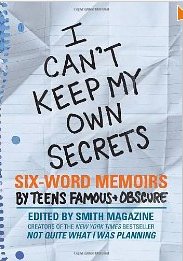
I Can’t Keep My Own Secrets: Six-Word Memoirs by Teens Famous and Obscure

 Could you write a six-word memoir? How do you sum up everything about you in such a compact narrative? SMITH Magazine has published a small book of these six-word memoirs. “From cancer to creativity, prom dates to promiscuity, and breaking hearts to breaking laws, the memoirs in this collection reveal that often the youngest writers have the most fascinating stories to tell.”

Here are a few samples—you’re going to want to read them all.

Always listening, but never really heard.

Falling apart because Dad’s behind bars.

Okay with not going to prom.

Turn around and you’re all alone.

I love you. Please stop drinking.

I never got my Hogwart’s letter.

I am more than just gay.

Always all-county, never all-state.

Never been drunk. Never been happier.

God abandoned me, so I reciprocated.

Music and God are my constants.

Money’s tight; thankfully imagination is free.

We’re the family you gossip about.

You can add your own six-word memoir to http://www.smithteens.comI Can’t L

Posted in Biography/Memoir, Hi-Low/Quick Read, Young Adult Literature | Leave a comment

“My Brother’s Voice”

My Brother’s Voice

by Stephen Nasser, Holocaust survivor

In 1944, the Nazis took 13-year-old Nasser and 21 members of his family to the Auschwitz and Muhldorf Concentration Camps. Pista, as he was known, was the only member of his family to survive. (He witnessed the horrific murder of his aunt and baby cousin.) His remembrance of his brother, Andris, telling him to live helps him through his ordeal. His memoir My Brother’s Voice is a moving account of his experience. From page one, we read of horrific treatment, first by average Germans, including schoolmates, and later by Nazi soldiers. Something that I’ve never read in a book by Holocaust survivor is about the difference between common German soldiers—who are trying to give the victims a chance to survive—and the sadistic SS soldiers who are working hard to insure their deaths. Chapters about the struggle for survival are intertwined with chapters about Nasser’s life and family before the death camps.

Pista had a small Boy Scout knife, and he used it to carve little figures which he then traded for food and pencils with the German Wermacht. He used cement bags as paper and bound pieces together with wire. Thus he had a diary. Though this diary was lost when Pista, unconscious and seemingly dead, was pulled from a pile of bodies in a boxcar, he rewrote his memories, and from these, he tells his story in this book.

Nasser will be speaking to history classes here at COHS on Tuesday, Feb. 22. If you would like to buy his book and have him sign it, you may. He will have copies (hard cover $21, soft cover $15) to sell. (If you pay by check, make it out to Stephen Nasser.) The book is also available on Amazon. Ms. Waddle has also purchased several copies for our library which can be checked out by anyone with an Ontario City Library card, including students.

For more information on the Holocaust, check The United States Holocaust Memorial Museum.

Posted in Biography/Memoir, Historical Fiction/Historical Element, Human Rights Issues, Multicultural, Non-fiction, Young Adult Literature | 2 Comments

Awesome Highlighter

Try Awesome highlighter.

Awesome Highlighter lets you highlight text on web pages and then gives you a small link to the highlighted page.

Posted in Uncategorized | Leave a comment

“The Wave”

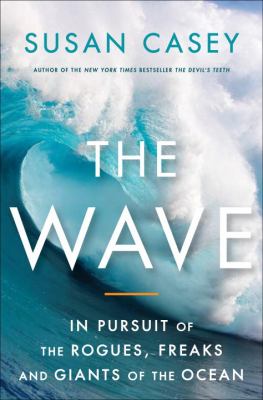
The Wave by Susan Casey

Here’s a great human v. nature story, one about the fierce power of gigantic waves and man’s efforts to subdue them. Casey alternates chapters between discussions of scientists who study ‘rogue’ waves—those that are vastly larger than the waves around them and can wreck ships, kill whole crews and destroy environments when the ships’ contents (oil, toxic chemicals and more) leak into the ocean—and surfers who risk anything for the ultimate ride, following weather reports and racing around the world for the opportunity to plunge down the face of monsters that are 50-100 feet high.

The dangers to anyone involved with such colossal waves, be they scientists, ship salvagers or surfers, read like the most suspenseful of adventure stories. All over the world, the waves have names and personalities to fit—Jaws and Egypt off Maui, Mavericks and Ghost Tree off the California coast, Todos Santos off Baja, Teahupoo in Tahiti. For most of history, these waves were thought to be mythical, the stories of sailors’ imaginations because, according to the laws of physics, they didn’t seem possible. But in 2000, the British research ship Discovery with scientist Penny Holliday  on board was caught in a storm in the North Sea with wave after wave peaking at over 100 feet—and the vessel had all the equipment to measure and verify their height.

Reading, you move from terrifying stories of shipwrecks and disappearances, of a 1,740 foot wave (really!) that destroyed a swath of Alaskan coastline—and which four boaters actually lived through—to follow big wave surfers, primarily Laird Hamilton, Brett Lickle and Dave Kamala, as they travel the world seeking the ultimate wave. The waves they surf are so huge that they must use jet skis to be towed in. Casey spent a lot of time interviewing the men, following them around the world, and even getting in the ocean and riding a few waves with them.

And if our sense of fear hasn’t been fully awakened, Casey shows that the number and frequency of ferocious killer waves is increasing due to environmental damage as the temperature of the ocean quickly rises and glaciers melt, as ocean current change and collide. (Look for more tsunamis like the one in 2004 that killed 170,000 people in Indonesia.)

I think everyone will like this book—a lot. So if your teacher asks you to read non-fiction, don’t miss it. If you happen to have an interest in oceanography, physics or surfing, you won’t like this book. You’ll love it. You, ocean lover, shouldn’t miss it whether you have an assignment or not. Read it.

Posted in Adventure Stories, Environmental Issues, Non-fiction | Tagged , | Leave a comment

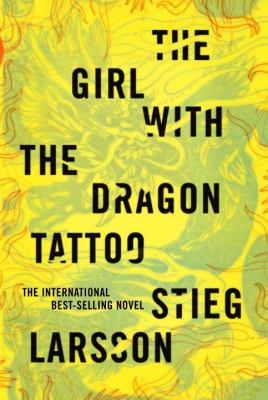
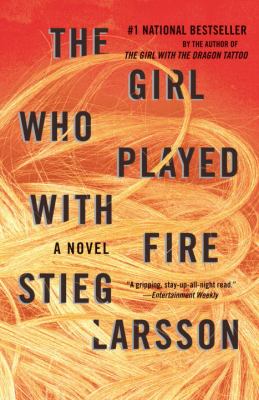
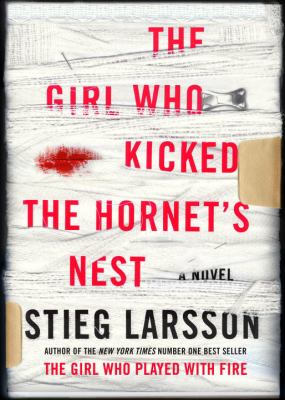
Stieg Larsson Books: The Girl with the Dragon Tattoo, The Girl Who Played with Fire, and The Girl Who Kicked the Hornet’s Nest

I enjoyed reading all three books in this series. What made me think of them today was something that may seem unconnected: I read an article stating that a new version of the classic The Adventures of Huckleberry Finn by Mark Twain is going to be published soon.

I don’t think of “The Girl” series as on the same level as Huck Finn, but I did think about why I haven’t recommended the three books to you even though I liked them all. They’re not YA books and they don’t fit with any of our library projects. They’re adult books and they contain some graphic violence, particularly against women. So I worry a bit about your maturity level, about whether your parents would mind if you read these uber-popular bestsellers.

The reason Huck Finn is no longer read much in schools is that some people find it offensive because the characters use the ‘n’ word. The new version is taking that word out in the hope that with this censoring, it will be allowed back in the schools. So I thought about whether a YA version of “The Girl” books would be popular with teens. But here’s what I came up with:

The book is available in the library in the regular adult fiction section.

The violence against the women is not glorified–it makes you hate the perpetrators and root for Lisbeth. I remember when I finished the first book, The Girl with the Dragon Tattoo, I thought that the book title should have been “Men Hurting Women.” Sure enough, I later read a review that said the title in the original Swedish was “Men Who Hate Women”(or something very close). And in a later book, the narrator even tells us that this is a story about men hating women, even more than it’s a spy story. I think the circumstances of the novel are sort of a cautionary tale–a safe opportunity for teen girls to see just how bad some men can behave toward them.

I let my own teens read it. I didn’t worry about them. They were not emotionally scarred or damaged.

There are  teens who don’t like some of the books teachers recommend, but they get hooked on The Girl with the Dragon Tattoo and then read through all three novels. Library folks call these types of novels ‘homerun books’ because they are the ones that get you into the reading game. You read them and then you move on to other books. And that is exactly what we want to happen.

So, if you’re mature and not easily scared, you could give these a try. In the first, an old uncle hires a journalist to help him find out what happened to his niece. The journalist seeks help from Lisbeth Salander, a brilliant computer hacker. And through the series, this becomes Lisbeth’s story, the damage done to her, her will to fight back and survive in bizarre circumstances that involve spies, intrigue, government cover ups and some incredibly loyal friends.

Posted in Controversial Issue/Debate, Family Problems, Fiction, Horror/Mystery/Suspense, Human Rights Issues, Mature Readers, Movie Tie-In, Over 375 pages | Leave a comment

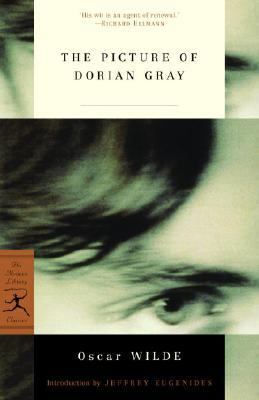
“The Picture of Dorian Gray”

The Picture of Dorian Gray by Oscar Wilde

As a classic, The Picture of Dorian Gray is summarized and analyzed in many places, and I have nothing to add.* However, as the new semester starts and seniors at both schools are beginning projects, I think this quick classic is a great choice for either the novel required before research at Chaffey High or, at Colony High, as one of the two works of British literature to be read and later analyzed. 

My oldest son once told me that he thought half of all witty quotes posted anywhere were by Oscar Wilde—and that if you saw a quote and had to guess who said it, naming Wilde would mean you’d be right half the time. Should you read The Picture of Dorian Gray, you’ll know why he said this. Although the character Lord Henry Wotton is a sort of Satan personified and gets Dorian started on his life of evil and debauchery, a lot of what he says contains wry witticisms that you’ll enjoy. Even when he is perfectly awful, I couldn’t help but laugh about his observations of women and romance. Whether you sympathize with Basil Hallward or with Sibyl Vane, you’ll have to agree that in love, everybody plays the fool. (Sorry if you have already been that fool who’s had your heart broken. If you aren’t, steel yourself—it’s around the corner.)

As a novel to analyze, the many quotable lines will give you a lot of citations in your paper. As a jumping off point for historical research, the novel outlines many practices of the late 19th century—the division between classes, the things people did as work and recreation. It also minutely details Dorian’s interests, which alter frequently. You may have a hard time with the lists of things he likes to do—his study of perfumes, tapestries, art, music, etc.–as modern novels don’t do this (and modern readers seem to have no patience for it). Still, I’ll make a prediction: when mainstream reading goes multimedia, Dorian Gray will be very popular. Imagine as these places and objects are listed that you will click on the words and have images of them. Perhaps in a bit more distant future, perhaps you’ll even smell all the perfumes that are mentioned. Very cool.

Try this one.

*Our own resources for summaries and criticism include Dorian Gray. All students can use the city library’s online database The Literature Resource Center, but you’ll need to give your library card number to view it. Chaffey students can use ProQuest Learning Literature (You need the passwords—ask us if you don’t know them.)

Anyone can use the free online guide from Shmoop.

Posted in Classic Fiction, Historical Fiction/Historical Element, Horror/Mystery/Suspense | Leave a comment

“The Supernatural”–Book Trailer

http://static.animoto.com/swf/w.swf?w=swf/vp1&e=1292012046&f=FP458vZlebvSnCsS2GKL0Q&d=146&m=a&r=w&i=m&options=

Posted in Uncategorized | Leave a comment

“Peace, Love, and Baby Ducks”

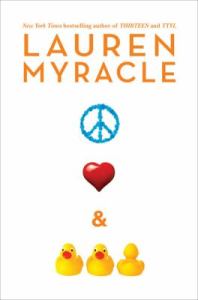
Peace, Love and Baby Ducks by Lauren Myracle

I bought this book for the library quite a while ago, but didn’t read it myself because, based on the title and cover (I know, I know!), I thought it was mind candy, a sort of literary junk food. And I’m a believer in the feel-good value of junk food, both for the body and the mind, but I’m too busy trying to keep up with other reading to have much time to indulge.

I’m so glad I did get around to reading Peace, Love, and Baby Ducks. I highly recommend this story of sisterhood and friendship, of religion (and religious hypocrisy), and of romantic relationships.

The narrator, Carly, lives in a very affluent neighborhood (Buckhead) in Atlanta, Georgia. When she comes home from a summer of outdoor volunteer work, she is thin and has hairy legs. But Carly is her own person—or so she believes—and she thinks she just might buck the girly trend of her private Christian school classmates, those that Carly derides as Holy Rollers. Although Carly is also a believer, she has a fine sense of when classmates are doing good in order to be perceived as the right kind of people (and to pad their college-entrance applications). One particularly poignant example of this is when a group of students is delivering Christmas stockings to poor children. Carly goes along because she wants to hang out with the guy she has a crush on. When she questions whether they should have given the stockings to the adults, privately, so that they in turn could give them to the children later as a surprise from Santa, one of the more devout girls says, ‘But we are Santa’—with the implication that they need to take credit for that. Details like this throughout the novel indicate that Myracle is having fun with the old idea that going to church doesn’t make you a Christian anymore than standing in a garage makes you a car.

So Carly is an oddball at school, but she has always had a deep and loving connection with her younger sister Anna. But Anna is changing, and Carly notes when she arrives home from her summer volunteer experience that Anna has blossomed physically. Yes, Anna has curves and big breasts, a figure type nothing like Carly’s. When the two go back to school at the end of summer vacation, Anna is perceived as a hottie and people ask Carly what it’s like to have a sister who is so gorgeous. And, despite herself, Carly is jealous.

This is where the story could break down into cliché, but Myracle treats the changes in the girls with depth. Other students—especially boys—and teachers—especially males—objectify Anna. She is Anna’s breasts more than she is Anna. And she’s uncomfortable with this. Even her own mother is quietly reprimanding her for gaining too much weight until Carly has the guts to come to Anna’s rescue, telling their mom that ‘they are breasts,’ not fat and to get over it.

Carly—deemed the confident child, the individual, the nonconformist—is used to coming to Anna’s rescue since Anna is a year younger. So it’s pretty rough on her when Anna seems to have more in common with Carly’s lifelong best friend than Carly does. Carly’s great hope for connection is with the new guy at school, Cole, who has ‘soulful eyes’ and loves classic rock music, just as Carly does. But, sadly for Carly, she is going to learn a hard lesson about what soulfulness is.

As the sisters’ relationship shifts, they are, at times, truly vicious to each other. Their ‘fashionista’ mom and social climbing dad aren’t much help. (In fact, if there’s a weakness in the book, it’s that these detached, one-dimensional parents could have raised such great kids.) But the lessons learned and the feel-good ending are rewards.

I think you’re going to like this one.
Posted in Faith-Based/Religious Element, Family Problems, Fiction, Romance, Young Adult Literature | Tagged | Leave a comment

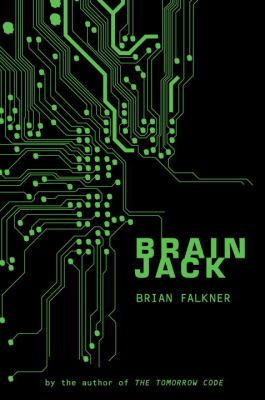
“Brain Jack”

Brain Jack by Brain Falkner     

Sam Wilson is a brilliant teen hacker, able to breach the computer security system of the White House itself. This feat lands him a job in the top tier of the country’s computer system protectors. When terrorists hack the system, and Sam and his fellow computer geniuses barely keep the system from being infiltrated, the group starts to use neuro-headsets which turn thought into action, without the need to use a keyboard or a mouse.

While neuro-headsets seem to be a boon, Sam is suspicious after his best friend becomes addicted to their use and then dies. Soon after, several of the U.S. security team members have their brains emptied and Sam believes someone is controlling their brains through the neuro-headsets. Their consciousness is being ‘hijacked.’

While I believe that this novel is more enjoyable if the reader knows a little bit about computers, the fast-paced, continual action and the near-future dystopian setting (in which Las Vegas is destroyed and New York is a target) will appeal to everyone.

Posted in Adventure Stories, Fiction, Sci-Fi/Futuristic, Young Adult Literature | Leave a comment

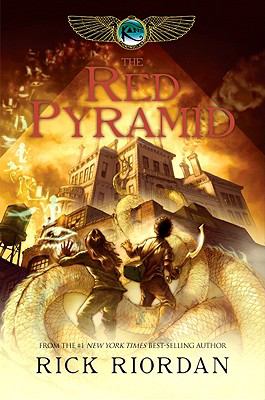
“The Red Pyramid”

The Red Pyramid by Rick Riordan    


If you’re already a fan of Rick Riordan’s Percy Jackson and the Olympians series, you’re going to love this book. And if you haven’t had the pleasure of reading Riordan yet, start here.

I picked up this book because a few CHS students, looking for a (easy) novel to start their senior project with, asked me for something on ancient Egypt. While this novel fits that description, it isn’t historical, even by the loose definition we use for our project. However, I believe it will work perfectly for any student who’d like to form questions on ancient Egyptian culture, particularly on religion.

At the center of the novel are the current-day Carter and Sadie Kane. Their father is a famous Egyptologist and their mother, who died mysteriously six years before the book opens, was an anthropologist. After their mother’s death, the children are separated, Carter then traveling the world with his father and Sadie settled with her maternal grandparents in London

Dr. Kane only has visitation rights with Sadie two days of the year. On Christmas Eve Day, he picks her up, and, along with Carter, they go to the British Museum to visit the Rosetta Stone. There, working magic, Dr. Kane blows up the priceless artifact and unleashes powerful Egyptian gods, including the evil Set, who encases him in a magic sarcophagus (coffin). The children run for their lives.

From here on out, it’s all action as the sharp-tongued Carter and Sadie discover their true natures and powers. While they are fighting ancient evil forces, much of Egyptian culture is mentioned—various pharaohs, a number of gods and their special divinities, famous architecture and archeological sites—all great teasers just perfect for posing research questions about ancient Egypt.

Posted in Adventure Stories, Fable/Fairy Tale/Fantasy, Fiction, Hi-Low/Quick Read, Historical Fiction/Historical Element, Horror/Mystery/Suspense, Young Adult Literature | Leave a comment