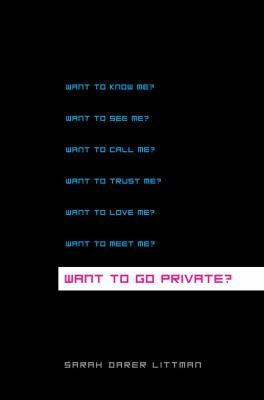
“Want to Go Private?”

    Want to Go Private? By Sarah Darer Littman

I want all of you to read this. Really.

Abby is worried about beginning high school because she thinks that life will be even worse than middle school now that there with be more Clique Queens to make her feel bad about herself. Her BFF, Faith, is looking forward to ninth grade as a chance to meet new people who attended the other middle school in town. But when Faith meets Grace and starts hanging out with her—and then finds a love interest with Ted—Abby realizes she was right.

High school sucks.

And home is just as bad. Abby’s dad recently started his own business and he’s never around. Her sister, Lily, is in 7th grade and lives to irritate Abby and fight with her. What Abby does have is her ‘second life’ on ChezTeen.com. It’s just like Second Life, but for teens only. Avatars get in groups, meet up, hang out, go to concerts. And Abby only talks to people she knows. Until she meets BlueSkyBoi.

BlueSkyBoi has the same favorite music as Abby. He thinks they are soul mates. When he asks Abby if she wants to go private, she decides it can’t hurt anything. After all, she’s not giving him her real name or her address. Plus, it feels great to talk to him, even though he is twenty-seven. He always supports her, agrees with her that Faith is being a jerk and not a very good best friend. He’s sweetly jealous, so that when Abby goes on her first date with a guy in her science class, BlueSkyBoi—whose name is Luke—convinces her that she is his girl.

Want to Go Private? does a great job at showing that academic intelligence (Abby is a straight A student) isn’t the same as emotional intelligence. She’s sweet and a bit nerdy even, but she’s very naïve. It also does a great job at showing how an Internet predator grooms his victims. He doesn’t ask her to do crazy things all of a sudden. Luke builds Abby’s trust over months. Even when he starts to ask her to do weird things (“What is your bra size?”), she knows that she wouldn’t put up with that in class from a boy at school. But in her own bedroom, wearing her pajamas, she feels safe.

How Abby progresses from telling Luke her bra size through the many online sexual behaviors he gets her to do is a gripping story. And when she agrees to meet him and gets into that car, the next page of the book is black. Just black. And the next chapters are narrated by her sister Lily, her BBF Faith and the science class guy, Billy, who’s been crushing on her. What happens to Abby then isn’t the whole story. Luke—and that isn’t his real name—isn’t done with her, and has the opportunity to ruin her life, with all the explicit videos he has of her.

I had a nightmare about this after I read it, something that just doesn’t happen to someone like me, who’s read so many YA books. But it’s better to have nightmares about a character in a book that about a real-life student. So even though there are some explicit scenes of online sexual behavior, I hope you’ll read Want to Go Private? Because you’ll get an idea of how a predator can make someone really smart do something really dumb. And you’ll learn without getting hurt.
Posted in Controversial Issue/Debate, Family Problems, Fiction, Hi-Low/Quick Read, Mature Readers, Young Adult Literature | Tagged , , | 2 Comments

What will Hook You?

After the Moment by Garret Freymann-Weyr. 

This slideshow requires JavaScript.

Uglies by Scott Westerfield

I was looking for a love story with some reality to it. I wanted to read a YA love story that didn’t end with the perfect couple, after a few fights, lasting forever in their fairy tale. So I checked some reviews and settled on After the Moment. Here are some of the reasons why:

“expertly-crafted story”

“The author’s feel for character and voice has never been better.”

“Leigh narrates with deep intelligence and heightened feeling.”

“The story focuses on the teens’ emotionally wrenching senior year, which begins in love before a possible date rape sets off escalating tragedy.”

Now I’ve been reading. And this got me to thinking. Because:

100 pages into the book, as the reader, I’ve met Maia, the girl half of this couple in love, long enough to see her eat a piece of cake and bring a suitcase full of sheets and books to a grieving girl. And here’s what I know:

It doesn’t matter that every professional reviewer raved about this book or that the first two pages of prologue are a real hook and that eventually I will get to the heart of the story (but God only knows when). I am never going to get a non-reader hooked on this book. The pace is way off. It has gone on so long about neighbors and their brothers, about what color the protagonist will paint his second bedroom and . . . If I recommend this book to any student who isn’t already a constant reader, I’m doomed. S/he won’t read the book past the first ten pages. And worse, that student will never trust my recommendation again.

That’s why I need to read all these books before I chat them up in the library.

Which got me to thinking some more.

What is one of the best books out there can make a non-reader read? One that has good writing, a great (even important) idea behind the story, but also has a rapid-fire plot line and lots of adventure? Yes, of course, The Hunger Games. But that trilogy is still wildly popular right now, so I don’t need to convince you to read it. Instead, let me move backward a few years because you might have been too young to read this trilogy when it came out: Uglies by Scott Westerfield.

Uglies is one of the best, fastest moving, constant action, suspense-filled YA books I’ve ever read. In the future world of Uglies, all people have an operation at age sixteen to make them ‘pretty’—that is, they all are changed to be perfect, or what is deemed perfect by society. Big-eyed and full-lipped, they appear childlike for the rest of their lives. And for some reason, their intellect remains rather childish, too. (Sinister plot elements ahead!)

While Tally is awaiting her operation so that she can leave Uglyville and join her best guy friend, Paris, over in Pretty Town, she meets a girl, Shay, who has the same birthday as Tally and therefore, should be made pretty on the same day. But Shay doesn’t want to be like everyone else, and her escape propels Tally in a direction she never would have thought possible. Tally has some exciting escapes even before she decides to fight the system, but once she does, danger is around every corner.

A bonus in this novel is that Tally’s method of transportation and escape is often bungee jumping—or even more often, hover boarding. Hover boarding is like skating, surfing or snowboarding. Tally has to be balanced as she quickly evades her pursuers. But she’s not on the water or the snow. She’s flying through the air, and a wrong move can mean death. If you skate, surf or snowboard, you’re going to be able to relate to Tally and Shay immediately.

So, I can recommend books like After the Moment to students I know well enough. We can talk about Leigh’s feeling about the Iraq War and how they relate to the more personal violence that becomes a part of his life; about how he is trying so hard to be a good guy, and how that doesn’t always work. But if you’re just trying to find that first book that will hook you into reading, I’m going for Uglies. And when you finish it, you can go on with Pretties, Specials, and Extras. And then you can move onto other series by the same author. And then books by other authors with similar themes. And then books about other things.

Get hooked.

Posted in "Banned Book", Adventure Stories, Controversial Issue/Debate, Family Problems, Fiction, Human Rights Issues, Mature Readers, Over 375 pages, Romance, Young Adult Literature | 1 Comment

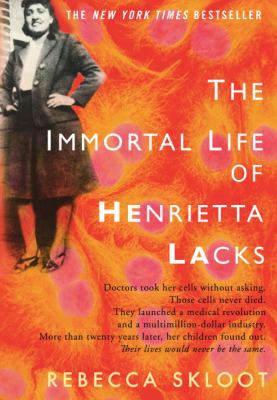
“The Immortal Life of Henrietta Lacks”

The Immortal Life of Henrietta Lacks by Rebecca Skloot    

Teachers who are thinking outside the box will let you read this for your biography/memoir assignment, and what a great opportunity!

The story of Henrietta Lacks is more than a biography of an individual woman, It’s the story of the first person’s cells that scientists could cause to grow in a lab—that could live outside the body and be shipped around the world, thus making new research possible. It’s the story of a family that knew nothing of the cells or the fact that they had been removed from the cancer-stricken and dying Henrietta. It’s about the effect that this medical miracle had on Henrietta’s children. It’s about medical treatment for African-Americans in the 1950s South.

Henrietta Lacks grew up in poverty in Clover,Virginia in the segregated, pre-civil-rights-era South. Her family were tobacco farmers, and the house she was raised in was once slave quarters. (The author discovers a white branch of the Lacks family, but they refuse to acknowledge their biological connection to Henrietta.) Amazingly, before Henrietta died on October 4, 1951, cells taken at Johns Hopkins Hospital during a gynecological exam for her cervical cancer had become the first cells to be cultured in a lab and survive. The cells, known as HeLa, were so strong, that they could be shipped to medical labs everywhere. These cells become the necessary component for medical advances such as the polio vaccine, chemotherapy, understanding the effects of nuclear bombs, and part of the search for a cure for AIDS.

Knowing this, you’d think that Henrietta’s children would have become wealthy. Ironically, they spent years without medical insurance, and for twenty years, didn’t even know that their mother’s cells existed. They couldn’t afford the benefits of the research done with their mother’s cells. In fact, they suffered from secrets as well as con men. Especially hard hit was Henrietta’s daughter Deborah, who, without the educational background necessary to understand how the cells survived, became prey to every report that her mother had been cloned or that her cells had been fused with those of other life forms.

Part of this biography of Henrietta and her cells is about the sad way that African-Americans were treated in medical experiments. (In this sense, Henrietta’s daughter Elise, who was sent to a state hospital and diagnosed with “Idiocy”—and then experimented on in a horrific manner—is just as interesting as Henrietta’s story.) But part of this book details the fascinating fact that no one has any rights over their cells, their discarded tissues. Even if this tissue becomes valuable, as Henrietta’s did, and makes millions of dollars for the companies and individuals that market it, it is considered a waste product, trash that the individual has discarded. (And most of the time tissue/cells aren’t worth anything—people have moles, appendixes, and gallbladders removed all the time.) So the horrible way that the Lacks family was treated also figured into the rise of bioethics—of getting informed consent from patients before using their tissue for medical experiments.

This great book embraces so many themes. Deborah’s life with its grounding in both superstition and spirituality is just as important to the reader as is Henrietta’s. The author has the ability to show us so many things about life, science, treatment of Africa-Americans, medical research—and we can understand it all because she is so good at making it clear. The only part of the story that she doesn’t dig into is the life of Henrietta’s husband, David Lacks. I wondered a lot about him as Henrietta’s cancer was caused by repeated STDs that he gave her. After she died at age 31, he allowed a new woman in his life whose cruel abuse of the children permanently scarred them—destroying the life of at least one of the five kids. Yet David is given a pass on everything. Perhaps the author didn’t feel that his story was crucial to the arc of the overall family story, but it was the one missing piece that bothered me. Still, this is one of the best books of its kind. Any student interested in medicine, the history of the treatment of African-Americans by researchers, the rise of bioethics—or just a good story of a suffering family—will want to read The Immortal Life of Henrietta Lacks.

Posted in Biography/Memoir, Controversial Issue/Debate, Faith-Based/Religious Element, Human Rights Issues, Multicultural, Non-fiction | 2 Comments

Great article on new YA novels

Hooray For YA: Teen Novels For Readers Of All Ages–by

Julianna Baggott for NPR

This slideshow requires JavaScript.

If you go to this link, you can read the article, listen to it, or both!

Posted in Adventure Stories, Fiction, Sci-Fi/Futuristic, Young Adult Literature | Leave a comment

Hunger Games–The Guys in the Movie

Sneak a peek at The Hunger Games‘ Peeta and Gale. Check out this post on EW’s blog. Of course the movie is never as good as the book, but these guys could make it a close second . . .

Posted in Fiction, Romance, Sci-Fi/Futuristic, Young Adult Literature | Tagged , | Leave a comment

“Millennials & K-12 Schools”

Millennials & K-12 Schools: Educational Strategies for a New Generation by Neil Howe and William Strauss

Note: I’m posting this review because I think this is a good book for educators. It’s not so much for students. (I’ll be back at the student books next week!)

My husband, who is also an educator, recommended this book to me, and as it is short (120 pp. 😉 ), I figured I’d have a look at it. Its premise is that generations are shaped by the eras in which they are raised. Millennials includes a discussion of Baby Boomers and of Generation Xers as they were when they were students and as they are now as teachers and school administrators. Millennials—the students who are now in our high schools and are just becoming old enough to be teachers themselves—are contrasted against these earlier generations. As their lives and attitudes are different from previous generations, schools that hope to give them the best education need to take into account just how they differ. Millennials also discusses how to cope with their parents.

I found the book interesting. It outlines seven characteristics of Millennials: special (vital to their parents’ sense of purpose); sheltered; confident; team-oriented; conventional; pressured; achieving. “They could become the best-educated youths in American history and the best-behaved young adults in living memory. But they also have a tendency toward copying, consensus, and conformity that educators will want to challenge. The new Millennial trends, both positive and negative, will require broad changes in the educational strategies.”

Each chapter of Millennials discusses one of the changes necessary to educational institutions that will help the kids and young adults of this generation. Information about how to get the best out of Millennials who become teachers is included. (Even as adults, they rely on their parents a lot, much more so than folks in previous generations, and districts may have to start appealing to the parents to be able to hire the teachers. I have to say, this astounds me.) Helping parents of Millennials get involved in a positive way at school is also tackled. (According to Howe and Strauss, Boomers and Gen Xers may be ‘helicopter parents,’ but Gen Xers who have Millennial children are ‘stealth bombers,’ swooping in to attack the system when they perceive any threat, no matter how minor, to their children. They are otherwise uninterested in the school and unlike Boomers, will not help in the hope of achieving general ideals and goals, but only if the task will forward their own child’s prospects. Of course, this is a generalization, and isn’t fair to all parents of Millennials, but research on the subject is included.)

The authors also warn administrators that the workaholic value of the Boomer generation is gone. Gen Xers want to spend more time with their children, who complete their lives; late Gen Xers with Millennial children perceive their children as the absolute purpose of their lives rather than the completion. Just as the strategies for student success must change, strategies for educators’ work place success must also, and it doesn’t look like it’s going to include 70-hour workweeks.

Millennials is a quick, fun read that will help you understand not only where your students are coming from, but why your colleagues who are a generation older or younger act as they do.

Posted in Non-fiction | Tagged , , | Leave a comment

“Trash”

This slideshow requires JavaScript.

    Trash by Andy Mulligan

Trash takes place in an unnamed third-world country in South America. (The main characters want to go to Sao Paulo, Brazil, so they must be somewhere close enough to have heard of the city.) Raphael, Gardo, and Rat—three “dumpsite” boys—keep off starvation by digging through trash, recycling items and hoping to find money or items of value. Since there is no sanitation in the poorer districts of the city, what they often find is human excrement. It’s hard to imagine a more miserable life than theirs, surrounded by filth, hunger and disease.

One day the impossible happens. Raphael finds a leather bag with several items including a map, a wallet with some money, a driver’s license, some pictures, and a key. Since he always works with Gardo, he splits the money with him. But when the police come looking for the leather bag, Raphael senses it is very important and doesn’t reveal his secret. He gets Rat, the most destitute of all the children, to hide it.

Rat is able to identify the type of key Raphael has found; it belongs to a locker in the train station where Rat used to beg. Once the boys find and open the locker, they know they are in serious trouble. They’re onto a scandal, and the corruption goes way past the local police, all the way to figures in the national government. People are dying in this cover-up, and the boys need to decide whether to collect a reward or seek justice for the poor.

This is a good mystery for everyone. Most of the story is told, in alternating chapters, by the three boys, although adults, such as the priest who runs the local school for the dumpsite children, give the reader some important background information. Join them on their adventure in fighting governmental corruption in a country where political dishonesty is the norm.

Posted in Adventure Stories, Fiction, Horror/Mystery/Suspense, Human Rights Issues, Multicultural, Young Adult Literature | Tagged , , | Leave a comment

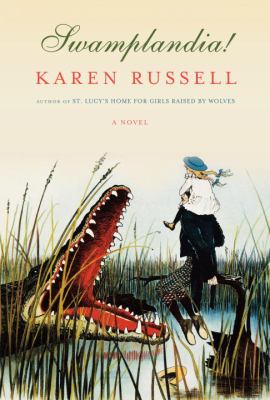
“Swamplandia!”

Swamplandia! by Karen Russell 

First the confession: I think if Karen Russell wrote a manual on how to put a bicycle together, I’d pretend not to understand the assembly process, so that I could read it over and over. Her language is so fresh, original and creative, I just want it to last.

I know that starling language alone doesn’t make a book interesting for many students (or many adults for that matter). But we are all lucky in that Russell’s wild imagination extends to the plot of her story as well as to the language. This is one of the most fascinating and weird novels I’ve read.

Much of the narrative is told by Ava although her brother, Kiwi, leaves home and then his story is told in alternating chapters. Ava, Kiwi, and their sister Osceola Bigtree are the children of a couple who own a tourist attraction called Swamplandia! on an island off Florida. They raise and wrestle alligators (which they call Seths). When the mother, Hilola Bigtree, dies at thirty-six from ovarian cancer, the family loses its star and Swamplandia! loses most of its business. The attraction’s doom appears to be sealed when a macabre version of a Disney-style attraction opens on the mainland—The World of Darkness.

Family members try to save their business with Kiwi off to the World of Darkness to work; Ava raising a red alligator, hoping that its coloring will fascinate new tourists; and the Bigtree dad going off to seek backers for his Darwinism feature idea. But with their father gone, Osceola’s (Ossie’s) obsession with ghosts appears to become a possession. She has a spectral boyfriend who seems to inhabit her body. When she disappears, Ava, alone on the island, must face the Underworld and its inhabitants to save her.

It’s hard to explain why this book is so fascinating because it doesn’t fit the typical teen supernatural genre at all (or maybe that’s why it is fascinating). It’s hard to know when ghosts are real; when adults are friends rather than predators; when the past is inhabiting the present; who is in danger and who is safe. Add to this that throughout the story, there is much irony and humor derived from the siblings’ antics, from their utter unfamiliarity with the mainland and behaviors that are common in ordinary lives.

Swamplandia! is another book you could use to impress your teachers by comparing it to the classic works you are reading in school. The most obvious comparison would be to Heart of Darkness, but I saw some of Ralph Ellison’s Invisible Man in the way that the characters were losing everything and even a bit from a short story by Nathaniel Hawthorne (“Young Goodman Brown”) when a hair ribbon from a lost girl floats out of the sky and is caught by the seeker.

I’d recommend this weird, wild story broadly, but if you are a teen who likes to write creatively and seeks good examples, Swamplandia! is a must.

Posted in Adventure Stories, Family Problems, Fiction, Horror/Mystery/Suspense, Supernatural, Young Adult Literature | Tagged , | 1 Comment

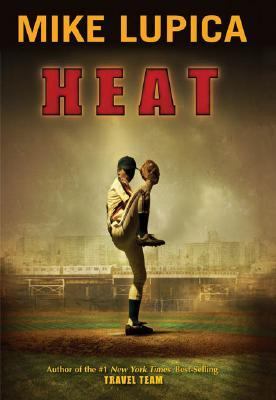
“Heat” (on Ms. W’s summer reading list)

   Heat by Mike Lupica

Michael was born to play baseball. At twelve, he can pitch a fastball at 80 mph. His Bronx Little League All-Star team, the Clippers, is a contender for league champions and hopes to make it all the way to the Little League World Series. But fate is intervening for Michael, in all the wrong ways.

His father had died of a heart attack a few months earlier. As an immigrant from Cuba without a mom, he has only his older brother, Carlos, to depend on. The two are afraid that they will be separated, and so are trying to make it on their own, with a bit of help from a kindly neighbor woman who lives in their apartment building.

While he is still grieving over his father in secret—only Michael’s good friend Manny knows the truth—a rival team, also with hopes of a district championship—accuses Michael of being older than twelve, thus violating Little League rules. Michael has used his baptismal certificate as proof of his age. Locating his birth certificate, back in Cuba, is almost impossible, and Michael can’t play until it’s produced. Through this experience, Michael gets a hard lesson about human nature. The only reason he is accused of being older than twelve is so that inferior teams will have a better chance at the district championship. When he asks himself why a rival team player, Justin, hates him, the reader knows the sad answer: simply because Michael is better at something that Justin does.

I worry that students might dismiss Heat because Michael is only twelve. But his problems are certainly serious; and his brother, Carlos, is sixteen. Several chapters are about Carlos’s heroic efforts and serious mistakes made to keep his brother with him; to provide food and shelter; to make sure that Michael can continue to play baseball, furthering his opportunity to make it to the Little League World Series. Plus, if you like baseball, there’s a lot of exciting description of the action. And one of the big lessons of the book will follow you into adulthood: certain people will try to hurt you when they figure out that you can do something they can’t. You won’t be able to stop them from trying. You’ll just have to take the higher ground.


Posted in Family Problems, Fiction, Hi-Low/Quick Read, Multicultural, Sports, Young Adult Literature | Tagged | Leave a comment

“An Abundance of Katherines” (on Ms. W’s summer reading list)

An Abundance of Katherines by John Green  

This slideshow requires JavaScript.

Another really fun and funny book from one of my all-time favorite YA authors. If you haven’t read any John Green yet, you must! And although I thoroughly enjoyed An Abundance of Katherines (despite it’s unfortunate and ugly cover!—the paperback has a different cover and that was wise of the publisher), I’m going to ask that this not be your first John Green book. Try any of the other three I’ve reviewed and come to this one afterward.

An Abundance of Katherines is about Colin Singleton, child prodigy who is: just realizing that being a child prodigy doesn’t mean he’ll be a genius in adult life; always dumped by his girlfriends, nineteen of them, all of whom are named Katherine and the last of whom just dumps him on graduation night as the book opens; great at anagrams; trying to create a mathematical theorem about romantic relationships that will accurately predict how long the relationship will last and who will dump whom (with the hope that said theorem will boost him into genius status and make him memorable).

Since Colin has just been dumped, he and his best friend, Hassan, decided to go on a road trip in a car they have named Satan’s Hearse. Hassan, like Colin, is very bright, nerdy, and speaks multiple languages; unlike Colin, he is very lazy. His goal is not to go to college but to watch Judge Judy every day and do as little work as possible. His dad agrees to the road trip if Hassan will find a job. Luckily, both guys do find jobs—in Gutshot, Tennessee, they are hired by the owner of a factory that manufactures tampon strings to interview residents for a local history project.

Green makes a lot of the action very nerdy—on purpose. When the boys say something in Arabic or French, there are footnotes translating, and these are laugh-out-loud funny. These characters are just very witty. (The scene where they two are taken on a wild pig hunt is hilarious—worth the price of admission.) And even though they are nerds, they appeal to the girls with their clever jokes and gags as well as they sense of honor when that becomes necessary. So in Gutshot, Colin meets Lindsey. Can he find true romance with a girl who isn’t a Katherine?

Apparently, as Green explains in an after note, the math in the book is real. Flipping through the pages, you’ll see a couple of graphs—but don’t worry if you don’t like/get math. It isn’t necessary to the story at all. If you like math, there are a few pages at the end of the novel in which a friend of Green’s, who is a math wiz, explains the theorem. I have math anxiety, so I didn’t get far with this, and, as I said, none of the math is “integral” to the story ;-).

Posted in Adventure Stories, Fiction, Romance, Young Adult Literature | Tagged | 3 Comments