COHS teacher discussion: “The Global Achievement Gap”

global achievement

Although this entry deals with significant ways in which education will change—and thus affect students’ lives—it’s written for teachers. Our principal has asked that we teachers read and discuss this book. (He bought 20 copies, and these can be checked out at our school textbook room.)

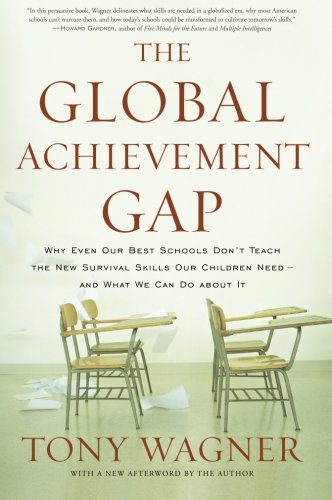
The Global Achievement Gap: Why Even Our Best Schools Don’t Teach the New Survival Skills Our Children Need—

and What We Can Do About It (2008) by Tony Wagner

Summary and Thoughts on Chapter 3: Testing 1, 2, 3


I’m glad we’re reading this book, if only for this chapter. I was so happy—validated—to see so many of my own thoughts, as well as the ideas I’ve culled from my reading, packed into this chapter that I was highlighting to the point of absurdity. (All the while thinking, “Yes!” “Exactly!” “Obviously!”) I will try to tighten up my enthusiasm here and be more succinct.

Wagner begins the chapter with real questions from standardized tests—from Texas, considered to have mediocre state standards, and from Massachusetts, considered to have high standards. I tried the test questions, quickly dispatching the English and social studies, and then sensed that somewhere in my brain resided the skills to work out the math, but it had been so long since I’d visited those skills that I couldn’t take the time to knock on all the necessary doors. I flunked the math.

Well, this played right into Wagner’s plan—apparently this is common, as is my sense that the possible answers to the questions on Whitman’s poem were stupid and the best way to answer would have been in an essay. The surprising gotcha was the fact that I am not competent to graduate from high school. Ouch.

This exercise leads to a conclusion that most educators made long ago: standardize tests aren’t useful; they don’t measure readiness for college or work; they don’t reflect the actual high school graduation rate. So the question is: why do we administer these tests? (I might add at great expense, when the money could be spent on more useful things. Further on in the chapter, Wagner does note that there are hidden costs to inexpensive testing.)

History of the issue

Wagner gives the reader some history. Basically giving such tests is politically expedient, and while very expensive, it’s cheaper than giving a meaningful test, which would be harder to assess. A few details:

  • No Child Left Behind (NCLB): now a train wreck, but originally the engine left the station pulling a very important cargo—accountability. Unfortunately, it also carried unrealistic goals and unsuitable approaches in some of its cars—100% proficiency in reading and math by 2014; punitive measures for not making AYP, poorly defined concept of ‘highly qualified’ teachers, and standards that so widely vary from state to state as to be meaningless.
  • Education morphs into test prep: Standardized testing has engendered the notion of education as test preparation. As we all realize, there’s nothing wrong with this if the tests are meaningful (that is, if they assess a student’s readiness for college or work and measure his citizenship skills), but since they aren’t, educators as whirling factoid-presentation dervishes is a pointless exercise.
    • A terrible result of the endless testing dance is that school is boring and students are unmotivated—to learn, or even to stay in school.
  • Value of tested material: A more controversial issue is that while testing places a high value on knowledge of advanced math and science, employers do not—there is little value in them as a prerequisite for work. (Victoria’s note: unless you are like my son and select biotechnology and informatics as a career path. So, we have to consider those kids in some way outside of testing—Wagner makes a case for changing the way schools teach math and science by helping kids to actually use them to solve real problems. If we make it interesting, we might be able to cultivate scientists. We also need to focus on arithmetic, statistics, and probability as folks like MIT grads report that those are the subjects they actually use.)

Another area where we are misspending our energy is in advanced classes, such as Advanced Placement (AP) courses. These courses do little to prepare kids for college and some colleges no longer offer credit for them. (As a mom, I have some insight on this. I have three sons. Among them they have a good 20 AP courses completed, and 4-5 on the tests. Whether they got credit depends on the specific school—not the system. UCSD gave credit for courses that UC Davis didn’t. It also depends on the student’s major. The son who majored in biotechnology got ‘elective credit’ for all his AP science and math. This actually put him in the terrible position as a ‘first quarter, first-time away from home and family’ freshman of taking a full load of all hard science classes, some upper division. His easier requirements were already fulfilled, and he wouldn’t get any credit by taking electives, English courses, etc. We’re lucky he didn’t have a nervous breakdown. What a mistake!)

So, what should we be teaching and how should we be teaching it?

Necessary (Applied) skills according to business leaders: These are pretty much the Seven Survival Skills that Wagner details in Chapter 1, but business leaders label them differently. Here they are named: professionalism and work ethic, oral and written communication, critical thinking and problem-solving, teamwork and leadership, reading comprehension and ethics and social responsibility. (I gave a lot of detail about the Seven Survival Skills from Chapter one here.)

Necessary skills according to college students: In a later section of the chapter, Wagner asks college students what they should have learned in high schools. The answers were: writing; research skills; time management; and learning to work with other students in study groups.

Necessary skills according to college teachers: Wagner also asked college profs what students don’t know/can’t do: comprehend complex reading materials; think analytically; employ appropriate work and study habits; write well; do research; apply learning to solve problems. Note that these are competencies and habits of mind, not knowledge of specific subject matter—which backs Wagner’s argument for Seven Survival Skills.

Necessary habits of mind according to David Conley, based on his research: “‘intellectual openness; inquisitiveness; analysis; reasoning; argumentation and proof; interpretation; precision and accuracy; and problem solving.’” The ‘overarching academic skill’ is writing and research.

Once we teach the right stuff, how do we test for it (accountability)?

Math/Science: Wagner discusses the international PISA and the test makers’ definitions of scientific and mathematical literacy. These include concepts of the disciplines as having real-world roles that shape intellectual and cultural environments. Competent practitioners use them to meet their life needs as “constructive, concerned and reflective citizens[s].” He notes that many countries use open-ended interviews rather than multiple-choice tests.

Writing Skills: Wagner also slams writing by formula and the testing of it. (If you’ve read this section of the book, you probably had the same reaction as Wagner did—as I did when reading the formula essay—“Lord Baltimore?” That kid didn’t read Harry Potter—he watched the movie. I disagree, however, that the Potter books are just for 9-12 year olds.) A dean of admissions at Sarah Lawrence College notes, “Such an essay is ‘not reflective of how our students are going to have to write’ many lengthy papers based on long-term research, analysis and discussion.”

Citizenship (through U.S. History courses): tests of citizenship should be more like that required to become a citizen—this includes analysis. (Which amendment in the Bill of Rights is the most important and why? Cite evidence from history and current events.) Another example is the ‘letter to the editor test’: research an issue; summarize pro/con arguments; write a letter to the editor of a local newspaper; mail it. Think in terms of students as ‘jury-ready.’ (This idea touched a nerve in me—I’ve been on many juries, judging defendants on trial for murder and attempted murder among other things. I was amazed at what passes for analysis in some minds.)

We teach, we test—so we come to the real question: How do we define rigor?

Today, information is hard to memorize. There’s too much of it and it changes too quickly. (Wagner calls it a tidal wave; school librarians refer to it as a fire hydrant—you can’t put a kid in front of it [Internet] and then open it without giving him information literacy skills first.)

The most important skill a person can have is to ask the right question. “Studying academic content is the means of developing competencies, instead of being the goal. . . . It’s no longer how much you know that matters; it’s what you can do with what you know.”

How do we keep students motivated?

Not by teaching to the test. A national survey shows that half of the dropouts polled left school because they were bored. Eighty-eight percent of those dropouts had passing grades when they dropped.

If our accountability systems tested for the core competencies mentioned above, we’d have both rigor and engagement. Examples of such tests exist—The Collegiate Learning Assessment (CLA), the College and Work Readiness Assessment (CWRA) and the PISA are three. Ironically, the CLA is much cheaper to administer than AP tests and students think it is valuable. Working from these models, we should develop higher-quality tests allowing open responses, give these tests less frequently and only to a sample group of students. This makes the institution accountable rather than individual students or teachers. We can also test information and technology skills (The Information, Communication, and Technology Literacy Assessment—iSkills Test—is an example.)

We have to accept that giving these tests is more expensive. Yet they test not just analytical skills (which the SAT may do) but also creative and practical skills, the other two types of intelligence, according to Robert Sternberg.

Wagner notes that having 50 separate state academic standards is a big mistake, but as the Common Core is coming, I won’t give his details. He wonders if we have the political will to give meaningful standardized tests.

Victoria’s note: I can’t walk away from this without one note about the PISA—recent studies indicate that the U.S. doesn’t perform so badly. I know you are crazy busy, but here are three articles that are well worth your time:

Posted in Non-fiction | Tagged , , , , , , , , , | Leave a comment

COHS teacher discussion: “The Global Achievement Gap”

global achievement

This is a guest entry from Mrs. Fiandaca.

Although this entry deals with significant ways in which education will change—and thus affect students’ lives—it’s written for teachers. Our principal has asked that we teachers read and discuss this book. (He bought 20 copies, and these can be checked out at our school textbook room.)

The Global Achievement Gap: Why Even Our Best Schools Don’t Teach the New Survival Skills Our Children Need—

and What We Can Do About It (2008)

Chapter 2 Summary and Key Points

Wagner refers to a global achievement gap. He associates this with what is being taught versus what students will need to succeed in today’s world.

He also discussed “ rigor” in the classroom.

o      Teachers often associate rigor with more work in less time.

o      Society associates rigor with AP courses and IB program.

o      Wagner associates rigor with critical thinking, problem solving, working collaboratively, taking initiative, communicating effectively, analyzing information and using creativity and imagination.

Learning Walks

o      Spend 10 minutes in 8 to 10 classrooms to get an idea of the rigor on a campus

o      It gives you a snapshot of the school

o      He completed learning walks at two “high performing” schools.

o      Teachers were teaching the grade level contents standards and what the students would be tested on.

o      Students use factual recall and memorization.

o      Teachers often “spoon feed” the answers.

Testing

o      Teachers had a common focus: core curriculum and test prep.

o      Tests are multiple choice and recall. Tests are not designed to measure analysis skills.

o      This is impacting students and their ability to become critical thinkers.

o      The “Bubble Kids” that give you “the most bang for your buck.”

Administrators

o      Surprised by learning walks

o      Scheduled observations were better focus on “standards based instruction” and “data driven decisions”

o      Dept. of Defense Schools required all principals to  focus on “standards-based instruction” and “data driven decisions”

The Competition

o      OECD to measure “cross curricular competencies”, critical thinking, and problem solving

o      American students performed really poorly.

o      Educational goals from other countries differ drastically from ours.

o      China: emphasize creativity and problem solving over test scores and recall knowledge.

o      Singapore: wants students to experiment, innovate, and take risks

o      America uses multiple choice tests to close the achievement gaps between the white middle class and economically disadvantaged minority students.

o      It is difficult to take risks and experiment when there is so much emphasis on testing.

Common Core

o      Will require more than recall

o      Assessments will require higher level thinking skills

o      Cross Curricular emphasis

o      Our units that we are creating at RCD are more rigorous according to Wagner’s definition.

o      Our students struggle with these higher level thinking skills.

Posted in Non-fiction | Tagged , , , , , , , , , | Leave a comment

Lockdown: Escape from Furnace, Book 1

lockdown

Lockdown: Escape from Furnace, Book 1

by Alexander Gordon Smith

Beneath heaven is hell.

Beneath hell is Furnace.


So begins the Escape from Furnace series, now complete at five books.

Lockdown is a great ‘guy read,’ full of injustice, desire for revenge, courage, and survival. It’s also full of weird creatures like hell hounds—dogs of muscle and sinew, but no skin—and tormentors with gas masks sewn into the skin of their faces and bandoleers full of dirty hypodermic needles.

Alex lands deep underground in Furnace Penitentiary after he’s convicted of killing his best friend, something he didn’t do. Not that Alex is a good guy. He’s a bully and a thief. But he’s no murderer. Yet in the group of boys who land in Furnace on the same day, the others that Alex meets are also framed. Later, when Alex meets his cellmate, Donovan, he finds that he was convicted of murder because he killed his mother’s boyfriend after he had beaten her one too many times.

Why is this suddenly happening to all these boys?

Furnace is a private company that contracts with the government to house juvenile murderers. It just so happens that after the Summer of Slaughter, people are afraid. They want harsh punishments for teen killers, and they consider those killers as good as dead once they are locked up in Furnace. You, reader, start thinking that there just may be some extra money to be made for the Furnace owners when they can add more guys to the number locked up. But there’s something more, too.

When Lockdown is announced with siren blasts, the skinless dogs are on the loose, and guys are hauled away in the middle of the night. What happens to them? Why are there so many bizarre creatures in Furnace and such nasty food in ‘the Trough?’

Despite all the terrors of Furnace, Alex is a thoughtful guy, one who reflects on how his bullying behavior out in the world is mirrored in Furnace by the roving gangs who torment inmates. This is a can’t-put-it-down page-turner that ends on a cliff hanger. You’ve got to go for this series.

Posted in Family Problems, Fiction, Hi-Low/Quick Read, Human Rights Issues, Read 180, Sci-Fi/Futuristic, Young Adult Literature | Tagged , , , , , , , | Leave a comment

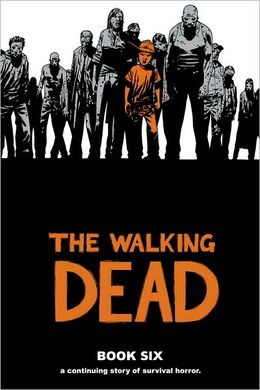
Walking Dead: Coming Soon

walking dead


Briefly:

You asked for it.

We weren’t sure about the novels–reports/reviews are that they are far more graphic than the TV series.

Decision:

We’ll have the graphic novel series available to you soon.  They are mature, for teens, but not over the top.

At Chaffey, we bought issues 1-17 (all that are currently available). At Colony, I asked the public library to purchase as there is adult appeal to all fans of the program. They jumped right on it and ordered the two book compendium of the graphic novels.

Zombie happiness all around? 🙂

Take a living walk into the library soon!

Posted in Fiction, Graphic Novel, Hi-Low/Quick Read, Horror/Mystery/Suspense, Mature Readers | Tagged , , , , | Leave a comment

“The Running Dream”: California Young Reader Medal Nominee

running dream   The Running Dream by Wendelin Van Draanen

Jessica, the best sprinter on her high school track team has just broken the league record in the 400-meter, beating her cross-town rival who is narcissistic snot. But the best day of her life turns into the worst as, on the trip home, the track bus is hit by an uninsured driver. While one of her teammates is killed, Jessica loses her leg below the knee.

Even in the hospital, Jessica is told that she is recovering quickly, She’s young and in great shape. She will get a prosthetic leg and be able to walk again. And yet that is little comfort to her. Jessica is depressed because she lives to run. She can’t imagine a life without running. She dreads going back to school and facing her classmates. She repeatedly has the running dream.

Life appears to be over, but Jessica has some good luck left, particularly when it comes to good friends. Fiona is truly there for her. She convinces Jessica to go back to school. She makes sure that her transition is as easy as possible. And there is Gavin, the cute guy that Jessica has been crushing on for over a year. He’s so nice to everyone, and although he has a girlfriend, he tries to understand what Jessica is going through and help. Finally, Jessica meets Rosa. Rosa has been in Jessica’s Algebra II class all year. But Rosa has cerebral palsy, and Jessica admits to herself that until she had to sit at a table with Rosa (because she can’t use the desk with her wheelchair), Rosa was invisible to Jessica. Jessica understands that she, too, is now—paradoxically—both invisible to some and yet someone for students to gawk at when she receives her temporary leg, which looks like a pipe. She decides to really see Rosa, who is not only kind, but also a math genius and willing to help Jessica catch up.

While Jessica struggles to get back to normal, her track coach and teammates come up with a plan to help her run again with a special $20,000 prosthetic running leg, a sort of curved piece of metal that adds spring. Meanwhile, Jessica’s parents struggle with her medical bills, insurance companies and lawyers.

I’m glad I had the chance to read this upbeat novel. I loved the way that, despite a few really mean girls, the teens had the courage to help one another—and the tenacity. Nothing they plan to do is easy, and they all have to work hard. Jessica’s better understanding of Rosa and her desire to help Rosa do something she’s always wanted was inspiring.

This novel is one of three finalists for this year’s California Young Reader Medal. It’s a book for everyone. Enjoy kindness of these characters. And if you fall for it, you might love a YA classic that deals with the same disability issue—Izzy, Willy-Nilly by Cynthia Voigt. Of the hundreds of YA books I’ve read over the years, it’s one that I remember because it’s so well written and has such beautifully realized characters. Just as The Running Dream is up for the California Young Readers’ Medal this year, Izzy, Willy-Nilly won that award some years ago.

Posted in Family Problems, Fiction, Romance, Sports, Young Adult Literature | Tagged , , , , , , , , | 2 Comments

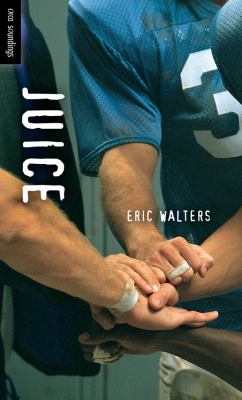
Orca Soundings: “Juice”

Juice by Eric Walters   juice

When Coach Reeves retires and Coach Barnes comes to coach football at Michael ‘Moose’s’ high school, optimism is high. Barnes has coached at Division One Central High and tells his new team that they can become Division One as well—with all the perks, including chances at college scholarships.

Coach Barnes has brought lots of sponsorship with him. There’s new equipment including a whirlpool, big screen TVs in the weight room, a massage therapist and new uniforms.

But a new attitude is expected too—one of winning at any cost. And Moose is the new team captain who is challenged to do whatever it takes in order to have a chance at an NFL future.

Another good one from Orca Soundings. Looking forward to seeing the READ 180 classes tomorrow at Chaffey!

Posted in Controversial Issue/Debate, Fiction, Hi-Low/Quick Read, Read 180, Sports, Young Adult Literature | Tagged , , , , , | Leave a comment

Orca Soundings: “Last Ride” and “Back”

This slideshow requires JavaScript.


Last Ride by Laura Langston

Back by Norah McClintock

I’m excited about seeing the READ 180 classes again soon, so I want to recommend a few more Orca Soundings books that I’ve read recently. You’re going to love these the same way you’ve been drawn into the Bluford series, Night Fall and Southside High.

Last Ride

In Last Ride, Tom is haunted by the ghost of his best friend Logan. He sees him everywhere and can even smell the cherry Twizzlers that Logan was always chewing. Tom had pushed Logan into an illegal street race, and now Logan is dead. Tom is out of the hospital, but his medical bills are astonishing, and his mom is unable to keep up with the payments.

Tom works at Ray’s garage, where they alter cars—illegally—to be better street performance vehicles. Ray seems to steal many of the parts that he uses to transform cars. What’s even worse is that he expects Tom to pay for all the work done on his car, or he will take it away and have someone else race it.

But Tom can’t make the money without racing, and he’s promised Hannah, Logan’s old girlfriend, that he will never race again. Tom has developed a crush on Hannah. Maybe that’s why Logan is haunting him. Should he keep his promise never to race again in the face of mounting money pressures and terrible odds of winning Hannah.

Back

In Back, Jojo, the neighborhood bully, is back after spending two years in prison for beating Eden Withrow. Eden was just stepping in to help Shauna, Jojo’s very pregnant girlfriend. Jojo had been harassing Shauna, demanding that she get an abortion, but she had refused. When Jojo and his friends started pushing her on the street, Eden tried to help. But the beating he receives is so bad that his brain is damaged, and he lies in a permanent coma in a care facility.

All the neighbors fear Jojo. Eden was college-bound, the most promising kid in the neighborhood. Now his younger brother Ardell is also college-bound. But when he sees Jojo back and walking free, he can’t believe it. He’s been taking martial arts classes, buffing up for this moment. He wants revenge and is coming up with some pretty creative plans to get it. But when Shauna comes into the neighborhood to visit Jojo and make sure that the baby sees his daddy, Ardell’s world turns dark. His brother is as good as dead because he helped Shauna and probably saved her baby before it was born. How can Shauna do this?

Back is my favorite Orca Soundings book so far. The end surprised me, and I think there has to be a sequel—I need to figure out which book it is. The author, Norah McClintock is my favorite author of quick reads. You might just want to read her books one after the other. I don’t think you’ll be disappointed.

Posted in Family Problems, Fiction, Hi-Low/Quick Read, Read 180, Young Adult Literature | Tagged , , , | 1 Comment

COHS teacher discussion: “The Global Achievement Gap”

global achievement   Although this entry deals with significant ways in which education will change—and thus affect students’ lives—it’s written for teachers. Our principal has asked that we teachers read and discuss this book. (He bought 20 copies, and these can be checked out at our school textbook room.) Here’s what I found in the first sections.

The Global Achievement Gap: Why Even Our Best Schools Don’t Teach the New Survival Skills Our Children Need—and What We Can Do About It (2008)

by Tony Wagner

Preface, Introduction, and Chapter 1

Preface

Wagner sets up his credentials for writing such a book—many years as teacher, school administrator,  a doctorate in education at Harvard, educational consultant, work with the Bill and Melinda Gates Foundation, and more.

As he does research for his doctorate, Wagner sees that teachers are being asked to try new educational methodology without understanding why. As a result they don’t try hard at reforms, and they know that reforms won’t last–others will be along in a few years. The problem is that there’s urgency for change and teachers don’t get it. What they do get is that there’s too much testing in schools and that NCLB has done more harm than good.

Wagner’s research shows that there’s no evidence that charter schools or vouchers will fix problems or that teachers’ unions make them worse. Still, business leaders jump to these as problems/solutions out of desperation.

What’s to be desperate about? Our kids live in a era when they must compete with people from all over the world in a way we never had to. That’s the game changer. Yet there’s no real communication between business leaders, educators and parents about this. Students rarely use technology at school in a meaningful way (learning) and they, along with their teachers, work in isolation. The work world “had been organized into teams for decades.” (Victoria’s comment: This is interesting in light of the cartoon about team work that all district staff has been shown—the doltish student who can’t answer a single question in the job interview, and hopes to rely on her pair share and group. Yet Wagner will champion group work later in the book—provided that it is done in a way that compels critical thinking.) There’s no discussion of real world problems in the classroom (deaths in Iraq or global climate change, for example).

Questions that The Global Achievement Gap will focus on include what it means to be an active and informed citizen in a democratic society; what is meant by ‘rigor;’ and how we can get more of it into the classroom.

Introduction

Wagner asks the reader to face some facts about graduation rates, lack of college preparation among high school students (and the fact that almost all jobs now require postsecondary education). There are statistics to back up claims—our kids don’t complete college, they are unprepared for work, and they don’t vote in presidential elections. (Victoria’s note; the book was published in August 2008, before the youth groundswell of voting for Obama. No matter where you are on the political spectrum, you can see that if youth are engaged, they will vote.)

We are trying to fix things by testing and teaching to the tests and that has resulted in a disaster. Schools are obsolete (as opposed to failing). We should instead be teaching kids new skills. (Victoria’s thought: This was written before the adoption of the Common Core, which does test for higher-level skills. However, the Common Core will require A LOT more testing and A LOT more expense on providing the infrastructure for that testing.)

The rest of the introduction is about creating ‘habits of mind’ in our students—effective communication, curiosity, and critical thinking. Wagner also goes back over why this is essential—the global economy and global competition for jobs. He quotes other authors who have looked at that problem. He believes we need to quickly respond to three fundamental transformations:

  • The rapid evolution of the knowledge economy
  • The shift to limitless information
  • The impact of media and technology on learning, social behavior and one’s relationship to the world.

Chapter 1: The New World of Work and the Seven Survival Skills

Wagner rubs elbows with many giants of industry and technology. He’s always asked them what qualities they would like to see in new employees. He’s always been surprised that they don’t respond with a list of specific technical skills. From this experience, he compiled a list of seven vital skills that should be taught in high school.

Before detailing the vital skills, Wagner goes into problems he sees on his many classroom observations: teaching to the test; teachers unable to agree on what a good lesson is (they have no idea of what a good lesson is); STEM students not properly trained and unable to observe.

There are in fact, two achievement gaps in our system—the one we know of in urban schools, where minority students receive inferior instruction in poorly equipped environments—and the one in middle class schools, where kids are learning neither what they need to know in a global economy nor how to be an informed citizen in a democracy. There are reasons for this and Wagner gives a short history of the educational pendulum—why it swings from teachers training kids as though they were performance monkeys to an ‘anything goes’ creativity. NCLB was to correct the wild swinging, but studies show that it’s a failure.

How do we get out of this failure cycle? Wagner gives us seven survival skills anyone needs in today’s world and that can be taught at high schools across the country:

1. Critical Thinking and Problem Solving—employers demand it and there are examples in the book. There’s no middle management in business anymore, so all workers have to be able to problem-solve on their own, and sift through lots of information. So what is critical thinking, really?

  • Wagner doesn’t use the word gestalt, but the thinker has to understand the root of an issue and how parts affect the whole, what the connections are (not just what’s visible at the surface).
  • Advice to teachers: Throw out the textbooks (from a Cisco Systems VP). Surround yourself with people with whom you have a difference of opinion and who can help create the best solutions (from a military full colonel).

 2. Collaboration Across Networks and Leading by Influence

  • There is a lot of ‘virtual’ collaboration today, so an issue arises with interacting and developing trust.
  • People should be able to work with others from different cultures.
  • People need to influence others rather than direct and command.
  • These skills are essential for citizenship (e. g., understand culture—Sunni v. Shiite Muslims).

3. Agility and Adaptability

  • Clay Parker (BOC Edwards): “I can guarantee that the job I hire someone to do will change or may not exist in the future.”
  • This relates to the idea of a ‘lifelong learner.’
  • People must deal with ambiguity.
  • People must know how to manage disruption (innovation, change, uncontrollable factors, etc.).

4. Initiative and Entrepreneurialism

  • Companies expand rapidly and can’t succeed without keeping this sort of talent.
  • A problem with large companies is that they are risk averse. They are now trying to create entrepreneurial culture within the organization.
  • (Victoria’s thought: Teachers are risk averse; that’s why they teach when they could be making a lot more money doing something else—not because they aren’t smart, are lazy, or any other nonsense they’re accused of. But, how does a risk-averse person teach someone else not to be? Is that a personality trait?)

5. Effective Oral and Written Communication

  • Includes communicating effectively across cultures.
  • Partnership for 21st Century Skills study—80.9% high school graduates are deficient in written communication.
  • Advice from industry: Teach them to write!
  • People need not only to communicate clearly and concisely, but must be able to create focus, energy and passion.
  • Teachers have too many kids to teach anything but formulaic writing. Business leaders complain that writers show fuzzy thinking that lacks voice (which takes us back to the idea of passion, etc.).
  • (Victoria’s thought: Studies show that passionate readers are better writers/communicators. That’s why people should be encouraged to read all sorts of things. And, yes, fiction creates that passion.)

6. Accessing and Analyzing Information

  • Access and evaluate information from a variety of sources.
  • (Victoria’s thought: This is a national and state standard for school libraries! This is what librarians are supposed to help teach—and why the national standard is one librarian to every 750 or so students!)

7. Curiosity and Imagination

  • People must be disciplined thinkers, but they also must have “a burning curiosity, a lively imagination, and engage others empathetically.”
  • (Victoria’s thought: Fiction, fiction, fiction! Check out those new brain studies!)
  • Curiosity includes a desire to problem solve by looking at the entire issue (There’s a quote from Annmarie Neal and she defines curiosity in almost exactly the same words as she does critical thinking at the beginning of the chapter. I found that interesting. Either she’s not creative enough herself to delineate the difference, or she’s trying to tell us that they are pretty much the same thing.)
  • Important people are quoted. Particularly resonant is Daniel Pink and his notions of high concept and high touch—detect patterns, create beauty, craft narrative, combine seemingly unrelated things, find purpose and meaning in connecting with others.
  • People will create their job requirements around their own abilities (or—it’s implied—they’ll be sacked.)

One more note from Victoria: I’ve read and reviewed several of the books Wagner is quoting. A look at the reviews can give you an idea of how all this is connected.

Daniel Pink’s A Whole New Mind is here.

Daniel Kahneman’s Thinking Fast and Slow is here.

Thomas Friedman’s The World is Flat is here.

Last note: In the leadership meeting, a teacher expressed a concern about studies which show that the U.S. trails other countries in educational performance. He commented that this is skewed data. This is a real issue and worth looking into since these studies are highlighted in The Global Achievement Gap’s Introduction.

If you are distraught over how hard you work and how it seems others are always ahead in the race to the top, you may find solace in the following blog entry, which links to many articles on why those statistics may not be accurate.

http://larryferlazzo.edublogs.org/2010/12/08/the-best-sites-for-learning-the-truth-about-international-test-comparison-demagoguery/

Here’s an excerpt of a conversation with a Shanghai principal:

“Developed countries like the U.S. shouldn’t be too surprised by these results. They’re just one index, one measure that shows off the good points of Shanghai’s and China’s education system. But the results can’t cover up our problems,” he says. Liu is very frank about those problems — the continuing reliance on rote learning, the lack of analysis or critical thinking — and he says the system is in dire need of reform. “Why don’t Chinese students dare to think? Because we insist on telling them everything. We’re not getting our kids to go and find things out for themselves,” he says.

As well as the limitations of the Chinese education system, Liu says, it was only students in Shanghai who took the PISA tests, and Shanghai has some of the best schools in China.

Posted in Non-fiction | Tagged , , , , , , , , , | Leave a comment

Darren Shan Fans: “ZOM-B” is here

ZOM-B by Darren Shan  ZOM-B

Darren Shan is popular with kids of all ages. His Cirque du Freak, Demonata and The Saga of Larten Crepsley series have been bestsellers. He’s got a new series. And ZOM-B is the first book. Considering the nonstop action—the zombie apocalypse explodes about halfway through the book, but its beginnings in Ireland are described in a prologue—this is really a teen book, one that will appeal to even the most reluctant readers.

Sitting in front of the television in their London home, ‘B’, just like Dad, doesn’t believe that the zombie footage on the news is real. The zombies appear to be attacking a rural Irish town, and everyone in England thinks it’s just a stunt for a new movie.

As B, Dad and  Mum interact, we see learn a lot. B’s dad is a racist and a brute. He beats his wife, and B as well if B tries to stop the beatings. And B does try.

B is growing up to be like father. Terrible at school, a petty thief, a vandal, and a bully, as a protagonist, it would be hard to have any sympathy for B except that somewhere in that dark soul, there appears to be a kernel of light.

B has one Black friend and  keeps that a secret from Dad in order to avoid a beating. B harasses people of color (Indians—from India, not Native Americans—this is England—as well as Blacks) and Muslims at every chance, while claiming not to be a racist.

At a museum display about the Holocaust, B gets a sense of the horrors that racism can cause. B also acts heroically in helping a baby, who is Indian. While the rest of the community is giving B props, Dad tells him that he shouldn’t have helped any Indian, even a baby. And this is where a major conflict comes into the novel.

B both loves and hates Dad and can’t reconcile these emotions. And Shan does a great job of showing what this is like for a teen coming from a racist home with a brutal dad. In fact, I thought the tension in the family was better stuff than the zombie scare. But the appearance of zombies in London will force B to start connecting to all sorts of people if B and others are to survive.

This is a short book with black and white illustrations, some of which are of zombies munching on the students and teachers at B’s high school. It’s a super quick read and ends with “to be continued.” So while you’re having scary fun living through the horror story, you’ll also be forced to question prejudice. And you’ll be waiting for the next title to come out. Not bad for a few hours’ reading. Try it.

Posted in Family Problems, Fiction, Hi-Low/Quick Read, Horror/Mystery/Suspense, Read 180, Supernatural, Young Adult Literature | Tagged , , , , , , , , | Leave a comment

“Daughter of Smoke & Bone” Fans

days of blood

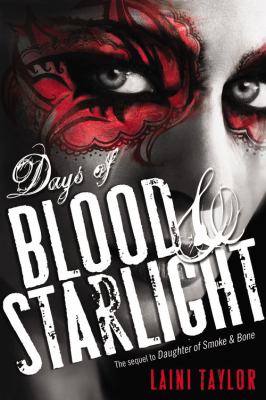
Look what arrived in both our libraries–book 2:

Days of Blood & Starlight

Come on over and check it out!

Posted in Fable/Fairy Tale/Fantasy, Fiction, Horror/Mystery/Suspense, Over 375 pages, Romance, Supernatural, Young Adult Literature | Tagged , , , , , | Leave a comment