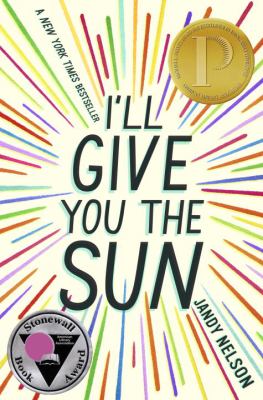
“I’ll Give You the Sun”

I'll Give You the SunI’ll Give You the Sun by Jandy Nelson

“How can love be such a wrecking ball?”

Noah and Jude are twins who have distinct personalities but sense that they are two halves of a perfect whole. While both are artistic (like their mom), Noah is the quieter child. He envisions the world and his experience in it as a series of artworks, which he is always naming (“GROUP PORTRAIT: All the Glass Boys Shatter)”. Jude is more of a risk-taker. At first her risks are challenges like surfing. But about the time she is fourteen, she begins to act out, taking risks with older boys. She depends on the wisdom of superstitions handed down from her grandmother to keep her safe in love (“Nothing curdles love in the heart like lemon on the tongue”). Ironically, misunderstandings fueled by their artistic impulses and rivalries for their parents’ affection are pulling Noah and Jude apart. While still in high school, their deep connection is severed. They are both living the reality of their family’s story, but for each it is half a reality. And they can only complete their visions of themselves and their futures by becoming one again and learning what the other half already knows.

While the twins alternately tell their tales, Jude immediately jumps ahead to after the point when tragedy has stricken the family. Noah moves more slowly discussing his art, his realization that he is in love with Brian, a friend who is equally a nerd (often searching for meteorites) and very cool. Brian seems to have the world in the palm of his hand–except that he feels he can never tell anyone about his feelings for Noah as this would cause shaming among his baseball teammates. It would risk the loss of his private high school and college scholarship opportunities.

Jude channels ghosts. Her grandma’s specter helps her and gives her advice. But there is another ghost who breaks every piece of artwork that Jude makes. This convinces Jude that she will never be forgiven for a great betrayal, unless she can somehow make a sculpture in marble—something not so easily broken. This leads Jude to seek out the help of a famous sculptor, one who is far more significant in her life’s story than she could know. And one who is about to break and recast the twins’ world.

High school housekeeping: The emotionality of I’ll Give You the Sun is so textured, so strikingly real. Any teen can love this book, but those who feel that their own imagination is being stifled will find many good lessons, and even, perhaps, the courage to push their way into the inspired life they were meant to live. Questions about how important it is to simply feel alive and how important it is to feel safe—and how the two are sometimes in conflict—are woven throughout the tales of the twins. The desperation of their need when they are separated from their own creativity is palatable. Their grief, unresolved.

“No one tells you how gone gone really is, or how long it lasts.”

The title of the novel comes from a childhood game that Noah and Jude play. They have a vast universe between them, and they trade its elements. To get the sun, Noah gives Jude a portrait of a beautiful man, one that mesmerizes Jude.

While there is so much tragedy in this novel, there is also so much happiness, such coincidental good fortune. It’s very much like life. For people to admit the terrible things they do to one another is the beginning of repair. And the secret to a life infused with creative endeavors is to turn toward the desire to create. And begin.
Posted in Family Problems, Fiction, Romance, Young Adult Literature | Tagged , , , , , , , , , , , , , , , , , , , , , , | 2 Comments

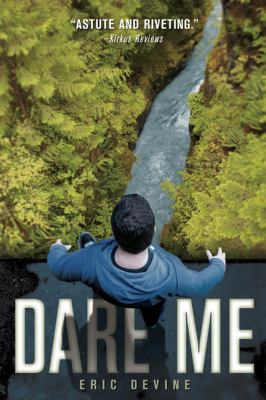
“Dare Me”

dare meDare Me by Eric Devine  

Ben Candido has known enough about trouble and his former best friend Ricky to stay away for more than three years. But when their senior year of high school finally arrives, Ben can’t help it. Ricky has a great plan for finishing 10 dares–one per month–and posting them on YouTube. He convinces Ben as well as their friend and basketball star, John, that they will graduate as school legends.

From the beginning the dares are super dangerous. The guys could easily get hurt and possibly be killed. They need to keep their daredevil stunts a secret, remain anonymous. But as the number of viewing hits on their videos skyrocket, they are pressured to take on more and more risks. They have a shady sponsor, and their contract with him locks them into a terrifying reality. They have to take on another classmate who appears to have figured out their secret and could get them arrested. But now, in addition to the hope of becoming legends, a lot of money is involved. With Ben’s dad’s job in jeopardy, he has all the more reason to risk himself.

Ben has more than one love interest, but the girl of his true heart is Alexia. He’s known her since they were childhood friends. For some reason, she can’t seem to escape her abusive relationship with Jesse. Could Ben’s new courage and daring help him to help her?

High school housekeeping: This is a fun book for just about any high school student, but it has particular guy appeal. I recommend it to all my guy reluctant readers who are looking for more action in their novels.One flaw in the novel is that the motivation of Ben, Ricky, and John’s secret sponsor is unclear. But on the whole, you’ll be pulled through the story by one dare and then the next, wondering how the guys can ever get out of this, and if all three of them will manage to live. The end is quite the white-knuckler. Wild and unexpected, it’s a satisfying conclusion to a fast-paced thrill ride.


Posted in Adventure Stories, Controversial Issue/Debate, Family Problems, Fiction, Sports, Young Adult Literature | Tagged , , , , , , , , , , , , | 1 Comment

“Gabi: A Girl in Pieces”

gabi  Gabi: A Girl in Pieces by Isabel Quintero

“My mom says, ‘Ojos abiertos, piernas cerradas.’ Eyes open, legs closed.”

This advice, the total sum of Gabi’s sex education at home, gets more ironic (and darkly funny) as the book goes on. This is because, while all the adults are advising the kids to be good, they can’t manage to keep their own legs closed, as Gabi wryly notes.

A realistic look at teen sexuality is at the heart of this novel. This is clear before we open the book as the cover art—of a girl in pieces—has a vaginal opening as the centerpiece of the girl’s dress bodice. However, realistic in this case does not just mean gritty or explicitly sexual as it often does. It means that Gabi has lots of questions about sex that aren’t answered in textbooks. It means that she is sometimes naïve and giddy, sweetly dreaming of the boys she crushes on. It means that she discovers that sex is messy in more ways than one—and not at all like anything she has learned from the movies or Spanish-language television novelas.

Quintero writes her novel in a diary format. Gabi begins her diary—a record of her senior year in high school—with thoughts about being too boy crazy and a note to herself to lose weight. But she immediately has to deal with larger problems—her best friend Cindy is pregnant and her other best friend, Sebastian, who is gay, makes the mistake of telling his parents. They immediately toss him out of the house. Worse, Gabi’s father is a meth addict and her younger brother is acting out.

Despite Gabi’s fear that she is too fat to be attractive, several guys take an interest in her—some nice, some not so nice. She examines her feelings and soothes her troubles through writing. She takes a poetry class and, through her assignments, she explores her grief at the deaths of her grandmother and grandfather. To express her feelings of love for, and frustration with, her drug-abusing dad, Gabi writes him letters that she keeps hidden. She completes college applications and hopes to attend Berkeley in the fall.

Gabi has an unfair share of family and financial problems, but she dreams, as all teens dream, of fulfilling her potential and having love in her life—the kind that isn’t predicated on guilt and obedience to irrational conditions.

High school housekeeping: There’s so much you’ll like about this novel. Gabi is very realistic—she frets about her weight, but isn’t motivated to lose it—instead it serves as a shaming mechanism. More than she needs to lose pounds, she needs to lose the guilt, not only about eating treats, but about her budding sexuality, her desire to leave her family and attend college, her inability to help her father or be a ‘good girl’ Mexican daughter to her mother.

Gabi’s sense of having to walk on eggshells to avoid upsetting her tweaking father is one that anyone who has had an alcoholic or drug addict in their family can easily relate to. The diary format of this novel is one that teens connect with, although the pieces here seem less like journal entries than well-organized and lovely writing. The smattering of Spanish gives the book a genuine Southern-California sensibility, yet it is easy to understand, even for the reader whose Spanish is minimal.

Realistic in both its search for answers and in the answers themselves, you’ll connect with Gabi’s situation and with her problem-solving grit immediately.

Posted in Faith-Based/Religious Element, Family Problems, Fiction, Romance, Young Adult Literature | Tagged , , , , , , , , , , , , , , , , , , , , | 4 Comments

Thoughtful Readers: “August”

August by Bernard Beckett   august

I’ve been looking for books for our deeper thinkers. August is one.

Unfortunately, the cover description says it’s a “philosophical thriller” and also gives the reader the impression that it will be a love story. And this makes lots of readers jump to the conclusion that it is a romance. And then they hate the book, get online and say that August is neither a romance nor a thriller.

And, of course, they are right, technically. Because the love story here is not like a formula romance at all. And the thriller aspect of the book is not like a murder mystery. This is the story of a couple of teens–Tristan and Grace–who, after veering off the road and landing upside down over a cliffside, contemplate their very serious injuries, the possibility of death, and the circumstances that brought them together in this tragedy.

They seem to be an unlikely pair. Raised in a dystopian world where people are either within the walls of the City of God or struggling for survival outside of them, the two shouldn’t have met. Tristan has been raised in a ‘grand and cold’ monastery, schooled by severe monks on thinking about theological questions of free will and predetermination. Grace is a prostitute from outside the city walls. They don’t even appear to know one another. And yet a chance meeting, in which they didn’t speak a word, has delivered them to this precipice of pain and questioning.

After their car crashes, in order to survive through the night and be seen in the morning by a passerby, the pair discusses the events that led them to their fractured ribs, dislocated shoulders broken teeth and glass-pocked faces. Tristan has been raised to absorb the tenets of St. Augustine, to believe that submission is salvation. He’s the smartest boy in his class. So while this means he can recall best what the monks teach the classes, it also means that he is the likeliest to question what he is taught. Grace,too, has had a strict upbringing by convent nuns who teach her not to question their mode of salvation. But question she must. and it costs her dearly.

The big questions in life–whether humans have free will, whether they are directed by God’s hand, or whether they are damned from the beginning, seem only to be intellectual exercises. But once Grace and Tristan are trapped upside down over the side of a cliff, the answer becomes a matter of life and death.

High school housekeeping: This really is a book for the teen who wonders about the existence of God–and more specifically, the existence of a loving God, whether all human actions are predestined, and other philosophical conundrums. While it takes place in a dystopia, it’s not a future one. There’s no science fiction element to August. The setting is modern. Yet the upbringings of both Grace and Tristan are almost medieval in their exquisite mental torture and physical torment. There is the question not just of whether a supernatural power is out there pulling strings, but whether Grace and Tristan can be manipulated by those that insist on a specific worldview. As they tell one another what they’ve been through in seeking answers and fighting back against those who would control them, you realize that love does mean a great deal in the struggle. As the reader feels the couple’s desperation and flies through the pages, seeking the answers to questions about free will, chances of the couple’s survival are becoming mighty slim. So, yes, this is a philosophical thriller. The prospective reader just has to realize what that means. There’s no formula plotline here. But in a very short space (200 pages), the author gives the thoughtful teen a crazy ride that plummets off the edge of the typical-teen-novel landscape.

Posted in Controversial Issue/Debate, Faith-Based/Religious Element, Family Problems, Fiction, Human Rights Issues, Philosophy, Young Adult Literature | Tagged , , , , , , , , , , , , , | Leave a comment

Women’s History Month: Look what I won!


This slideshow requires JavaScript.


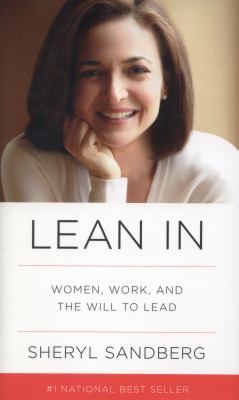
I won these five books at the California School Library Association Centennial Conference! Just cataloged in time for Women’s History Month. Be a leader and a history make–come check one out!


Posted in Non-fiction | Tagged , , , , , , , , , | 1 Comment

“Wake”

Wake by Lisa McMann  wake

Janie started being pulled into other people’s dreams when she was eight. At least, that’s when she noticed it. By the time she’s eleven, she’s sure that the dreams are wrecking the quality of her life. At a sleepover at BFF Carrie’s house, Janie falls into both a nightmare—Carrie is trying to save a drowning boy and can’t—and a dream of Melinda’s, Janie’s frienemy, that is just TMI.

Janie has no control over her entry into dreams. In high school, during study hall, lots of kids fall asleep and Janie tries to hide in the corner of the room in order to keep the dreams out. They are so terrifying to her, so deeply disturbing that she rattles and shakes, spasming in a way that appears to others that Janie is having a seizure. (No, I’m not sure why since the nightmare only scare the actual dreamers in the usual way.)

Cabel had been a dark, goth sort of troubled guy, but in her sophomore year, Janie notices that he has changed. He’s good-looking and smart. He is also troubled by a terrible dream of turning into a monster and killing someone. And for some reason, he knows that Janie is in his dream with him, seeing it all. (No, I’m not sure why.) Can Janie help him?

High school Housekeeping: This is a quick read based on a very interesting idea. It would have been nice if Janie’s internal universe—the dream-hopping, the efforts to help others, the way she learns to connect to people seeking help—had been better thought out and better detailed. The first 70 pages are more or less Janie entering and leaving dreams, shuttering, eyes rolling back into her head. So it’s about a third of the book before the story starts, and then there is little time to have it evolve. But, according to the book cover, this is the first book in a New York Times bestselling trilogy, so hats off to McMann for pulling off that tough achievement.

Posted in Family Problems, Fiction, Hi-Low/Quick Read, Romance, Supernatural, Young Adult Literature | Tagged , , , , , , , , , , , , , , | Leave a comment

“The 5th Wave”

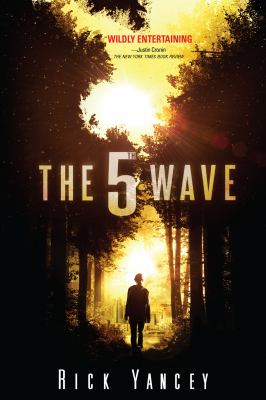
The 5th Wave by Rick Yancey   5th wave

There are two reasons I needed to read The 5th Wave. One is that it’s going to be a movie, and that’s always exciting in teen books. But the greater reason was that I loved Yancey’s writing in the Monstrumologist series, which was alternately suspenseful, grotesque, and comic.

The 5th Wave is sci-fi rather than horror, but it will not disappoint fans. The tradition of alien invasions, the decimation of the human race, and frightening body snatching lives!

An alien species has come to take over the earth. They don’t want to enslave the human population. They want to wipe it out. And they do this in waves. Most of the world’s population is easily eradicated by plague in the 3rd wave. The mother of protagonist Cassie is one of billions killed. But in general the family is strong and ‘lucky’ (we have to use that word loosely here). Cassie, her father and her little brother Sammy survive. But luck runs out as the waves of killing continue, each using a different method of murder. The aliens are intent on destroying every last human being.

As bad turns to worse for the family, five-year-old Sammy is taken to what Cassie at first believes is a safe military base with army protection. But horrifying events lead Cassie to understand that Sammy is in danger and must be rescued. She also comes to understand that the aliens have been able to meld into the consciousness of the humans—bringing a 4th wave of killings.

Who can Cassie trust? She has no idea since all of the bad guys look like people. She takes her M-16 rifle, her bowie knife and a few other essentials like Sammy’s beloved teddy bear. She faces off with everyone she meets. It looks like she may lose her battle when a “Silencer” has her in his sights.

While Cassie battles for her life, “Zombie,” known as Ben when he was in high school, is tormented over the fact that he left his younger sister to die while escaping the aliens. He had always been a football star and the secret crush of many girls—Cassie included, although Ben never knew it. But despite his big reputation, the alien invasion showed him to be a coward. He needs to make amends. He decides to stand and fight. But in doing so, he realizes that he may well be working for the enemy by taking innocent lives.

High school housekeeping: This is traditional sci-fi fare, and a lot for fun for fans. While the enemy is uncertain, and the stakes of being friendly are high, it’s every man (and woman) for himself, with lots of fast-paced action. Readers of the Monstrumologist series might miss the cleverly misconstrued conversations, but the essential struggles are here: against other life forms, against one’s own doubts and fears. And most important, the big questions are once again asked. Are some people more valuable than others? When danger lurks, who is saved? What, in fact, does it mean to be human?

Posted in Family Problems, Fiction, Movie Tie-In, Over 375 pages, Sci-Fi/Futuristic, Young Adult Literature | Tagged , , , , , , , , , | 1 Comment

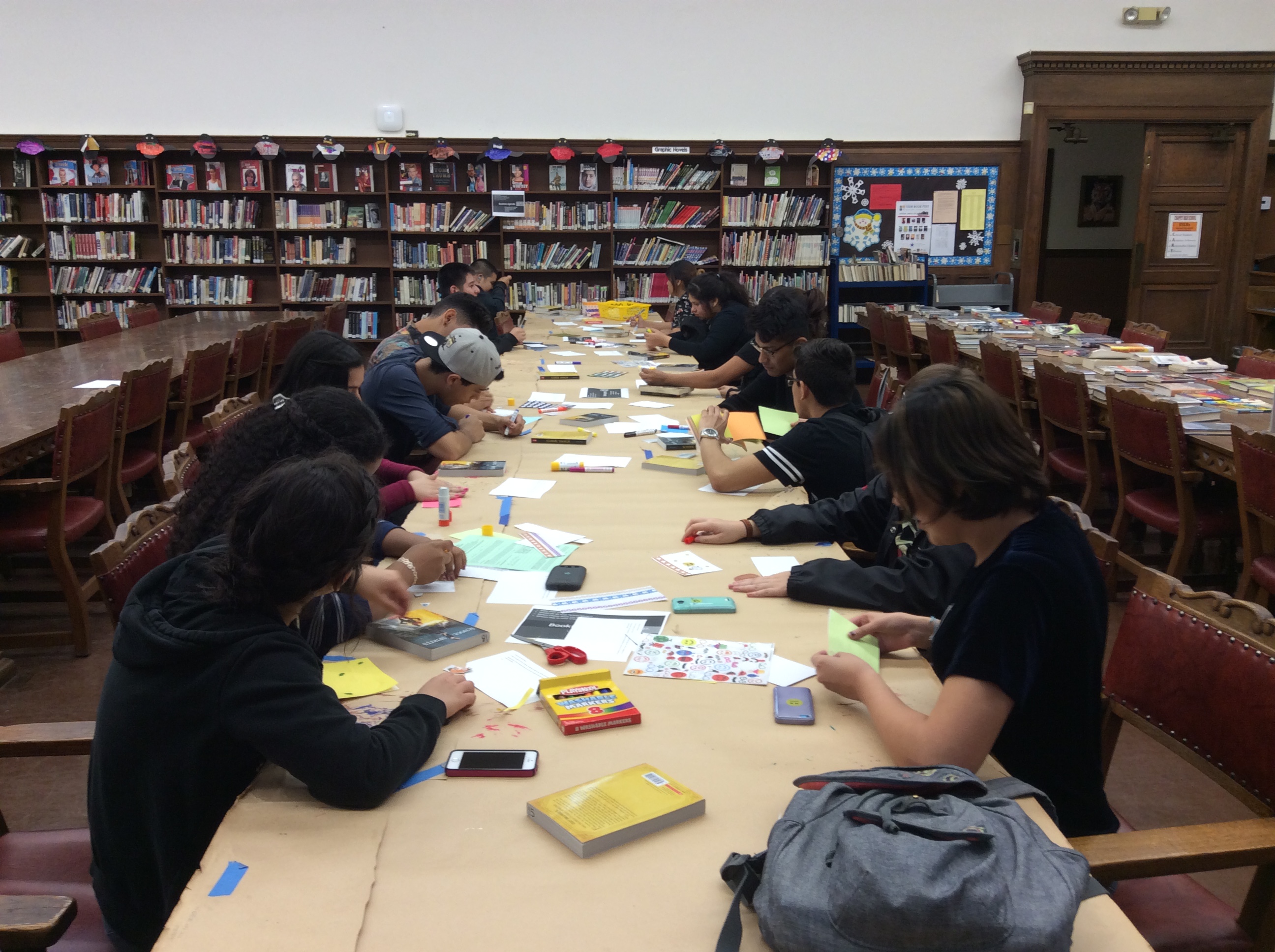
Bookies Making Shelf Talkers

I love the Bookies Book Club. Friday after school we were making ‘shelf talkers.’ They’ll be up and advertising the library’s best books soon!

making shelf talkers

Posted in Uncategorized | Tagged , , | Leave a comment

“A Bad Boy Can be Good for a Girl”

This slideshow requires JavaScript.

    A Bad Boy Can be Good for a Girl by Tanya Lee Stone

While the title may seem misleading once you start reading the book, you’ll understand it by the time you reach the final page.

This quick ‘novel in verse form’ tells the stories of three girls who are played by the same guy. Josie (just a freshman), Nicolette, and Aviva all fall for hunky senior “T. L.” While all three consider themselves girls who have a good, centered sense of self-worth, they all fall apart in TL’s arms.

As a freshman, Josie starts to question the positive ego she had in middle school. High school can be brutal, and being so sought after by a senior and being allowed into the popular group lifts her back up—so that she can be dropped from a greater height. Overhearing her boyfriend and his buddies talk about ‘nailing’ girls and freshmen as ‘freshmeat,’ she wonders if she is the topic of conversation. Nicolette is a very experienced girl, but she always goes out with guys from other schools so that she doesn’t get a bad reputation. With TL, everyone starts to know Nicolette’s business and exactly what she’s done. Aviva is a ‘criss-cross’ girl. She is able to hang out with all sorts of groups and cliques. But her goodness and honesty make her blind to TL’s deception. Josie is the first to be deceived and the one who helps all the girls played by TL to fight back.

High school housekeeping: There’s a good reason this book is becoming popular on my campus now that it has a new cover. Without being at all pornographic, it’s very sexy. It shows how young people sink into relationships (and bed) when their hormonal drives overpower their logic. It would be comic to see how TL says the exact same thing to all three girls (“You’re so soft,” etc.) if the consequences for them weren’t so bad. In using the (still quite popular) old book Forever by Judy Blume, Josie creates a way for all the played girls to have a conversation and to warn others. Most high school libraries have Forever (I reviewed it here); you may want to read it after reading A Bad Boy Can be Good for a Girl. The Lexile level of Bad Boy is 780, in the sixth grade range. I read it looking for good books for our Read 180 classes. However, on this one, I think interest is general for girls—just about everyone will come away wiser.

Posted in Fiction, Hi-Low/Quick Read, Mature Readers, Read 180, Romance, Young Adult Literature | Tagged , , , , , , , , , , | Leave a comment

Throwback Thursday: Bullying: “Give a Boy a Gun”

I’m thinking about my book talks with Read 180 classes tomorrow. I read Give a Boy a Gun for the first time last night–it stands the time of time. Still compelling.

Give a Boy a Gun by Todd Strasser  give a boy

“One of the things I used to like about writing books for young people was that it wasn’t necessary to deal with murder, adultery, and various other immoral or criminal activities that seem mandatory in adult novels these days. I find it sad and frightening that this is no longer the case.”

Author’s Note from Give a Boy a Gun

When Denise Shipley learns that her neighbor Gary Searle is dead of a gunshot wound after joining Brendan Lawlor in shooting classmates in his high school, she goes home to Middletown to find out why. This fictional character’s fictional interviews with the locals are interspersed with emails and characters’ diaries. Much like footnotes, factual information from real newspapers and magazines runs along the bottom of the pages.  The information is about guns, semi-automatic weapons, and special bullets meant to cause severe damage. It is also about incidents of gun violence.

What we learn from one of the shooters (Gary’s) ex-girlfriend, Allison, is that while the boys seem sexy when they become more dangerous, they are also—well, dangerous. There is a sixth sense that tells her to stand down. From the one friend of the shooters, Ryan, we learn that they are progressively getting more and more into drugs. From football player William, we see the point of view that athletes who bully the loners/awkward students deserve special treatment as athletes are the ones who work incredibly hard to win games and create an atmosphere of school spirit.

But no matter how anyone frames it or makes excuses, the school culture, the country’s gun culture, and the mental states of Gary and Brendan all collide into a sickening catastrophe. Innocent victims, like caged animals, have no way out when the shooting begins.

High school housekeeping: Strasser does a good job of showing how complicated are the events and relationships that lead up to a tragedy like a school shooting. He doesn’t provide easy answers, but he does give you a riveting climax. Although Give a Boy a Gun is fictional, it’s easy to see connections to the (Littleton, Colorado) Columbine High School shooting tragedy which was also committed by two boys who hoped to wipe the school off the face of the map. However, in the years since Columbine, more information has come out about the shooters, much of it indicating that they were neither loners nor friendless. For a good nonfiction connection to Strasser’s novel, you could read Columbine by David Cullen. Keep in mind that the two books were written for different audiences. Give a Boy a Gun is for high school readers, with a 760 Lexile level (about sixth grade reading level). So it’s a good choice for reluctant or struggling readers. Columbine is an adult work, long and detailed, based on research. Yet the Lexile website also gives it a 760 Lexile level—exactly the same as Give a Boy a Gun. I have to say that this surprises me. But if you have the ability to stick it, it’s a great read, and exactly the sort of thing that the framers of the Common Core would like you to try for ‘informational text’ (nonfiction). Check my review here to get an overview of the book.

Posted in Controversial Issue/Debate, Family Problems, Fiction, Hi-Low/Quick Read, Human Rights Issues, Read 180, Young Adult Literature | Tagged , , , , , , , , , , , , , , , | 1 Comment