The Sociopath Next Door by Martha Stout 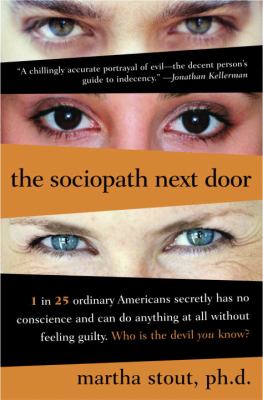
Something that has always interested me about people who are charismatic is how often they turn out to be evil. In school, we all learn this about dictators–watch film of them mesmerizing crowds with their fiery speeches, leading ordinary folks to do extraordinary things, often foolish or downright horrifying. Why does this happen? And how are we all so blinded by these leaders?
In her book The Sociopath Next Door, Martha Stout, who has a Ph.D. in clinical psychology, provides her readers with an answer. Equally interesting is her proposition that the type of brain that leads someone to be a megalomaniacal leader or a serial killer is also the type of brain that makes someone with lesser goals use others to serve their own purposes. In fact, she contends that one in every twenty-five people is a sociopath.
A sociopath (someone with ‘antisocial personality disorder’), as defined here, is someone without a conscience. S/he has no empathy or feelings for any living thing. So–there’s no way to shame that person or make her feel guilty. But like the exciting political leader, these seemingly ordinary men and women have ‘leadership’ traits. They are charming–as long as you don’t know them too well. They are also so spontaneous and sexy that others are easily attracted to them. But once they have others under their spell, they use and abuse them–sometimes physically, often emotionally and psychologically. Because they start out being so charming, it takes the victim a long time to realize the kind of person she is dealing with. No one wants to believe that someone they know is completely unscrupulous.
Coming to terms with a sociopath is strange for other reasons as well. Stout discusses how their brains are unlike the average person’s–and that they are born with their inability to feel anything (except, for some reason, glee at harming others). With this being so, are they responsible for their behavior? Nurturing–or lack of nurturing–appears to have some effect on their behavior. Loving parents and friends can’t make a sociopath care about others, but lack of care and structure can make their behaviors worse. Stout tells us we should be grateful that we are born with empathy and shows how much it adds to our daily life and happiness.
High school housekeeping: This is a quick read of a few hundred pages. Although an adult book, The Sociopath Next Door has great appeal to high school students. It’s a good nonfiction choice (Common Core) because Stout gives the reader several examples of sociopaths in everyday life and work places as well as examples of behaviors that indicate antisocial personality disorder (tortures animals or did so as a child; demands sadistic, torturous sex; throws decent coworkers under the bus for the pleasure of doing so; and many more). She has thirteen rules for defending yourself against a sociopath. Her ‘rule of threes’ is a good life skill to practice even if the people you are dealing with are not sociopaths, but merely narcissistic. Someone can lie or hurt you once and be forgiven, But if someone messes with you three times–and when a sociopath does this, s/he will ask you for pity (it’s all about him or her!)–you are done with that person. Trust your instincts even if the other person has authority. And read this book for a clear picture of how to keep someone without a conscience from messing with your well being.

 School Library Lady
Pingback: Unheard Witness: The Life and Death of Kathy Leissner Whitman | School Library Lady
Nice to have this information about a fascinating non-fiction book. I especially like the summary about the Rule of Threes.
I’ve always envied the charming and charismatic types because they are popular, attractive, etc. However, I will let others have it if it comes with indifference towards others and lack of empathy. I’m a bit narcissistic (who isn’t nowadays?) and think my own ideas are great even when they are average, but I’m definitely genuinely concerned with the welfare of others. Not a sociopath?