
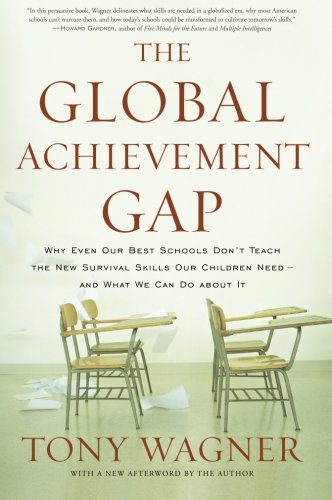
This is a guest entry from Mrs. Fiandaca.
Although this entry deals with significant ways in which education will change—and thus affect students’ lives—it’s written for teachers. Our principal has asked that we teachers read and discuss this book. (He bought 20 copies, and these can be checked out at our school textbook room.)
The Global Achievement Gap: Why Even Our Best Schools Don’t Teach the New Survival Skills Our Children Need—
and What We Can Do About It (2008)
Chapter 2 Summary and Key Points
Wagner refers to a global achievement gap. He associates this with what is being taught versus what students will need to succeed in today’s world.
He also discussed “ rigor” in the classroom.
o Teachers often associate rigor with more work in less time.
o Society associates rigor with AP courses and IB program.
o Wagner associates rigor with critical thinking, problem solving, working collaboratively, taking initiative, communicating effectively, analyzing information and using creativity and imagination.
Learning Walks
o Spend 10 minutes in 8 to 10 classrooms to get an idea of the rigor on a campus
o It gives you a snapshot of the school
o He completed learning walks at two “high performing” schools.
o Teachers were teaching the grade level contents standards and what the students would be tested on.
o Students use factual recall and memorization.
o Teachers often “spoon feed” the answers.
Testing
o Teachers had a common focus: core curriculum and test prep.
o Tests are multiple choice and recall. Tests are not designed to measure analysis skills.
o This is impacting students and their ability to become critical thinkers.
o The “Bubble Kids” that give you “the most bang for your buck.”
Administrators
o Surprised by learning walks
o Scheduled observations were better focus on “standards based instruction” and “data driven decisions”
o Dept. of Defense Schools required all principals to focus on “standards-based instruction” and “data driven decisions”
The Competition
o OECD to measure “cross curricular competencies”, critical thinking, and problem solving
o American students performed really poorly.
o Educational goals from other countries differ drastically from ours.
o China: emphasize creativity and problem solving over test scores and recall knowledge.
o Singapore: wants students to experiment, innovate, and take risks
o America uses multiple choice tests to close the achievement gaps between the white middle class and economically disadvantaged minority students.
o It is difficult to take risks and experiment when there is so much emphasis on testing.
Common Core
o Will require more than recall
o Assessments will require higher level thinking skills
o Cross Curricular emphasis
o Our units that we are creating at RCD are more rigorous according to Wagner’s definition.
o Our students struggle with these higher level thinking skills.

 School Library Lady