
Water for Elephants

Water for Elephants by Sara Gruen is the story of a young man who joins a traveling circus during the Great Depression. It’s well researched and includes period photos. It’d be a really fun book to use as the starter fiction for the junior project. Though it’s not true historical fiction, it’s the sort of book that many English teachers at COHS will accept when they assign the reading of historical fiction or period pieces. It’s recently been a best seller and has elements to appeal to just about anyone—adventure, romance, revenge, and ultimately murder.


Jacob Jankowski is on the verge of taking his final exams at Cornell and becoming a veterinarian when his parents are killed in an automobile accident. Jacob’s world suddenly ends. He finds that his parents have mortgaged their home to pay for his education; the bank repossesses it. With nothing of his old life remaining, Jacob jumps a train on his way to living as a ‘hobo.’ However, without knowing it, he’s jumped a circus train, and as a man with valuable veterinary skills, he is offered a job with the Benzini Brothers’ Most Spectacular Show on Earth.


Circus life is tough; there’s a pecking order within the cast of workers and the performers are the stars. Just about everyone is mistreated, including both animals and humans, by the unscrupulous owner and manager, Uncle Al. Jacob almost seems doomed from the start. He must room with Kinko, an angry dwarf who’d like to blame some of his life’s misery on Jacob; he falls in loves with the stunning Marlena, who performs stunts with horses. Unfortunately, Marlena is married to a deeply mentally-ill man (psychotic?) who happens to be the animal trainer and very high in the pecking order. August is often brutal to the animals. Jacob, as you would guess from his profession, has a difficult time abiding this. He is particularly disturbed by August’s treatment of Rosie, the circus’s only elephant, who seems not to be able to obey commands and yet also shows deep intelligence. He discovers that Rosie only responds to Polish. This, however, does not stop August’s mistreatment of her.


The story is told as a series of memories of a contemporary Jacob—he’s ninety-three years old and resides in an assisted living facility; he suffers the many indignities of old age. How the story of Rosie, Marlena and Jacob turns out; and how the story of Jacob the old man concludes, were both a little too neat for me to believe either one. However, circus life, as it is presented to the consumer, is magical. So in this case, a fantasy ending isn’t so bad.
Posted in Fiction, Junior Project | 3 Comments

The Memory Keeper’s Daughter

The Memory Keeper’s Daughter, by Kim Edwards, has had a nice run on the bestsellers’ list, I think, because it deals with the ways in which making a single bad decision can wreck lives.

To be honest, it was difficult for me to accept the premise of the novel. David Henry, a young orthopedic surgeon, delivers his own twins when his wife, Norah, goes into labor during a snowstorm. He has been able to drive as far as his office, and his nurse, Carolyn Gill, meets him there to help with the delivery. Norah, who is unconscious, first births a healthy boy, but afterwards, delivers a girl with Down Syndrome. Believing that Norah will be incapable of dealing with a mentally-disabled child, David gives the baby to Caroline to take to an institution. He then tells his wife that the second baby died.

Caroline tries to give the baby up at an institution, but doesn’t have the heart. She is single, in love with David (although he can’t be sure of this). With no ties, she decides to take the baby and run away to a new life. She then raises Phoebe as her own daughter, constantly battling the medical and everyday prejudice against a child with Down Syndrome.

That a single woman with a good career would take on the responsibility of a mentally-challenged child is a tough sell for me. Further, the baby was born in 1964 and the mother was unconscious. Perhaps this indicates that David didn’t have the right drugs in his office, but my mother gave birth to five children beginning in 1954, and was always conscious (though drugged). Knocking women out cold to deliver a baby seems dated. In addition, the prejudice against Phoebe runs deep. As a small child, she is stung by a bee and is allergic. When Carolyn takes her to the hospital, staff members assume that she will not want the child treated (meaning that Phoebe would die and no longer be a burden). Again, I knew people in the 1960s and 1970s with kids who had Down Syndrome, and seeking a quick way to have them die wasn’t part of any of their agendas. I really wish the book had been set back at least twenty years—or more—so that the many incidents would seem more believable.

Even though I couldn’t believe many of the details of this novel, I still enjoyed the main issues. David makes a life-altering mistake by not letting life take its course. Norah always grieves the daughter she believes has died. David must hide his lie for a lifetime and it makes him more distant and emotionally unavailable, so that Norah looks outward for emotional support. The twists and turns of their relationship and of David’s relationship to his son are more honest than other aspects of the book in examining how secrets destroy lives. Phoebe’s life is seen as something whole and containing its own happiness–despite what the people around her assume about her inability to lead a fulfilling existence.

This novel would be a good choice for the junior project. It might be fun for a student to look into some of the facts of the 1960s and 1970s—what childrearing was like, how Down Syndrome was ‘treated,’ etc. I’m guessing that most COHS students would truly enjoy the book. I know several people who have read it, and none had as difficult a time as I in suspending their disbelief in order to become engaged in the plotline.

Posted in Fiction, Junior Project | 2 Comments

Ordinary Wolves

Although my copy of Ordinary Wolves tells me it’s a best seller, unlike The Kite Runner, I don’t know anyone else who has read it. Like The Kite Runner, it’s a good choice when a teacher asks for a ‘multicultural’ novel or a book about a culture different from your own.

Ordinary Wolves is the story of a white boy who grows up in the 1970s in the Alaskan wilderness. Cutuk lives in a sod igloo with his artist father and his brother and sister. They have no modern conveniences and live like the local Inupiak (Inuit or Eskimo) people have traditionally done. The father, Abe, is an environmentalist to a degree that few people can (or are willing to) manage. Ironically, as the local Inupiaks are adopting some modern American conveniences such as flush toilets and fast food, Cutuk wants to follow tradition. Tradition not withstanding, because he is not really an Inupiak, he is taunted, beaten up, and generally rejected by other children. Loneliness and isolation are important themes of the novel.

The author, Seth Kantner, lived such a childhood, and the novel is autobiographical. Because he knows what he’s talking about, Kantner doesn’t romanticize the wilderness. Living in the icy north of Alaska is tough at all times. Even running sled dogs requires constant vigilance as ice may get between their toe pads and cause frostbite. (Summer is no easier as flies swarm and cause the dogs misery by biting their testicles.) In the struggle to make a life on the frozen tundra, Cutuk, like his father, attempts to do no harm to the people and world around him. When he moves to Anchorage as a young adult, he finds life in the city confusing and the residents disingenuous.

Ordinary Wolves is a good choice for those who enjoy Jack London’s fiction, like wilderness survival stories, have a deep concern for the environment, or just have a desire to understand what ‘roughing it’ really means.

Posted in Environmental Issues, Fiction, Junior Project, Multicultural | Leave a comment

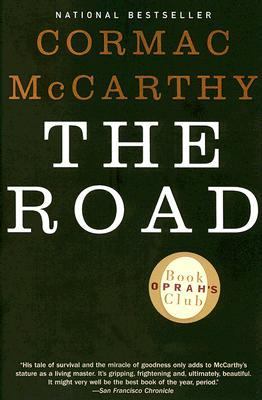
The Road

road  One of the comments you’d never see in a professional book review is “The book is graphic enough to appeal to high school guys.”  I hate to admit it, but this is something I think about when I’m reading. Research shows–and anecdotal evidence at Colony High backs up that research–that high school boys rarely read, almost never when they have the choice.

This summer I read a great book–and I mean great in every sense—a literary masterpiece, a stunning work of fiction, an insightful look into a bleak future, a beautiful rendering of the father-son relationship. And–ta da–a book graphic enough that it will appeal to high school guys.

The Road by Cormac McCarthy is the story of an unnamed father and son who are making their way to the sea in a post-apocalyptic world. “A long shear of light and then a series of low concussions” have left the world barren. Animals are dead (or long ago eaten by the few remaining people), plant life is scorched and roads are melted. The air is always gray with ash, as is the snowfall. The sun is blotted out and winter arrives early. All living people are scavengers—and with little left to scavenge, most are cannibals as well.

In a world that is virtually hopeless, it is amazing that McCarthy can wrench the heart of his reader with the love of the father and son. The father has often told the son that they are “the good guys” and while they have to be on a constant alert for others (who might capture and eat them), they would never do such a thing themselves. Though starving and exhausted from their trek, the son reminds the father that the two of them “carry the flame.”  The son always wants to do well, including helping other people. The father knows better and is more wary. Understanding that he is dying, he saves two bullets in his gun so that he can take his son with him.

Some of the situations McCarthy envisions are horrific (people imprison others and eat them limb by limb, cauterizing the amputations) and yet all strike the reader as inevitable in such a world. Too often, I’ve read reviews that describe a new novel as a ‘tour de force.’ After reading the book, I assume that the reviewer was the author’s best friend. The Road is one novel that deserves the praise.

Posted in Fiction, Movie Tie-In, Sci-Fi/Futuristic | Tagged , | 2 Comments

A Map of the World

I just finished a book by Jane Hamilton entitled When Madeline was Young. It’s about how crazy accidents alter life, about family rivalries and how very ordinary, undramatic incidents lead to severing ties. I’m not sure that it would interest someone in high school (although I enjoyed it), and I always feel guilty when I read a book that I can’t use, in some way, for work. The ‘work’ benefit of this new novel of Hamilton’s is to remind me of another of her books that would make a great read for COHS students.


A Map of the World is aptly titled. It’s about how one finds one’s way in the world—which is not always safe and never predictable. The story begins serenely enough with farmwife Alice Goodwin reflecting on her life as she searches for a bathing suit. She plans to take her own two girls and the two girls of a friend swimming in the farm’s pond. For a few minutes, she daydreams over a ‘map of the world’ she created as a child. Her mother had died when she was eight, and she fantasized a safe place. In the minutes that she searches and daydreams, her friend’s two-year-old makes her way out to the pond and drowns. In an instant, Alice’s world is shattered, and she is undone with guilt. More devastation follows as a local mother unjustly accuses Alice of abusing her child. Without the money for bail, Alice goes to jail while awaiting trial. Living on the last farm in a growing suburban area, she is seen as an outsider. She seems to have no allies. What Alice learns in jail, what she perceives about friendship and marriage are the kinds of insights all writers would love to explore in their fiction. This writing is beautiful, the story engaging. Although A Map of the World is about adults, the theme of making one’s way in the world is important in teen life. At 389 pages, it’ll take you a long way toward that 800 page per quarter marker—and quickly because you’ll want to finish it in one sitting. I honestly think you’ll love it.

Posted in Fiction | Leave a comment

The Red Badge of Courage

When I was asked to discuss The Red Badge of Courage with this year’s Academic Decathlon team, it had been at least thirty years since I’d read it. I figured another reading was in order if I hoped to be of any help to the team members. I had only remembered one scene with any clarity—that of the protagonist, “the youth” or Henry Fleming, coming to an opening in the woods to find a corpse. The reason I remembered it well was that there were ants crawling on the lip of the dead man. This was the first time I had read a book that realistically portrayed battle.

The fact that The Red Badge of Courage is one of the first American novels to portray battle realistically is part of the reason it has such staying power. Most critics wouldn’t call it a truly great book, and yet it was, artistically—stylistically–something new and striking when published in 1895. I believe it’s still worth reading and can be a great choice for several COHS projects.

The Red Badge of Courage will work for any assignment which requires historical fiction. If the assignment goes further—as does the Junior Project—in asking that you do research on the time period in which the fiction takes place, then the Civil War is a good choice. It’s interesting, there’s a lot of easily accessible information about it, and it’s one of the most important events in the history of the country. Equally, The Red Badge of Courage is a good choice for literary analysis. You can discuss Realism or Naturalism and examples abound. You can make a careful contrast to Romanticism if asked to write a paper comparing and contrasting.

Basically, The Red Badge of Courage details the events in one battle–presumably the Battle of Chancellorsville, Virginia, near Richmond, in 1863. (Although the novel never states this, there are many geographical clues.) The battle is seen through the eyes of an untried young soldier. After a first skirmish, the youth becomes afraid and flees the battlefield, running through the woods. He is ashamed and doesn’t know how he will manage to return to his regiment. He is struck in the head with a rifle butt by another disoriented soldier and wounded. This ‘red badge of courage’ enables the youth to return to his regiment under the pretense that he was wounded in battle. He then has the opportunity to show his mettle.

In discussing the novel, you have many themes to choose from—man v. nature, the individual v. society, coming of age, appearance v. reality, and alienation and loneliness. However, the thought I’ll leave you with is from critic Sharon Cumberland: “The Red Badge of Courage is a study in what a rational person can do in an irrational situation.”

Posted in Fiction, Historical Fiction/Historical Element, Junior Project | 3 Comments

The Kite Runner

In thinking of recent bestselling adult books that would appeal to highs school students, The Kite Runner by Khaled Hosseini comes immediately to mind. Much of the novel is set in Kabul, Afghanistan, and the life of the protagonist, Amir, is foreign enough to feel exotic. Even so, his emotional turmoil has a universal ring. With redemption as an ultimate theme, the tragic tale ends with the good feeling many of us seek in books.

The novel follows Amir from early childhood in 1970s Afghanistan through his adulthood in Northern California. As the son of a prosperous Afghan Pashtun businessman, Amir longs for his father’s love. He feels as though he can never make up for the death of his mother, who died giving birth to him. It seems to him as though his father cares as least as much about Hassan, the son of his Hazara servant, Ali. Amir and Hassan pal around together—at least when Amir doesn’t have anything better to do. He, too, is motherless. When he is an adolescent, Amir wins a kite flying contest. Hassan, the locale’s best kite ‘runner,’ scurries away to collect the prize of the second-place kite. When Amir catches up to him, a horrific scene is underway, as the local sociopath (an admirer of Adolf Hitler and a boy who will grow up to join the Taliban) is abusing Hassan. Amir is too terrified to help. He hides in his cowardice and later withdraws from Hassan’s friendship, blaming him for all Amir’s problems.

The novel continues through Amir’s middle age including the move to California, marriage and his own father’s death. However, the incident with Hassan has been the crucible of Amir’s life and he always understands that he has failed. Ultimately, he has the opportunity to redeem himself.

Though The Kite Runner is wildly popular, one is fair in criticizing the novel for relying much too heavily on coincidences. However, when these coincidental events are planted as a frame that allows the final chapters of the novel to mirror the early ones, it’s a nice literary device, and I don’t mind it at all. I like to see how a novelist will try to come to terms with the more horrific elements of real life by exploring them in his writing. There’s some sense in which we all want to create a world in which people heal, and a novel is a good place to begin. As an added bonus for students, this literary frame is something that can be neatly (and intelligently) discussed in a book report or essay. A student who sees himself as a future editor might be a bit more discerning and criticize the inclusion of the last paragraphs, which diminish the impact of the framing device. The Kite Runner is a great choice when a teacher asks you to read something ‘multicultural’ or from a culture different from your own. It will also help you learn a little bit about the various peoples in Afghanistan, a place that smashed through the consciousness of the average U.S. citizen on September 11, 2001.

Posted in Fiction, Multicultural | 1 Comment