“The Perks of Being a Wallflower”

perks of wallflower“The Perks of Being a Wallflower” by Stephen Chbosky

“The Perks of Being a Wallflower” is the next book for the Teen Book Club here at the library, sponsored by the Ontario City Library, Colony High Branch. Since the discussion date is quickly approaching (January 26), I moved this title to the top of my list and read it last week. I can see why it’s a ‘cult classic.’

Charlie, the protagonist, sends letters to an unnamed ‘friend’ without giving his identity away. He discusses what it’s like to be in high school. He’s a wallflower in the sense that he is an observer of all that goes on, yet he is not a participant. Something about his writing style made me think of the narrator of “The Curious Incident of the Dog in the Night-time,” a character with Asperger’s Syndrome. Charlie is much more average on the scale of normal interaction, but still, he doesn’t quite understand social situations in the same way that most people would.

Despite the strikes against him, Charlie befriends a small group of misfits—and the novel makes clear that just about everyone in high school is a misfit, even the most popular cheerleaders and football stars. Though “Perks” has been compared to “The Catcher in the Rye,” partly because it deals with teen depression, the subject matter is more contemporary—the characters must deal with current sexual attitudes, parties and drugs, date rape and teen pregnancy. Not that they don’t have fun—some of the most poignant passages in the book are on how carefully Charlie chooses gifts for his friends, how well he ‘reads’ their hearts and how much he loves them—and receives love in return. This is a truly engaging and honest book for mature readers. It’s also a quick read, so if you’d like to check it out before the discussion on January 26, come by the reference desk and pick up a copy!
Posted in Fiction, Hi-Low/Quick Read, Mature Readers, Young Adult Literature | 2 Comments

“And You Invited Me In”

” by Cheryl Moss Tyler

I’m writing a blurb on this novel not because it’s got terrific writing, but because the story is one I’ve wanted to read—or at least see available—for a long time. I’ve often thought about the moral dilemma it presents and how various parties would react.

One of the protagonists, Alex Marshall, is a gay man dying of AIDS in 1994. In the 1980s, as a young man, he ran away from home and his community of fundamentalist Christians in Hallton, Wisconsin because he couldn’t face them and the truth about himself. After a period of wildness, he settles down with his partner, Scott, and becomes a lawyer who is active in the gay community. Other than at his father’s funeral, he hasn’t seen his family members since he left for Atlanta.

Annie Whitley, another of the book’s protagonists, is Alex’s sister. She’s shocked when he calls her out of the blue, and asks her to care for him as he is dying of AIDS. Her church and community hold a stance of keeping away from bad influences—and they regard Alex as just that. Yet, Annie had always loved her brother and believes that a Christian should have unconditional love for others. With this in mind, her husband encourages her to go care for Alex.

The novel details Annie’s discomfort in living with a gay couple and the gay couple’s discomfort in living with someone who judges them as sinners bound for hell. Both parties soon recognize how important they are to one another, how much they love one another. With this, Annie decides to bring both Scott and Alex back to Hallton. The community squares off—those who oppose this, believing the devil is taking over Annie’s goodness, and those who are there to support Annie, remembering how they loved Alex when he was young. And, of course, other secrets of the town’s most upstanding members start to come out.

So, this is a good story about opposing values and how people can accept one another without necessarily condoning one another’s behavior. (FYI—there’s nothing in here that’s beyond a PG-13 rating. Very mild stuff, intended for conservative Christians.) The one problem I had with the novel is that, frequently, the characters talked as though they were reading paragraphs from an essay. That is, they were just mouthpieces for the two philosophical points of view, and didn’t sound like real people. Overall, though, it’s worth reading as it deals with the basic Christian tenets of reconciliation and forgiveness.

Posted in Controversial Issue/Debate, Faith-Based/Religious Element, Fiction | Leave a comment

“A Three Dog Life”

“A Three Dog Life” by Abigail Thomas

Here’s a memoir that truly is poignant (a word very much overused). When a teacher assigns memoir reading, ask if you can read “A Three Dog Life.” It’s short at 182 pages—many teachers here require a minimum of 200—but has more to offer than many much longer works. Point out to your teacher that the writing is wonderful, exactly the type that English teachers want you to be exposed to. The figurative language is quite simply lovely.

The author, Abigail Thomas, marries her third husband when she is 46 and he is 57. She describes him as the nicest man in the world, and they live together for thirteen years. Their lives crack open one day when Abigail learns that her dog, Harry, is in the apartment building elevator by himself. Where is her husband, Rich?

The tragic answer is that Rich has been hit by a car while going after Harry, whose leash had broken. Rich suffers a traumatic brain injury and it’s permanent. This nicest man in the world then has short-term memory loss, hallucinations, and becomes paranoid and violent. I expected here to have a story about what a drag Abigail’s life became—or a rationale for why she had to divorce her husband, as he must be hospitalized due to his rages. But no. Thomas discusses how she moved from her Manhattan apartment in order to be closer to her husband. Rather than seeing herself as a martyr, she shows the reader what is still good in her life. She records the strange and beautiful way her husband speaks and finds that, though he never put any stock in such things, he now has a sixth sense that surfaces under the strangest circumstances.

The title is based on the idea of a ‘three dog night’—a night so cold that one has to cuddle with three dogs in order to survive. (I actually knew this because when I was very young, a popular band was named Three Dog Night!) And in the course of her years after Rich’s accident, Abigail does acquire two more dogs. Thomas wrote another memoir that discusses the death of her second husband entitled “Safekeeping.” At present, we don’t have it in our library, but it appears to contain the same wonderful writing and lucid understanding of life’s foibles, so I’ll try to get (afford) it.

Posted in Biography/Memoir, Hi-Low/Quick Read, Non-fiction | Leave a comment

“The Sorcerer of the North”

“The Sorcerer of the North” (Book 5 in “The Ranger’s Apprentice” series) by John Flanagan

I’m sure this book—and the series—is being marketed as a guy’s book—which it is—but I loved it. In fact, I’ve read all five of the books in the series and recommend all of them to anyone interested in adventure or fantasy.

Though books 2-4 follow, chronologically, right on the heels of the last, book 5, “The Sorcerer of the North,” begins with five years having passed. Will is now a true Ranger on his own rather than just Halt’s apprentice.

Will is assigned to the Fief of Seacliffe, a place where there is little action, because he is new to the job and needs some practical experience. However, very soon he is called to a secret assignment. On the kingdom’s northern border, Castle Macindaw appears to be beset by sorcery. Even those who don’t believe in such stuff cannot attribute their problems, such as ghost sightings and possession by evil, to anything else. And Lord Orman, the son of the deathly-ill proprietor of the castle, appears to be involved in practicing dark arts.

Will is to discover what is happening by going in disguise as a roving musician. Alyss, also no longer an apprentice, but a Courier in her own right, is also dispatched when things get rough. She, too, is in disguise—as a dimwitted, self-centered woman of noble caste. She and Will are romantically interested in one another. Even some Skandians with evil intent (the treaty of the last book is in jeopardy) make an appearance.

Although I did miss some of the characters I’ve come to know, especially Princess Cassandra (and Halt until he finally appeared about halfway through the book), I liked seeing Will with more responsibility for his own fate.

Posted in Adventure Stories, Fable/Fairy Tale/Fantasy, Fiction, Young Adult Literature | 1 Comment

“In Our Own Best Interest”

“In Our Own Best Interest: How Defending Human Rights Will Help Us All” by William F. Schulz

“In Our Own Best Interest” is a great choice for students concerned about global issues, students who care about what happens to other people and students who are writing or debating on any controversial issue related to these themes—public health and access to it, economic policies, environmental policies and human rights at home and abroad. The author, who was the Executive Director of Amnesty International USA when he wrote the book, obviously believes that people have a moral obligation to care about others. However, the book itself moves beyond this argument to detail the many ‘selfish’ reasons—practical reasons—that working for others’ rights benefits us. Don’t skip the introductions (yes, there are more than one!) because Schulz discusses his interaction with high school students.

In Schulz’s words, here’s what he hopes to achieve with the book:

“I propound here no grand new theory of international relations nor offer revelations about human rights that are unavailable to the avid reader of high-quality newspapers. Rather, this book is intended to reframe the debate about human rights for the intelligent layperson who wants to understand the role of human rights play in the United States and it people. It is designed to take the human rights debate out of the hands of ‘experts’ (on both sides) and make it accessible to the average American. After all, their interests are really at stake here, and it is they who will pay the highest price for American indifference. . . .

“Second, the human rights I treat herein are the traditional civil and political ones, like the right to vote, to express opinions without fear of retaliation, to demand a fair trial, to be free from torture.”

The book includes an appendix that is a directory of human rights organizations.

If you are doing research on human rights, global climate change, foreign policy, economic policy, or the changing business and economic map of the world, other good books to check out (whether you agree with their arguments or wish to refute them!) are “The World is Flat” and “Hot, Flat and Crowed” by Thomas L. Friedman; and “The Post-American World” by Fareed Zakaria. I’m hoping to write a little review of each very soon.

Posted in Controversial Issue/Debate, Environmental Issues, Human Rights Issues | Tagged , , | Leave a comment

“The Reader”

“The Reader” by Bernhard Schlink , translated from the German by Carol Brown Janeway

Although “The Reader” is one of those books about which little can be said without giving away the ‘secret,’ it’s a great novel in the way that it approaches guilt and moral responsibility. Since it has been made into a movie that’s coming out in a few weeks (January 9, 2009), I thought I’d review it now.

“The Reader” is set in post World War II Germany, starting in the 1950s. Michael Berg, a 15 year old becomes so sick from hepatitis that he vomits in the street. Hanna Schmitz, who is much older than he—in her thirties–helps him. After months of recovery, Michael goes to Hanna’s house to thank her for her assistance. The two begin a love affair. Right away, we wonder about the moral ambiguity of the characters as Michael is only a minor. (Note that this is not a book with any sexual description; the things that the reader will find offensive or at least question are the decisions and actions of the characters, not graphic scenes.)

Soon Hanna makes Michael read to her each time he visits. When Hanna disappears without a trace, Michael is forlorn. Several years latter, when Michael is a law student, he is assigned to follow a trial in which Hanna is one of the defendants, accused of Nazi war crimes as a former SS officer.

When other defendants place the blames for many atrocities on Hanna in order to mitigate their own guilt, she is both evil and a scapegoat. Why she allows this is one of the secrets of the novel. “The Reader” raises questions about whether a person can be both evil and benign and about society’s responsibility to remember its history, including its atrocities. Though a quick read at just over 200 pages, the novel is thought provoking.

Posted in Uncategorized | Leave a comment

“Eat, Pray, Love”

“Eat, Pray, Love” by Elizabeth Gilbert

Although you are younger than Elizabeth Gilbert and, hopefully, have not experienced the kind of life crisis that prompts the journey detailed in this memoir, I think you’ll be able to relate to the idea of trying to pull your life together after some sort of loss. Since Gilbert is an excellent writer, you’ll also enjoy the wry way she is able to poke fun at herself at the same time that she works through some serious life changes.

When she was thirty years old, Gilbert realized that her marriage wasn’t working and that she had no desire for children. She spends nights crying on her bathroom floor, wondering what she should do. She comes to understand that she should get a divorce, and then all hell breaks loose. Her husband makes it as difficult as possible, and she gives him all her assets (house, etc.), just to get out. At the same time, she falls in love with a man whom she describes as wonderful, but who is also a bad choice for her. She’s a human shipwreck—too thin, too sleepless, lost and sinking fast.

Gilbert decides to go away for a year and visit three countries for four months each—Italy, India, and Indonesia (specifically, Bali). In Italy, she learns to speak Italian simply because it is such a beautiful language—and she eats the most delicious food she’s ever had, gaining some much needed weight. In India, she stays in an ashram to learn how to meditate and pray with the intensity that she believes spiritual life requires. In Bali, she befriends two traditional healers and falls in love.

All of the author’s experiences help her along a journey of self-discovery where she gains spiritual insight and finds the balance she seeks in her life. Her good-humored writing style will make you feel like she’s just chatting with you across the table, and yet will help you gain insights into life as well. A good choice when your teacher assigns a biography/memoir—or when you seek balance in your own life.

Posted in Uncategorized | Leave a comment

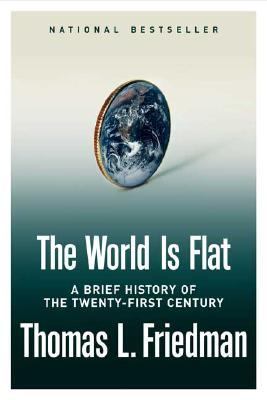
“The World is Flat”

“The World is Flat” by Thomas L. Friedman

Throughout my reading of “The World is Flat,” I wondered, would your average high school student want to read this? This is ironic, because where subject matter is concerned, this book should be required reading for every teen. It’s all about you and the world you will be living in, the world in which you will succeed (or fail) at making a living, at making peace and progress.

This isn’t a book about life before 1492. The author, a Pulitzer Prize winner, uses the word ‘flat’ to mean that the world is now a level playing field for opportunities—economic and educational. Whereas young Americans and western Europeans once had more opportunity than any other people in the world, modern technologies, especially communications technologies, have insured that bright young people from third world countries are now competitive. Friedman discusses ten ‘flatteners’ that caused this including outsourcing, the change in supply-chains and in the way we organize and receive information. The examples are both diverse and numerous. Manufacturing will be off-shored to China for years to come—the only thing altering this is when China becomes a technology leader and competes at another level. In the meantime, India is available for the outsourcing of jobs that had been ‘safe’ for many years—service jobs such as accounting, engineering, and computer programming. Even tutoring is outsourced quite effectively.

As I have children your age, reading this book made me want to run around like Chicken Little screaming, “The sky is falling!” Would all jobs—not just those for the uneducated—walk out the door? What would my kids do once I got them through college? Happily, the outlook is not all dim.

Friedman makes a good case for being educated—and even for a broad liberal arts education that includes high level math, science and language. The old “reading, writing, and ‘rithematic,” just to a higher power. To succeed, young American s will need to be both creative and adaptable. To keep their country safe they will, paradoxically, need to be open and embrace globalism. School Library Journal says that this is “an ideal title for tech-savvy teens.” I think it’s an ideal title for all teens—who will realize how tech-savvy they need to be.

Posted in Non-fiction | Tagged , , , | Leave a comment

“Same Kind of Different as Me”

“Same Kind of Different as Me” by Ron Hall and Denver Moore with Lynn Vincent

Ms. G here at COHS recommended this book to me because it was so moving that she couldn’t put it down. It’s quite a tale—and I think you, too, will be moved to tears.

Author Ron Hall is married to a woman who cares so deeply for others that her story is pure inspiration to the reader. Debra Hall’s willingness to not only feed and clothe but befriend the homeless shows us what true faith can do—it knocks the patronizing ego right off the shelf and helps us see the real person we are connecting with. Debra’s faith is the force that lets her recognize Denver Moore as a man for whom God has big plans.

Denver was a homeless African-American who came to the Union Gospel Mission for meals, but who kept himself apart from others and trusted no one–with good reason. Denver grew up in the American South not only under Jim Crow laws, but as a sharecropper—which translates as a sort of modern slavery. He lived in a place that time left behind, where he worked land he didn’t own and owed money to ‘the man’ for bare essentials. He never went to school; being illiterate, there seemed to be no escape for him from desperate poverty. (There’s a story of racism in the book that will chill your bones, but I don’t want to give away the whole book!)

Denver and other homeless people start referring to the Halls as “Mr. and Mrs. Tuesday” because they work at the homeless mission every Tuesday, unlike most folks who are just holiday volunteers. Soon Deborah is spending many days each week helping, organizing outings, and more. Denver’s faith is revived through Deborah’s actions.

When tragedy strikes the Halls, the tables turn and Denver’s friendship helps them keep their faith. As Denver says, using fishing as his metaphor, true friendship isn’t a catch-and-release program. It’s for keeps.

When your teacher asks you to read a biography or memoir, pick this one up and see how ordinary people overcome extraordinary obstacles.

Posted in Biography/Memoir, Faith-Based/Religious Element, Multicultural | Leave a comment

“On Writing” and “Extraordinary Short Story Writing”

 “On Writing” by Stephen King and “Extraordinary Short Story Writing” by Steven Otfinoski

Happily, here at Colony High there are several of you who are interested in creative writing. Here are two books I’ve read recently that I think are very helpful for the emerging creative writer.

“On Writing” by Stephen King

Stephen King has had more success than nearly any fiction writer who has ever lived—and that’s saying a lot. I wondered if his advice would be any good—I mean, after all, didn’t he just arrive at stardom and hang out there ever since? So I was happy to find that he has a lot of sound recommendations. Although every one of his books has been a bestseller, it took him a while—and many rejections of shorter work—before his career took off.

“On Writing” starts by telling of memorable incidences in King’s life. This helps us understand how he comes up with some of his ideas, but some are just based on dreams or his creative imagination. After discussing some useful rules of writing, King again discusses his life and the accident that nearly ended it. (An aside: although it isn’t the most important rule, I loved King’s diatribe about adverbs and how you should never, ever use them. I wondered about fans of “Twilight.” I just read it and though I can see why it’s popular, the author’s use of adverbs drove me crazy! The main character does everything ‘incredulously’—which detracts rather than adds to the description.)

The claim on the book jacket that “On Writing” is “friendly and inspiring” is true—so try it as you work toward your creative writing goals.

“Extraordinary Short Story Writing” by Steven Otfinoski

Here’s a fun book written especially for high school students. As I mentioned of Stephen King, most writers have short works published before they can get anyone to seriously look at their novels. Agents will often want to see publication credits, even if those credits are from very small magazines.

“Extraordinary” covers the story process (ideas, outlining, first drafts, and revision) and includes how-to mini-guides (humor, suspense and mystery, science fiction and fantasy, and historical). Try out some of the exercises. Work those creative writing muscles!

Posted in How-to, Non-fiction, Young Adult Literature | Tagged | 1 Comment