“What I Saw and How I Lied”

What I Saw and How I Lied by Judy Blundell

There are a lot of reasons to read this book—it’s got a mystery, a romance, a mother –daughter relationship, parental betrayal, shady business deals, secrets kept from World War II, the revelation of the anti-Semitism of the time, and a murder trial. The writing is good. It has enough of a historical setting (1947 East Coast/Palm Beach, Florida) that it would be a good choice for a project that begins with historical fiction, like the Chaffey High senior project for English.

The novel takes place in 1947. Fifteen-year-old Evie’s stepfather, Joe, has returned from the European front after WW II. He appears very loving toward both Evie and her drop-dead gorgeous mom.  Now happy, the family decides to take a vacation and drives down the coast to Palm Beach, Florida.  Since it’s off-season, few people are around, but they find an open resort and there meet the Graysons, with whom Joe appears to want to do business. Another man shows up at the resort—young and handsome Peter Coleridge, who had served in the army with Joe. Evie is immediately infatuated, but finds that there is a strange tension between Joe and Peter.

It takes Evie some time to understand what is happening around her since everyone is lying to her. No one is who s/he pretends to be, and Evie learns secrets of the Graysons, of both Joe and Peter, and the personally devastating secrets of her mother’s life. When someone turns up dead, what will Evie tell about what she knows?

Posted in Family Problems, Fiction, Hi-Low/Quick Read, Young Adult Literature | Leave a comment

“Mockingjay” by Suzanne Collins

Mockingjay by Suzanne Collins

If you’ve read the reviews of The Hunger Games and Catching Fire on this blog, you already know that I love this series. The first day Mockingjay was available in bookstores, I bought it. Now I’m reading it aloud with some family members—which is a little slower than I’d like, but it’s fun to share the experience.

If you, too, are a fan, you know that Katniss has survived the arena twice, but that she was saved from her second experience when rebels based in District 13 (long thought to be destroyed in a nuclear war and uninhabitable) pull her, wounded, into a hovercraft. Now she is expected to become the ‘mockingjay’ of all Panem—that is the living symbol of rebellion against the Capitol. Once she agrees, she becomes enemy one and Capitol target. Ironically, she’s also gotten on the bad side of Coin, the leader of District 13 and head of the rebellion by making demands to favor both Gale, who is fighting with her, and Peeta.

As Peeta was taken prisoner by Capitol forces and has publicly stated that the two sides should reconcile, he’s considered a traitor to the rebel cause. Katniss insists that Peeta and other Hunger Games contestants be given immunity if the rebels win the war. So Coin needs to assert her authority over Katniss in other ways. She publically announces that she holds Katniss responsible for rebel outcomes.

So Katniss has to worry about being a target for both sides. She’s got some new, incredible weapons, including a bow that recognizes her voice—and she’s off to fight for the rebel cause with both Peeta and Gale’s lives in the balance.

A must read!

Posted in Adventure Stories, Fiction, Over 375 pages, Sci-Fi/Futuristic, Young Adult Literature | Leave a comment

“They Poured Fire on Us from the Sky: The True Story of Three Lost Boys from Sudan”

They Poured Fire on Us from the Sky: The True Story of Three Lost Boys from Sudan by Benson Deng, Alephonsion Deng and Benjamin Ajak with Judy A. Bernstein

In the introduction, Judy Bernstein compares the situation that the three ‘lost boys’ of this title have been through as analogous to that of the novel Lord of the Flies. I liked this because you are reading this book for your English II Honors class and Lord of the Flies is required reading during the sophomore year. Once you have read both of these books, I think you’ll have great class discussions on the ideas of whether individuals need to be governed—whether they behave differently if they know that there is no policeman (or policewoman) on the corner, keeping them in line.

The three young men who tell their stories here are brothers and a cousin from ‘Dinka Land’ in the Sudan. They walked a 1,000 mile journey to the safety of a refugee camp in Kenya. (The map in the book is very helpful.)  One of the first things that the lost boys did when they came to the United States (to San Diego, CA) was buy journals and write their stories. They begin with ordinary life in their villages—coming-of-age rituals of being circumcised, daily meals, caring for animals, the relationships between husbands and wives. As rumors of war spread, the boys are instructed on how to hide when the government soldiers come through the village. Eventually, the villages are raided and the boys lose track of their parents and other family members. They are on their own, trying to make it to safety.

Their trips—both together and separately, in the company of soldiers or with groups of similar lost boys—are circuitous. As the reader, I wondered about the long-term effects of their having witnessed so much death—murder, kids stepping on land mines, bombs going off in other kids’ hands. I wonder how they survived starvation and death from lack of water on numerous occasions. I also thought that, at your age, you may not have heard of some of the more awful things the book addresses, such as female circumcision.

If you are very moved by this book, you may enjoy reading A Long Way Gone, which I’ve reviewed on this blog. The boy in that book did not escape the rebel soldiers (as the three in this book managed to do), so his story is a bit different. He is forced to become a soldier as a mere child and to brutally murder villagers. The veteran soldiers keep him and other boys drugged all the time, so that they don’t have a real awareness of what they are doing.

Both books give us an idea of what war is really like when it is happening in your own backyard.

Posted in Biography/Memoir, Controversial Issue/Debate, Human Rights Issues, Multicultural, Non-fiction | Leave a comment

“Fast Food Nation”

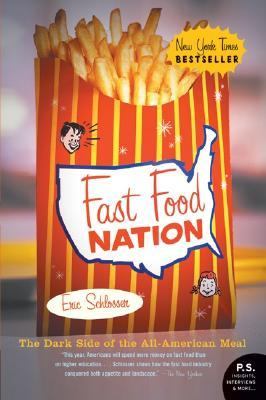
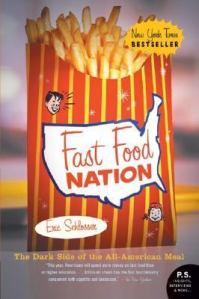
Fast Food Nation by Eric Schlosser

Though I’d read several books about food in the last few years, I missed this one. So when it came up as a choice for summer reading in the English II Honors class, I thought I’d try it as well.

Fast Food Nation follows a tradition of muckraking journalism—it takes a problem, reports on it in depth, and hopes that through education, people will come together and demand change. I recommend reading the paperback edition because there is a section about the blowback from the original book. It made some very powerful people very angry. Also—don’t let the length of the book scare you. The last 100 pages are just the notes and bibliography.

Fast Food Nation begins by making interesting connections between the American Dreams of Walt Disney and Ray Kroc, one of the founders (the man who started the franchise we know today) of McDonald’s and goes on to discuss those of Carl Karcher (founder of Carl’s Jr.). Schlosser shows the darker side of these men as well as the energy, hard work, and vision that each needed to make his dream come true. (If your understanding of Walt Disney is completely rosy, and you are interested, you can find documentation of the other side in any biography written in the last 15 years—his involvement in fast food in minor. So FFN doesn’t spend too much time on him.)

Well, unfortunately, some big dreams turn into nightmares, and fast food dreams came to cause many problems across the nation. As McDonald’s and Ronald McDonald became the most recognized brand and character across the country, Americans ate more and more fast food, becoming fatter and fatter—and thus unhealthy in many ways. Schlosser discusses some of the social forces that are involved as well—with both parents working outside the home, often no one feels like cooking.

The sections of the book on teenage employees and how easy it is to create an uneducated, low-wage, benefits-free work force are interesting, as is the successful efforts of McDonald’s to keep workers from unionizing, and fast food employers’ ability to get millions of dollars in federal funds (yeah, taxpayers’ money) to train their workers while mechanizing jobs so that no training is necessary. There’s also the outrage of vegetarians and Hindu people over beef stock in French fires (it makes them taste better) as well as how fast food production has eliminated that American icon, the cowboy on the range. But the part of the book that really had people upset—that caused attacks on Schlosser’s credibility—was the section on the meat-packing industry. This feels like a flashback to The Jungle by Upton Sinclair. (A comparison of the two books would make a great class project.)

The speed with which cattle are killed and processed has risen exponentially. A job that once required the skill of a butcher is done in assembly-line fashion. Large meat-packing corporations advertise for workers in Mexico, who come to the jobs (legally or illegally). They have no health insurance, and the injury rate is very high. Injured workers are ‘kicked to the curb’ and new ones replace them. Reading this section of the book makes you think that working in meat packing must be one of the worst jobs in the world. But the part that makes you sick is that, due to the speed and lack of training in butchering, when cattle are disemboweled, feces sprays on the meat which is later ground in and arrives in your fast food hamburgers. That’s one reason why E. coli started breaking out, leading to illness and death. In addition, sick cows are killed, dirty meat and blood from the floor is mixed in with the final product. While this section of the book is stomach-turning, it’s also riveting—you can’t stop reading.

And there’s a great lesson. Although people have tried through government to pass laws to change the industry (pretty unsuccessfully—meat packers donate a lot of money to conservative legislators, and one who was vital to these decisions at the time the book was written was married to a woman on the board of the largest meat packer in the world), what has worked much better is to stop eating at fast food places. When business declines, they make changes to bring it back.
Posted in Controversial Issue/Debate, Human Rights Issues, Non-fiction, Over 375 pages | Leave a comment

“Shakespeare Bats Cleanup”

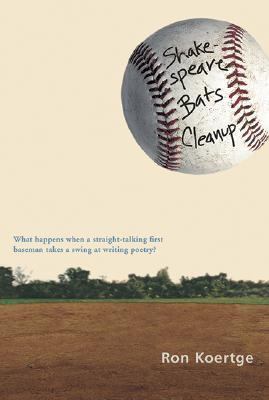
Shakespeare Bats Cleanup by Ron Koertge

Mrs. Martin recommended this to me and asked me about the last entry—some students who read the book saw some hidden meanings there. Well—hidden meaning? That was intriguing enough to get me to read. And now I want to recommend this book to you—it is so short, it’ll take you about an hour to read.  And yet it deals with so much.

Kevin is fourteen. He’s a great first baseman and baseball is his joy, but when he gets mono, he has to stay home in bed. His father gives him a journal to pass the time, and he decides to write a few poems to deal with the break-up with a girlfriend and more importantly, with his mother’s death. What’s fun is that he writes poems about these things—a sonnet, a ballad, a pastoral, a haiku (OK, that one is funny), blank verse (unrhymed iambic pentameter), couplets, a sestina—but you just smoothly read through these poems without knowing what he’s doing. What you do know is that through these forms, Kevin does a better job of expressing his emotions. Instead of saying, “I’m bummed that my mom died,” his images and language show you what his mother was like and why he misses her so much.

So, yeah—read it. As for the hidden meaning? I didn’t get it, but if you do, let me know!

Posted in Fiction, Hi-Low/Quick Read, Sports, Young Adult Literature | Leave a comment

“Into Thin Air”


Much has been written about Jon Krakauer’s Into Thin Air and I can’t say anything new, but that, like every reviewer, I thought it was a great book. I’m glad that it’s one of the options for your summer reading.

As you know (or will know when you finish the book), Krakauer climbed Mt. Everest in 1996—at the very time that one of the worst killing-storms hit the mountain. His party (as well as another linked to a famous guide) was one of the most affected in a storm that left five climbers dead and one–who appeared dead–very frostbitten, losing his hand and parts of his face.

Though it’s been awhile since I read the book, three things have stayed with me. The first is the deep irony of the circumstances—that Krakauer hoped to show how, with the right guide and enough money, these days just about anyone could climb the much commercialized Everest. Yet two of the five people who died in the storm of the day Krakauer descended the peak were guides Rob Hall and Scott Fischer, the world’s best. And so nature can’t be controlled, no matter what we believe. The second thing that has remained with me over the years is how an oxygen-deprived brain can cause people to make terrible decisions, ones that put their own and others’ lives at risk. And last, though I can’t say it was surprising, is the sadness of learning that climbers, who were very close to their long-time goal of climbing Everest, left others to die because helping them would have meant that they had to turn away from the peak and not ‘summit.’

So—what most affected you?

Posted in Adventure Stories, Biography/Memoir, Non-fiction | Leave a comment

“Telling”

Telling by Marilyn Reynolds

The novel begins with twelve-year-old Cassie meeting her new neighbors, the Sloans, and agreeing to baby-sit their children. Each time Cassie baby-sits, Fred Sloan makes a sexual advance toward her, progressively becoming more obvious and direct. In the beginning, Cassie doesn’t tell anyone, but instead tries to beg off the baby-sitting jobs. Unfortunately, Cassie’s mother often says ‘yes’ for her, thinking that Cassie should enjoy making the money.

When Cassie finally tells her older cousin, the two go to baby-sit together. Cassie only baby-sits alone when Fred is out for his bowling night and will be home later than Angie. One night this plan backfires and Fred catches Cassie alone. He forces kisses upon her and promises he won’t hurt her. She freezes in fear. Afterward, she won’t go out. Once the truth comes to light, not all adults believe Cassie –and Fred and his wife won’t admit what happens. The novel continues with the effects of the truth upon both families and the danger that Cassie is in while she is ‘telling.’

We just got two copies of this book for our ‘SSR’ library in the textbook room at COHS. I thought it was realistic and recommend it. Ask in the textbook room if you’d like to read it.

Posted in Controversial Issue/Debate, Fiction, Hi-Low/Quick Read, Young Adult Literature | Leave a comment

“Teacher Librarian”

Wordle: Teacher Librarina

Posted in Uncategorized | Leave a comment

“Superfreakonomics”

Superfreakonomics by Steven D. Levitt and Stephen J. Dubner

Maybe I shouldn’t do this so soon after commenting on Freakonomics, but I just loved this one, too. Superfreakonomics: Global Cooling, Patriotic Prostitutes and Why Suicide Bombers Should Buy Life Insurance, like its predecessor, has the reader looking at trade, data and economic transactions in a new way. Chapters include:

  • How is a Street Prostitute like a Department Store Santa?: In which we explore the cost of being a woman.
  • Why Should Suicide Bombers Buy Life Insurance: in which we discuss compelling aspects of birth and death, though primarily death.
  • Unbelievable Stories about Apathy and Altruism: in which people are revealed to be less good than previously thought, and also less bad. (This was my favorite chapter!)
  • The Fix is In—and It’s Cheap and Simple: in which big, seemingly intractable problems are solved in surprising ways.
  • What Do Al Gore and Mount Pinatubo Have in Common: in which we take a cool, hard look at global warming.
  • Monkeys are People Too.

When you have an assignment for outside reading in your econ class, this is another fun choice.

Posted in Non-fiction | Tagged | Leave a comment

“Graceling”

As a fantasy book for teens, especially for girls, Graceling by Kristin Cashore, is nearly perfect. The heroine, Katsa, has just the kind of power in life that girls often dream about. (The first time a man tries to grope her, she kills him effortlessly.) Though she is spirited, strong, good and able to make her own decisions, men still find her very attractive and one very beautiful man is more than willing to sacrifice himself for her—a reversal of the roles we commonly experience in real life.

In Katsa’s world there are people called Gracelings who have special powers. They can be identified by the fact that they have two different colored eyes (Kasta’s are blue and green). Sometimes it takes awhile before they find out what their special grace is. Often they are employed by the kings in their seven kingdoms. Katsa has the misfortune of being the niece of the ruthless King Randa. When he finds out that her grace gives her the ability to kill or hurt anyone without being harmed herself, he uses her as a sort of henchman. She does his bidding, but as she comes of age, she also comes into her own power. She creates a secret council which works against Randa’s evil influence and later she turns away him altogether.

Enter Po, a graceling prince with one eye silver and one eye gold. He, too, is an excellent fighter. The two work together to save a young princess. They have constant battles of wills, yet Po (sigh deeply here) understands all of Katsa’s moods and is willing to do just about anything to be her true love. Unlike many such fantasy stories, in Graceling, Katsa doesn’t want to be under the command of a man, and that means she refuses to marry, taking Po as a lover.

My real criticism of the book is that it could have been much shorter, as the writing is redundant. Characters will have conversations—You don’t love me—yes I do—followed by a summary of the conversation—she felt that he didn’t love her, but he said that he did. Not only does this happen again and again, but it happens again and again on the same topic—you don’t love me ‘round five’ and the fifth round summary. However, the up side of this is that it adds to the total number of pages in the book, so you can impress your teacher by reading 475 pages—and you can do it quickly without having to pay too much attention because if you miss one train, it’ll be coming around again very soon.

This is a super-popular book, one of YALSA’s top ten of 2009. COHS students who’ve read it love it, and I’m guessing you will, too.

Posted in Fable/Fairy Tale/Fantasy, Fiction, Over 375 pages, Romance, Young Adult Literature | 1 Comment