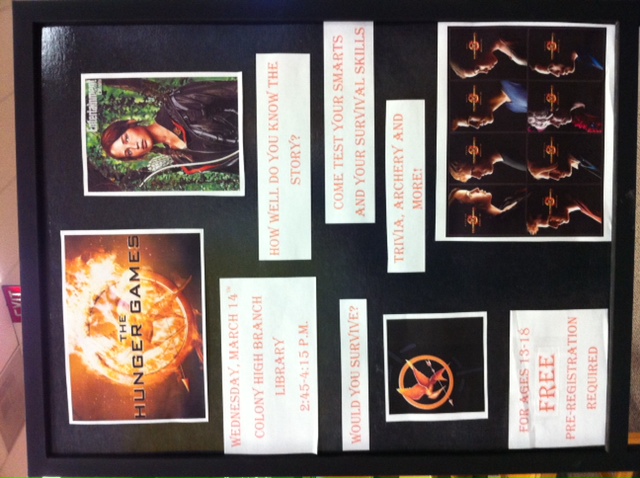
Hunger Games Event March 14! Get Ready!

I’m getting excited about our Hunger Games challenge!

We’ll have prizes for the physical challenge and prizes for your knowledge of any of the three books in the trilogy. (Hint: the questions are hard, so look back over the books.)

Don’t worry if you don’t win a challenge. There will be something for everyone, as well as a raffle for more nice prizes.

Come by the library reference desk to pre-register.

May the odds be ever in your favor!

Posted in Uncategorized | Tagged , | Leave a comment

What to read after The Hunger Games

You finished The Hunger Games trilogy and you want more. What to do? Luckily for you, lots of really good YA science fiction books have been published in the last several years. Some have a bit more of a fantasy element, most have romance, including a love triangle, and all have adventure. The titles that follow are  recommended by California teacher librarians. I’ve read several and have included links to my reviews. Happy reading!

This slideshow requires JavaScript.

Delirium by Lauren Oliver :Lena looks forward to receiving the government-mandated cure that prevents the delirium of love and leads to a safe, predictable, and happy life, until ninety-five days before her eighteenth birthday and her treatment, she falls in love.

Graceling and Fire by Kristin Cashore: In a world where some people are born with extreme and often-feared skills called Graces, Katsa struggles for redemption from her own horrifying Grace, the Grace of killing, and teams up with another young fighter to save their land from a corrupt king. (My review of Graceling is here. My review of Fire is here.)

Uglies trilogy by Scott Westerfield:Everybody gets to be supermodel gorgeous. What could be wrong with that? Tally is about to turn sixteen, and she can’t wait. Not for her license — for turning pretty. In Tally’s world, your sixteenth birthday brings an operation that turns you from a repellent ugly into a stunningly attractive pretty and catapults you into a high-tech paradise where your only job is to have a really great time. In just a few weeks Tally will be there. But Tally’s new friend Shay isn’t sure she wants to be pretty. She’d rather risk life on the outside. When Shay runs away, Tally learns about a whole new side of the pretty world — and it isn’t very pretty. The authorities offer Tally the worst choice she can imagine: find her friend and turn her in, or never turn pretty at all. The choice Tally makes changes her world forever. (My review is here.)

Divergent by Veronica Roth: In a future Chicago, sixteen-year-old Beatrice Prior must choose among five predetermined factions to define her identity for the rest of her life, a decision made more difficult when she discovers that she is an anomaly who does not fit into any one group, and that the society she lives in is not perfect after all. (My review is here.)

Legend by Marie Lu: In a dark future, when North America has split into two warring nations, fifteen-year-olds Day, a famous criminal, and prodigy June, the brilliant soldier hired to capture him, discover that they have a common enemy. (My review is here.)

Matched and Crossed by Ally Condie: All her life, Cassia has never had a choice. The Society dictates everything: when and how to play, where to work, where to live, what to eat and wear, when to die, and most importantly to Cassia as she turns 17, whom to marry. When she is Matched with her best friend Xander, things couldn’t be more perfect. But why did her neighbor Ky’s face show up on her match disk as well? (My review of Matched is here. My review of Crossed is here.)

Unwind by Neal Schusterman: In a future world where those between the ages of thirteen and eighteen can have their lives “unwound” and their body parts harvested for use by others, three teens go to extreme lengths to survive until they turn eighteen. (My review is here.)

Surviving Antarctica: Reality TV 2083 by Andrea White: In the year 2083, five fourteen-year-olds who were deprived by chance of the opportunity to continue their educations reenact Scott’s 1910-1913 expedition to the South Pole as contestants on a reality television show, secretly aided by a Department of Entertainment employee.

Cinder by Marissa Meyer: As plague ravages the overcrowded Earth, observed by a ruthless lunar people, Cinder, a gifted mechanic and cyborg, becomes involved with handsome Prince Kai and must uncover secrets about her past in order to protect the world in this futuristic take on the Cinderella story.

Ender’s Game by Orson Scott Card: Child hero Ender Wiggin must fight a desperate battle against a deadly alien race if mankind is to survive.

The Golden Compass by Phillip Pullman: Accompanied by her daemon, Lyra Belacqua sets out to prevent her best friend and other kidnapped children from becoming the subject of gruesome experiments in the Far North.

Posted in Adventure Stories, Fiction, Sci-Fi/Futuristic, Young Adult Literature | 2 Comments

“That Used to Be Us”

that used to be us

“This is a book of exceptional importance, written on a sweeping scale with remarkable clarity by two of our most gifted thinkers. . . . It should be read by policymakers and every American concerned about our country’s future.” Library Journal

When I first saw That Used to be Us, I didn’t want to pick it up because I have approximately 70 books (but who’s counting? 🙂 ) at home on my shelves, on my Kindle, or on my iPad that I haven’t gotten to. In addition, I’ve already read Friedman’s other two books on the subject—The World is Flat and Hot, Flat and Crowded. (Click here for review.) But I started finding the kind of recommendation quoted above. And then our principal recommended it so, I figured I’d go ahead.

That Used to be Us is a very worthwhile read. I want to try a bit of an unusual review of it here for two reasons. First, some teachers are looking for serious non-fiction for students and have mentioned The World is Flat. However, that book is seven years old, and already a bit dated. (No, the US intervention in the Middle East didn’t pan out the way Friedman predicted.) If teachers are going to recommend this type of non-fiction outside reading as students all enroll in ERWC courses, it would be better to start with the newest version.

Second, I know that all the teachers don’t have the time to read the book, but it would be nice to at least have an overview of it. So—this is a detailed review with links to other documents related to topics within That Used to be Us that might interest you.

First, if you happened to have read The World is Flat, and you want to cherry pick sections of this book that weren’t covered there, Read Sections II (The Educational Challenge) and III (The War on Math and Physics). If you read Hot, Flat and Crowded, you could skip Section III, as it is the ‘hot’ (global climate change) part; however, That Used to Be Us is up-to-date and more scary.

Four copies of That Used to Be Us are available at the Ontario City Library, so it can easily be picked up at COHS.

OK—here’s a look at Part I:

Part I: The Diagnosis:

While we are sleepwalking, China is using ideas we came up with to overtake our place as a world leader. We’ve gotten used to living in an entirely dysfunctional state while China gets things done. Many anecdotal examples of this are given, including incidents from one of the author’s visit to China. The authors quote plenty of folks to drive home the frustration. (“We are nearly complete in our evolution from Lewis and Clark into Elmer Fudd and Yosemite Sam.”) A big part of the problem is that Americans don’t understand how urgent the situation is (and other sections of the book detail proofs that it is urgent), so that urgency must be created before it’s too late. Americans used the next generation’s money to fight terrorism while “indulging ourselves with tax cuts and cheap credit.”

The solution is not to become more like China, but to “become more like ourselves.” By this, the authors mean that unlike China, which lacks freedom, has widespread corruption, horrible pollution and an educational system that inhibits creativity, we need to make our democratic system work with “focus, moral authority, seriousness, collective action, and stick-to-itiveness.”

A second problem, ironically, is that the U.S. no longer has the Soviet Union as a Cold War enemy. The death of communism in many countries has enabled a much greater percentage of the world’s population to reach for the American dream—and so, all these people are new competitors in a global market. We all compete with them for jobs. Our children need to be educated to compete with them for jobs.

There are four core challenges to America in the post-Cold War era: adapt to globalization, adjust to the technology revolution, cope with soaring budget deficits (growing demands on government), and manage rising energy consumption and climate threats. If we can’t do this, it will not only affect Americans but could be disastrous for the whole world as there is no country capable of stepping in as the world’s leader. This is the crux of the book. If the authors can make you understand this, you will pay attention to their solutions.

The solution depends on five pillars that are a partnership between the public and private sectors and will promote economic growth: provide public education for more Americans; build and modernize infrastructure; keep doors open to immigration; provide government support for basic research and development; and regulate private economic activity.

The authors detail successful public-private partnerships over the history of the United States. Examples are given from both ends of the political spectrum. They assert that the two camps no longer pay attention to our history, and this may be the death of our future. “Liberals blame all of America’s problems on Wall Street and big business while advocating a more equal distribution of an ever shrinking economic pie. Conservatives assert that the key to our economic future is simple: close our eyes, click our heels three times, and say ‘tax cuts,’ and the pie will miraculously grow.” Yes, there’s something here to offend everyone—which is good, because it challenges the status quo, as it hopes to.

Next up: Part II—the section on education—the largest and, according to the authors, the most important section of the book.
Posted in Controversial Issue/Debate, Environmental Issues, Non-fiction | Tagged , , , | 1 Comment

“A Northern Light”

A Northern Light by Jennifer Donnelly

The Gillette murder case: In 1906, Grace Brown was a worker in the Gillette Skirt Factory (New York State) and was murdered because Chester Gillette, nephew of the owner, didn’t want to marry her after impregnating her. Chester wasn’t wealthy himself, but he wanted to marry a rich girl and have a better life. So, on the pretext of taking Grace away from home to elope, he took her to the Adirondack Mountains (also New York), checked into a hotel under an assumed name, and, took her out on a lake in a canoe. After hitting her in the head with a tennis racket, he tossed her over the side and she drowned. This might have appeared to be an accident, but Grace’s desperate letters to Chester were later found and helped to convict him, although he claimed that Brown had committed suicide. He was executed by electric chair. The murder was one of the most sensational events of the period, with a lot of media coverage, and a very famous novel was written about it about 20 years later (An American Tragedy by Theodore Dresier).

Though no one is out to murder Mattie Gokey, Mattie’s story interweaves with Grace Brown’s. As the novel opens, she is working in the Glenmore Hotel where Grace and Chester (‘Carl”) had stayed. Before Grace goes out on the lake with Chester, she hands Mattie all her letters and asks Mattie to burn them. (This is a fictional aspect of the story.) Mattie can’t sneak to a fire without someone seeing her, so she is stuck with the letters, which she begins to read.

Mattie is also a girl with few options. A top student at her school and a good writer, she earns a scholarship at Barnard College in New York, but there seems to be no way to go. A year earlier, her mother died of breast cancer, and then her only brother ran away from home after a fight with their father. As the oldest girl, Mattie has to take care of the other children and help on the farm. Family farm life is terribly difficult. The work never ends, there are no holidays and no vacations. And without their mother at home, their father can’t go away for extra work and extra money. The Gokeys live on the precipice of poverty, and anything—a serious illness, a bad crop, the death of their cows—could ruin them. The family is grieving, hungry and angry.

Mattie is smitten with Royal Loomis, her neighbor. At least physically. But the reader can see that although Mattie has the hots for Royal, these two would make a terrible match. Royal will make a good farmer, but he can’t understand why Mattie bothers to read, which he regards as a waste of time. Mattie senses the disconnect, too, but can’t see her way out.

I hope students don’t pass up this book because of the era. It’s a great story about the place of women at the turn of the twentieth century and a clever defense of feminism. The scenes when Mattie learns about some of the realities of life are more honest that any YA books I’ve read about the same topics.

Mattie’s best friend, , a married teenager, has twins within a year of her wedding. She almost dies in childbirth because one of the babies is positioned feet first. Though no one ever discussed sex with the girls, afterward,  confines in Mattie that having to care for the babies as well as feed farmhands is wearing the life out her. Her house is filthy. She wishes she’d never married, and she is sick of her husband always ‘at her’ about sex because she is afraid she will get pregnant again. She nurses the twins because she’s told it will keep her from getting pregnant, but her breasts are raw, sore and cracked. She’s gaunt, depressed and exhausted. Mattie is shocked since these realities had always been hidden from her. It’s not the life she wants for herself.

One of the biggest influences in Mattie’s life is her teacher. She appears to be a very independent single woman. Yet she has a secret, and her husband is tracking her down and threatening to put in a mental hospital if she doesn’t behave within her prescribed gender role. Ands legally, he can do this, just because his wife published poetry.

Donnelly also does a good job in giving the reader a sense of class and race issues. Weaver, Mattie’s best friend, is the first free-born child in his family. He, too, is very smart, and the friends often play word games. He plans on going to college and becoming a lawyer. His chances look good, as his mother is always adding to his college fund. But his refusal to put up with names, with the ‘n word,’ keeps the reader in constant tension, knowing that drunken loggers will seek revenge on him. In fact, all of the secondary characters are interesting, three-dimensional folks. As a bonus, the writing is beautiful. The reader sees, hears, smells and tastes life in the country, and identifies with Mattie’s desire for creativity and the education that will give her the opportunity for it.

I highly recommend this one!

Posted in Family Problems, Fiction, Historical Fiction/Historical Element, Human Rights Issues, Young Adult Literature | Tagged , , , , , , , | Leave a comment

Adult books for teens: “The Night Circus”

   The Night Circus by Erin Morgenstern

When the child Celia Bowen is delivered to her father, the famous magician Prospero (Hector Bowen), a challenge is taken up. Prospero believes that magical talent is inborn. Celia is an example with her uncanny ability to alter the environment around her, even to heal the wounds in her fingers, which her father slices as a way of having her practice. Prospero’s rival, Alexander H. (the man in the gray suit) believes that anyone can learn incredible magic. The two have been fighting over magic for years. When Alexander picks Marco Alisdair, an orphan, as his student, the game is on. Which of the two will grow up to be the better magician?

The playing field for the challenge is the black and white Night Circus—Le Cirque des Rêves. Celia and Marco control it, Celia as an illusionist inside the circus, Marco from London, as the assistant to the proprietor. Each adds mysterious tents full of wonders—paper animals suspending in midair that move and breathe, indoor ice sculptures with no means of refrigeration, a wishing tree with lighted candles that never go out. And, of course, there is the blindingly white bonfire. Lit at midnight on the first night of the circus, at the same time that the lion tamer’s twins were born, its supernatural powers hold the circus together.

In fact, the magic of the circus is awe-inspiring, and, although the circus always comes and goes unannounced, fans follow it, even to Europe. Everyone in the circus is caught in the magic; no one, except the twins, ages.

This would be the perfect dream if there weren’t a sinister element to the contest, one that neither Celia nor Marco knew of as they were brought up, unknown to one another, to compete. This is a game to the death. When Marco and Celia do meet, they fall in love. The flights of fancy they create at the circus are for one another. But how do they get out of the challenge alive?

The Night Circus moves back and forth in time between 1873 and 1903. I think this might be confusing to some teen readers, but my recommendation is just to lose yourself in the magic and not worry about the year. It will all come together nicely at the end. Meanwhile, the descriptions of the circus—the sights, the sounds, the smells of caramel and chocolate—is a feast for the senses.

Fans of paranormal books, of romance, adventure, and magic will love this book. Although it’s a much different story than Harry Potter, I think Potter fans will thrill to this one. A lovely adult book for teen readers looking for a textured read.

Posted in Adventure Stories, Fable/Fairy Tale/Fantasy, Fiction, Over 375 pages, Supernatural | Tagged , , , | Leave a comment

More new titles from Orca Soundings

This slideshow requires JavaScript.

The Orca Soundings series books are really just books that are not connected to one another, but are all published by a company whose mission is to provide interesting books to teens who are improving their reading skills. I’ve enjoyed those that I’ve read,and they are pretty popular in our library, so we’ve got some new titles for you. Check these out from the 372.41 special collection:

Last Ride by Laura Langston

Tom Shields killed his best friend, Logan, in a street-racing accident a year ago. While he tries to make amends to Logan’s girlfriend and keep his promise to never race again, he’s haunted by his dead friend.

Fallout by Nikki Tate

After the death of her sister, Tara struggles to deal with her guilt through slam poetry.

Shattered by Sarah N. Harvey

After March shoves her boyfriend and he ends up in a coma, she tries to figure out what it means to have a perfect life.

Posted in Family Problems, Fiction, Hi-Low/Quick Read, Read 180, Supernatural, Young Adult Literature | Tagged , , , , , | Leave a comment

“Ready Player One”

Ready Player One by Ernest Cline  

It’s 2044 and the world is such a rotten place for most people that they spend as much time as possible on the OASIS, a virtual universe where you can not only play video games, but go to school, and do most other things that you’d normally do in real life. It’s a sort of Second Life on steroids, populated with endless planets containing any landscape or idea a person could imagine. In fact, life on the OASIS is valued more than real life when real life stinks.

I think the publisher’s blurb gives you a good summary, so I’ll quote it below. (I don’t usually quote what publishers say because they mostly oversell the book—which isn’t a problem because that’s their job. I just don’t often agree with blurbs.)


I came to read this novel because it was recommended in professional reviews as a great adult book title for teens. (Longer, adult books with teen appeal are something I’m currently looking for.) I was surprised at how much I enjoyed Ready Player One since I’m not a gamer. So—you don’t have to be a gamer either to get into the adventures, the perils and the fantasies of Parzical. Art3mis, and Aech (‘H’). But I do want to add that if you have any love of the 1980’s—arcade games, videos games, movies—you will have a blast with all the fantastic detail of 80’s entertainment that are recreated on the OASIS as the gamers compete for a multi-billion dollar inheritance. This is the most fun I’ve had reading a book in a while.

OK—here’s the publisher’s blurb. Right now Ready Player One is only available at the city library, so I encourage you to use your Ontario City Library card and check it out!

“At once wildly original and stuffed with irresistible nostalgia, READY PLAYER ONE is a spectacularly genre-busting, ambitious, and charming debut—part quest novel, part love story, and part virtual space opera set in a universe where spell-slinging mages battle giant Japanese robots, entire planets are inspired by Blade Runner, and flying DeLoreans achieve light speed.

“It’s the year 2044, and the real world is an ugly place.

“Like most of humanity, Wade Watts escapes his grim surroundings by spending his waking hours jacked into the OASIS, a sprawling virtual utopia that lets you be anything you want to be, a place where you can live and play and fall in love on any of ten thousand planets.

“And like most of humanity, Wade dreams of being the one to discover the ultimate lottery ticket that lies concealed within this virtual world. For somewhere inside this giant networked playground, OASIS creator James Halliday has hidden a series of fiendish puzzles that will yield massive fortune—and remarkable power—to whoever can unlock them..

“For years, millions have struggled fruitlessly to attain this prize, knowing only that Halliday’s riddles are based in the pop culture he loved—that of the late twentieth century. And for years, millions have found in this quest another means of escape, retreating into happy, obsessive study of Halliday’s icons. Like many of his contemporaries, Wade is as comfortable debating the finer points of John Hughes’s oeuvre, playing Pac-Man, or reciting Devo lyrics as he is scrounging power to run his OASIS rig.

“And then Wade stumbles upon the first puzzle.

“Suddenly the whole world is watching, and thousands of competitors join the hunt—among them certain powerful players who are willing to commit very real murder to beat Wade to this prize. Now the only way for Wade to survive and preserve everything he knows is to win. But to do so, he may have to leave behind his oh-so-perfect virtual existence and face up to life—and love—in the real world he’s always been so desperate to escape.

“A world at stake.
A quest for the ultimate prize.
Are you ready?”

Posted in Adventure Stories, Fable/Fairy Tale/Fantasy, Family Problems, Fiction, Historical Fiction/Historical Element, Human Rights Issues, Over 375 pages, Sci-Fi/Futuristic | Tagged , , | 3 Comments

New titles from Orca Soundings

The Orca Soundings series books are really just books that are not connected to one another, but are all published by a company whose mission is to provide interesting books to teens who are improving their reading skills. I’ve enjoyed those that I’ve read, and they are pretty popular in our library, so we’ve got some new titles for you. Check these out from the 372.41 special collection:

This slideshow requires JavaScript.

B Negative by Vicki Grant

Paddy loves his family, all except for his annoying stepfather Anthony. When they have a discussion about his future, Paddy overreacts and threatens to join the army. Unable to back down, he finds he is alienating everyone around him. And when he takes the physical exam and learns his blood type, his world starts to crumble and he starts to question everything he thought he knew.

Breaking Point by Janice Greene

Alana, a new student at Oceanside High, decides it is time to take action when the sexual harassment of a group of boys nearly pushes a friend to commit suicide.

The Burning Time by Carol Matas

After her father’s sudden death, fourteen-year-old Rose Rives finds sixteenth-century France to be a dangerous place for women when her mother, a midwife and a healer, is arrested and accused of being a witch along with many other women in their village.

Posted in Family Problems, Fiction, Hi-Low/Quick Read, Historical Fiction/Historical Element, Read 180, Young Adult Literature | Tagged , , , , , , | Leave a comment

More in the Orca Soundings series 5

High interest books for a quick read; good for Read 180 students and English Learners

This slideshow requires JavaScript.

Breathless by Pam Withers

Beverly is in Hawaii, helping her uncle at his dive shop, learning how to dive and trying to lose weight and get a boyfriend. When Garth, an accomplished diver, shows an interest in her, Beverly is ecstatic, until it turns out Garth is only interested in one thing. Struggling with failing strength from her self-imposed starvation diet, Beverly finds herself in deep trouble when she has to fight Garth off underwater.

Bull Rider by Marilyn Halvorson

Layne is determined to be a bull rider like his father — who was killed by a bull.

Sticks and Stones by Beth Goobie (in YA fiction)

After developing an unearned reputation as a slut, Jujube finds a novel way to take on her tormentors and help a group of girls win back their self-esteem.

Posted in Fiction, Hi-Low/Quick Read, Read 180, Romance, Young Adult Literature | Tagged , , , , , , , | Leave a comment

More in the Orca Soundings series 4

High interest books for a quick read; good for Read 180 students and English Learners

This slideshow requires JavaScript.

Big Guy by Robin Stevenson

Derek thinks he might be falling in love for the first time ever. The problem is, he hasn’t been entirely honest with his online boyfriend.

Battle of the Bands by K. L. Denman

The smell in the garage is lousy. Old bulbs coated with years of dust and cobwebs don’t cast the best light either. But when I pick up my guitar and my fingers find the strings, and that first riff comes screaming out of the amp, the only thing that matters is sound.

Crush by Carrie Mac

Are Hope’s feelings for Nat, who is a lesbian, just a crush or something more serious?

Posted in Controversial Issue/Debate, Fiction, Hi-Low/Quick Read, Mature Readers, Read 180, Romance, Young Adult Literature | Tagged , , , , | Leave a comment