Journey to Merveilleux City by Stephanie Barbé Hammer

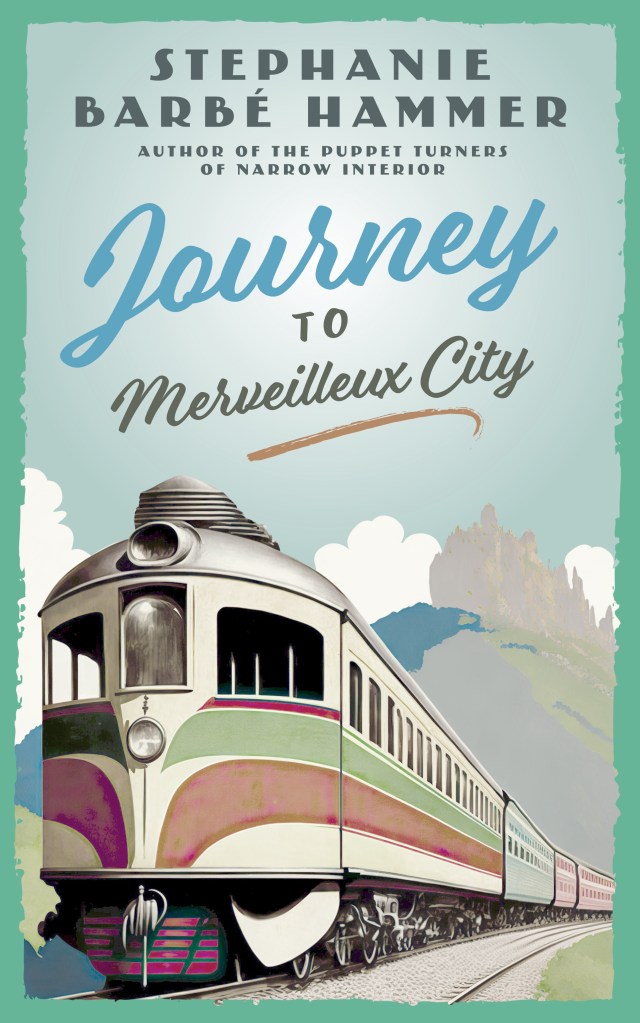
Book cover includes an art-deco era train coming down the tracks with mountains and clouds in the background.
Journey to Merveilleux City by Stephanie Barbé Hammer

Mackinnon (Mack) Macdonald Flores, a Scottish Salvadoran bagpipe band member, is on his way through the American Northwest to Merveilleux City in Quebec, Canada for a pipe band convention.

Mack, who hails from the eastern end of Los Angeles County, is having a hard time figuring out his life. Recently, he left his graduate film studies program after his ex-girlfriend made his cohort despise him. He is working on his teaching credential. He now uses the “San Dimas Serene AwarenessTM” program to calm himself and remain positive about any setbacks along the way. While his inner, better self often criticizes him, his interiority is a lot of fun for the reader. Mack sees the world around him in terms of movie plots, settings and characters. Quickly the reader realizes that the novella’s fictional world pays homage to classic films while spinning the characters into diverse, contemporary, and possibly magical beings.

“They are masters of evasion, you know. Octopuses. Marvelously flexible. They can stretch and contract. They can escape any container.”

Mack plans to take an old-fashioned train with other bagpipe players. It has all the luxury of a movie train—first class compartments, an elegant dining car, an observation car and even a balcony off the caboose. Unsure of his destination, Mack tries to flirt with the ticket seller. As he takes too long and backs up the ticket line, a petite goth girl wearing all black and Doc Martens berates him. He finds her privileged—and, in addition, she badly sings a Frank Sinatra tune. Yet in her conversation with her friends, who call her “Quirk” and are in the station to see her off, she mentions an oddity. Her octopus tattoo has been absorbed into her body. I’ve read a few other of Barbé Hammer’s books and was delighted by this detail as it hinted that magic is afoot. (Here’s a review of Barbé Hammer’s chapbook Rescue Plan, which is great for teens.)

“I seriously think it would make him feel better if he could get in touch with those feelings by projecting them onto an iconic and very masculine fictional persona.  Continue talking, says Inner Mack. Connect meaningfully with a potentially disruptive student.”

When Quirk—whose real name is Allison—turns her ankle getting on the train, Mack puts his lousy first impression behind him and tries to help her. This doesn’t go as well as it could (“How can someone so miniscule be so hard to lift?”). However, Allison tells him that a passenger she met in the station and boarded the train with is missing but must be on the train somewhere. Mack agrees to help find the elderly man. 

As the two work on the mystery of the missing passenger, the reader meets several oddball characters, whose jobs and dreams are often a send up of American desire. The pretenders and wacky American institutions leave the reader gleeful at times. 

“‘Movies about trains make me feel safe,’ [Mack’s father] said. ‘Every train movie  is an emotional journey.  The journey always completes and a better world is discovered at the end.’”

A woman who acts as the face double for the president’s daughter has written a memoir: Almost Tiffany: How I Gave My Face for the First Family, Volume 1. Two WWE wrestlers show a Chinese vlogger how they work together to create their act. The Chinese vlogger, May-Bel, is filming segments so her mainly Chinese audience can get an idea of American life. “‘We have not seen any guns,’” she, in surprise, tells her audience. Jimmy Shoulders, a Christian cowboy entertainer, has a phony Southern accent and an odd family. His advertising material gives details of his show:

Watch Jimmy Shoulders lasso a sinner right from the audience! Crack whips and make money changers disappear! Perform the famous Will Rogers rope tricks and sing his hit single “Jesus Is My Kind of Cowboy”!

Joe is a former congressman who is running for reelection and glad handing on the train. He’s also a Princeton grad, a former soap opera star and an Afghanistan veteran. He agrees to help Mack and Allison find the missing passenger. 

A bit of dark reality enters in the relationship between a college professor and his thirty-something student, Diamond. While it’s a hilarious send up of the self-satisfied, paternalistic college professor/minor writer, it’s also a glimpse of the difficulty a talented Black female poet has in trying to land herself in the professor’s world. From the professor:

“This architecture that we  inhabit—a gallery if you will, a library, a refuge or sometimes it’s only  a pop up caravan—that architecture I keep on telling you Diamond, is FRAGILE. It can only take so much before the wheels come off the little airstream and the toilet stops working and you have to come to a halt on the freeway or wherever it is you’re driving, and you have to flag down the cops and no one wants that. I know I’m being obscure. It’s just that I keep on telling you we are very lucky and yes, you are lucky to be in this position and we have to be careful, and sometimes this little spot in the panopticon (that’s a Foucault reference [yes, I know  you know; I’m just reminding you]) is going to feel a bit cramped and over-surveilled, but we get to make art and have people look at it or at least pretend to look at it, and I don’t know what else you can ask for. Yes, I know I have white male privilege. Diamond, I KNOW all that.  You aren’t telling me anything new here.”

“On the train one talks about sex and spying and money. And death too- of course.”

Who-done-its set in trains are classic fun. This one with updated themes of class, racial discrimination and modern views of spirituality is refreshing. The movies-set-on-trains motif throughout is lots of fun. Movies with trains mentioned include:

  • North  by Northwest
    • Silver Streak
  • Strangers on a  Train
  • Murder on the Orient Express
  • The Lady Vanishes
  • Mystery Train

High School Housekeeping

Though this is a book for an adult audience, Journey to Merveilleux City is a novella, so it’s short, fast-paced and fun. Both its societal references and nods to numerous movies (many more than the train movies mentioned above) are appealing to teen activists as well as film fans. There’s a bit of magic there as well. While there is a couple on the train—a professor and his adult (thirty-something) student—who are having an illicit affair, there are no descriptions of sex. The affair serves to show the power dynamics in an unequal relationship, something I believe is useful for teen readers.
Posted in Fiction, Horror/Mystery/Suspense, Movie Tie-In | Tagged , , , , , , | 1 Comment

My Experiences in Book Banning

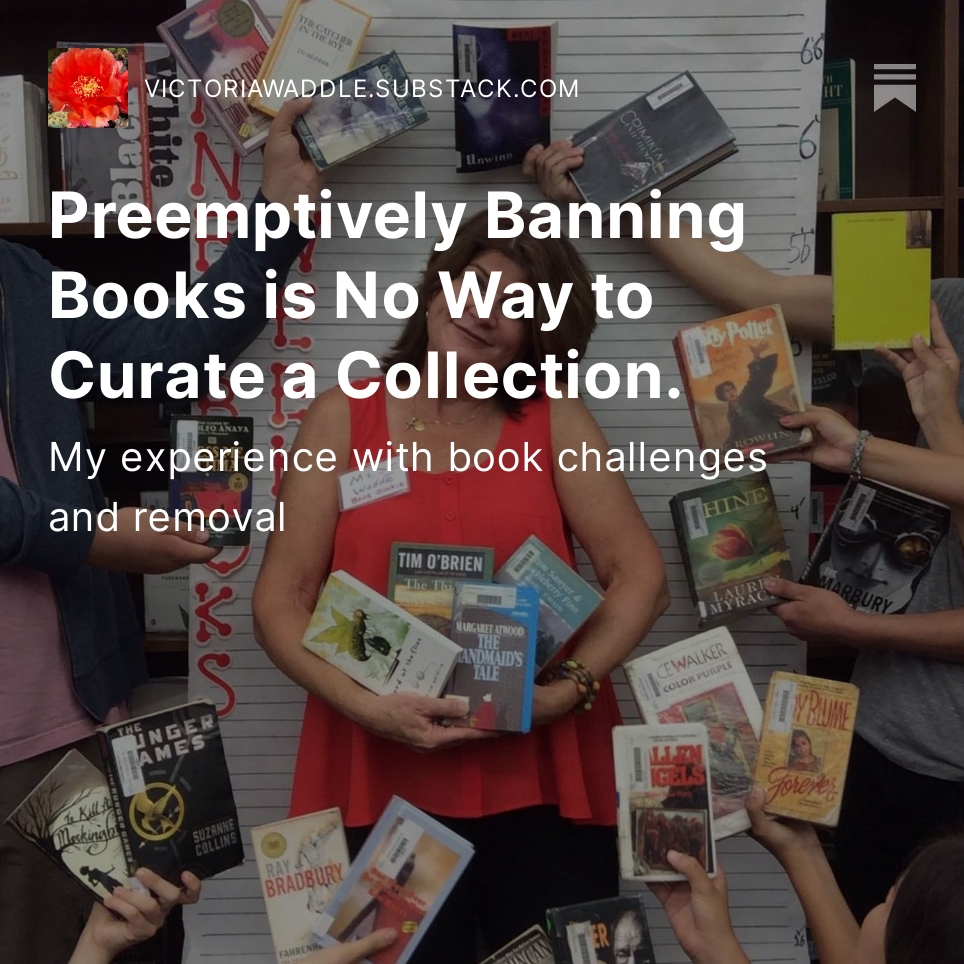
Victoria surrounded by many of the banned and challenged books she has read including: The Handmaid’s’s Tale; The Things They Carried; The Hunger Games; Forever; Beloved and more.
That’s me, surrounded by some of the banned and challenged books that I’ve read. My library book club was meeting after school during Banned Books Week. We were taking photos of the students in front of a height chart to represent being booked for a crime. Each of them had a banned book or two that they’d read. Then they suggested I have a turn, so we gathered some of my favorite books.

Removing library books from the shelf for later review is essentially banning them, no matter what the censors say. My experience with book challenges and removal are here on my Substack “Be a Cactus.”. 

I’ve moved to Substack for most of my posting, and I hope you will join me there. It’s a friendly place for writers and readers. I discuss libraries, books, and the craft of writing. There’s some great work going on there! 

Posted in "Banned Book", Human Rights Issues, Young Adult Literature | Tagged , , , , , | 1 Comment

Meet the Moon

The cover of Meet the Moon, which shows the shadow of a girl reaching up toward the mon in a star-filled sky.

Meet the Moon by Kerry L. Malawista

Jody (AKA Stringbean) is navigating adolescence in the early 1970s. She contemplates the moon and the stars with her mom. They worry together over the fate of the astronauts of Apollo 13 and whether those men will burn up on re-entry to Earth. One of five children, Jody has the typical issues of a thirteen- to fourteen-year-old girl of the era, the sort that easily resolves when teens grow up: Does her crush like her back? Will her breasts develop like her older sister’s have (and why are small bras called training bras anyway)? What will she wear to the dance? 

Death Changes Everything

Jody also experiences tragedy that no teen should have to face: her mom dies in a car accident. So while she’s negotiating the usual troubles, she is also facing larger life issues. Why can’t her mom be saved here on earth when scientists can save the Apollo 13 astronauts in space? Can her mom see or hear her or even be felt as a ghost? Was Jody’s behavior—she told her mom that she wished she would die—responsible for her mom’s accident? How is the family to get through each day?

With the death of their mother, things radically change for the Moran children. Their dad is still working hard on his tile business and the older kids—Claire and Jody—take on some of the responsibility for the younger ones. Meanwhile, the three younger children have a hard time understanding that their mother is never going to return. The added responsibility of mothering is too much for Jody. She campaigns to have her beloved Grandma Cupcakes live with the family, but after grandma arrives, it becomes clear that caring for five kids is too much for her at her age and conflicts abound. 

Jody starts to think that a new wife for her dad will help to resolve the family’s problems. But does that mean she is forgetting her mother or doesn’t love her enough?

I found Meet the Moon because I’m still looking for books from small publishers. Fitzroy Books is the YA imprint of Regal House Publishing. (I reviewed and recommended another Regal House title, Girlz in the Hood.) I saw the blurb for Meet the Moon from Alice McDermott. And while I know that blurbs are sometimes favors to authors or publishers, I loved McDermott’s National Book Award-winning Charming Billy, so I thought I’d give Meet the Moon a try. 

Meet the Moon has an emotional depth that I appreciate in a YA novel. Each of the characters—all five children and their father—are well drawn individuals. Each has his or her own grief over the death of their mom/wife and uses their own coping mechanisms to deal with it. Jody is observant and a keen judge of character. 

High School Housekeeping

This would be a good addition to a library collection, a title to recommend to students who have lost a family member and to thoughtful students who contemplate big life issues. 

Posted in Family Problems, Fiction, Grief, Young Adult Literature | Tagged , , , , , , , | Leave a comment

Two Seasonal Books

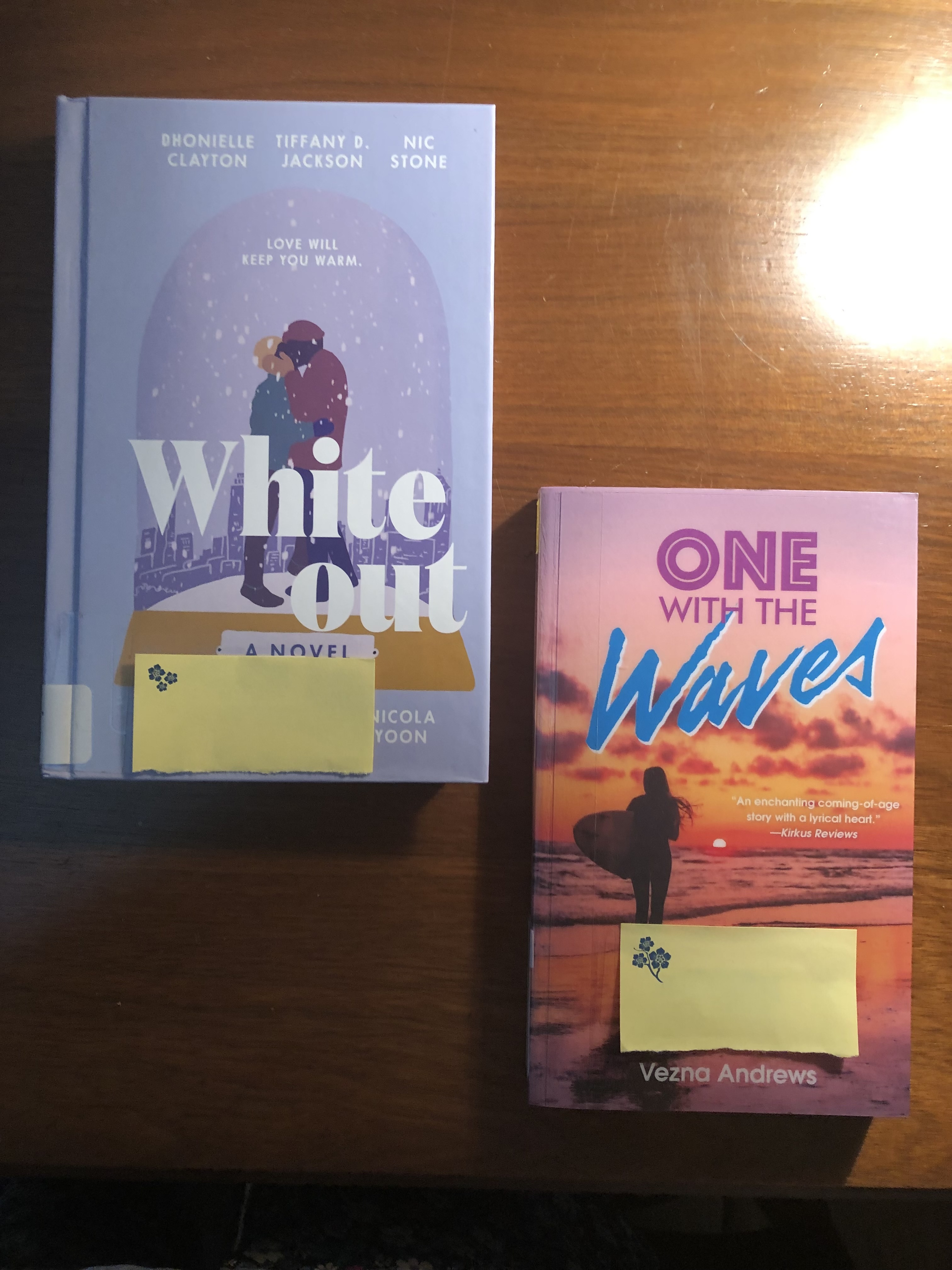
Two books: “One with the Waves” and “Whiteout.” The cover of “Whiteout shows a couple kissing in the snow inside what appears to be a snow globe. “One with the Waves” shows a girl holding a surfboard and walking along the beach as teh sun sets.

I’m still on the lookout for small press books. I grabbed these two on my last trip to the public library.

On the shelf, Whiteout looked like a small press cover to me because it it had that rebind look—a high quality rebind like you might find from Permabound. When I got the book home, I saw it wasn’t that at all. It was a large print edition from Gale/Cengage of a book originally published by Quill Tree Books.

Whiteout is a romance on overdrive with multiple couples finding their way through their relationship issues while all working to repair—under a very tight deadline—the relationship of a couple with whom they are friends. It’s probably a book solely for avid romance fans, but if the reader is a romance fan, they will love it!

The novel takes place in Atlanta as Christmas approaches. A snowstorm takes the city by surprise just as the characters spring into action to help create an epic apology and declaration of love between the two central characters, Stevie and Sola. Everyone is dealing with missed texts, missed calls, traffic jams, and unhappy parents.

The book is dedicated to Black teens and is about Black teen love. It’s written by six very successful YA authors—Dhonielle Clayton, Tiffany D. Jackson, Nic Stone, Angie Thomas, Ashley Woodfolk, and Nicola Yoon. What I loved about that is that the storyline worked. That is the novel wasn’t a jumble of writing styles and artificial twists where consecutive authors try to reroute the story.

My only other experience in reading a book by many authors was The Whole Family, a 19th-century project of William Dean Howells. Howells had a good idea, but the novel is a hot mess because each author tried to change the story and negate what the last one wrote. Howells and Henry James were the most famous authors of the bunch. And reading it was an interesting look into author egos. (If you’re interested, there’s a Wikipedia article about it and it is available on Project Gutenberg.) But, as a cohesive work, it was a failure. And this is what makes me appreciate the authors of Whiteout.

The second novel I picked up, One with the Waves, is a small press work. The publisher is Santa Monica Press, which I assumed was in Santa Monica, CA, but it’s in Solano Beach. It’s a coming of age story about a girl who is dealing with grief over the sudden death of her father. Ellie lives in the New York garment district, but after her dad dies, her mother sends her to California to live with her aunt and uncle, who are avid surfers. Surfing becomes integral to Ellie’s healing.

One with the Waves takes place in the 1980s and has a lot of interiority. The reader can learn a lot about surfing. I was excited about finding Santa Monica Press. However, thought they have ventured into publishing YA books, they only produce YA novels that are historical. And, of course, the 1980s are history to high school students.

Whiteout would be a good book to display or book talk before the winter holidays. One with the Waves would work before spring break.

Posted in Family Problems, Fiction, Romance, Sports, Young Adult Literature | Tagged , , , , , , , , , , | Leave a comment

Pest by Elizabeth Foscue

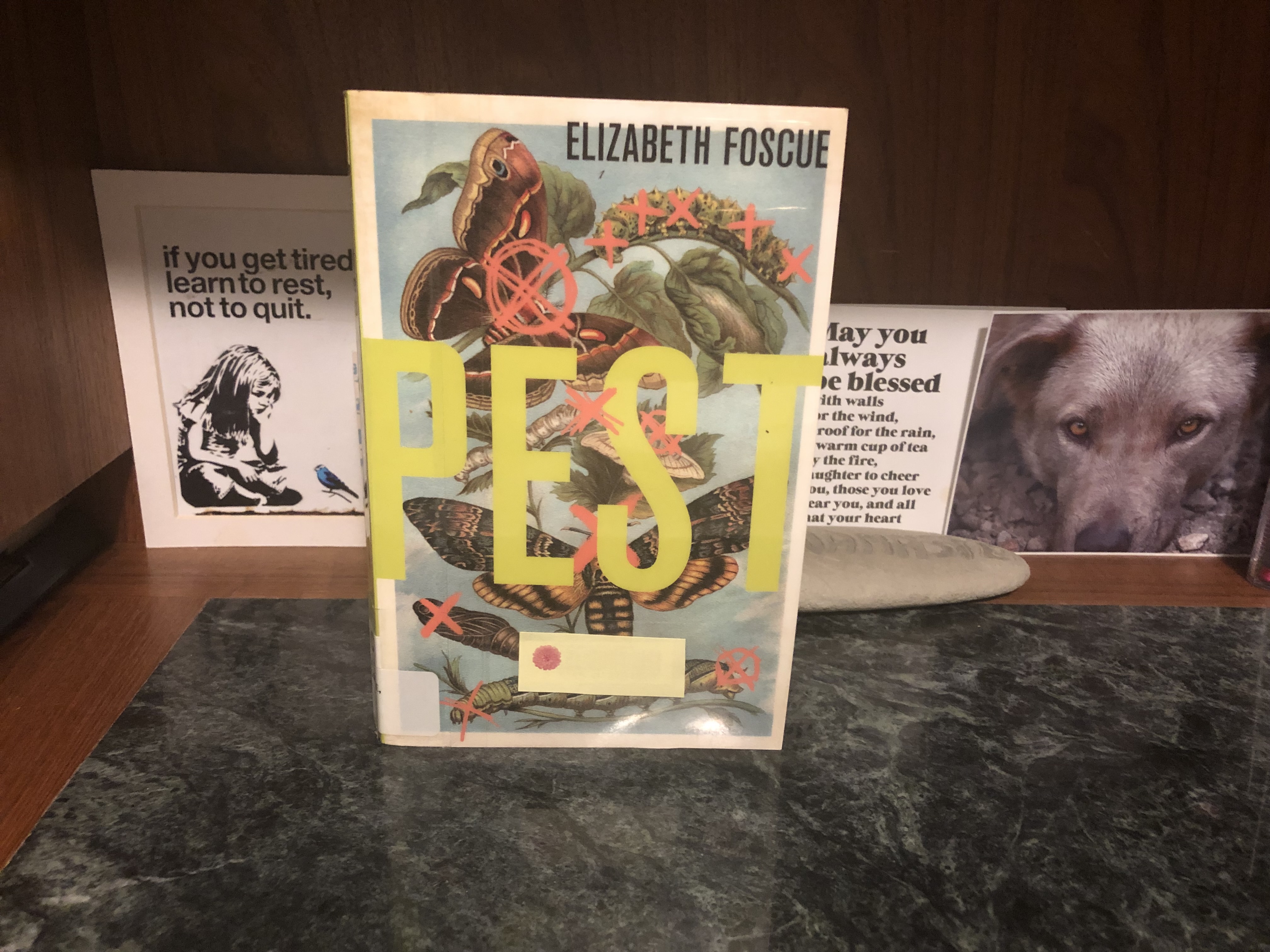
The book “Pest” standing on a desk with a few images behind it including a photo of the face of a wolfish dog. The book cover has images of bugs— a few butterflies, a few caterpillars, a few chrysalises. All have a red “X” over them.
Pest by Elizabeth Foscue

Pest is a fun, short and offbeat YA novel. 

I picked up Pest at the library when I went to get a new library card. I like to look around for books from indie publishers that don’t get the press that books from the Big Five do. This one caught my eye. Love the cover. When I read on the cover copy that the protagonist lives in Santa Barbara, CA and is desperate to make her exit, I wanted to find out why. I went to college in Santa Barbara and my roommates and I were all aching to live there permanently. But none of us had the money for such a pricey area, so off we went after graduation. (“This was Santa Barbara, after all, a town where every parking lot looked like a Range Rover rally.”) What would make a teen want to flee from one of the country’s most beloved destinations?

Hallie (Hal) doesn’t have the stereotypical Santa Barbara life. Her divorced parents are opposites. Her woo-woo mom owns a pond cleaning service and her libertarian dad owns a pest control business. Hal works part time at the pest control, exterminating a variety of bugs as well as vermin. For this, she is known as ‘bug girl’ at school. She also does periodic shifts at a golf course. Her working class life continually brings her in contact with the wealthy of Santa Barbara and the uber-wealthy of Montecito. For teens who are unfamiliar with Montecito, that’s where Oprah and the Sussexs (Prince Harry and Meghan Markle) live. Hal’s evaluation: “Rich Montecito weirdos made all other rich weirdos look like amateurs.”

Hal’s parents are at odds in a childish way. While they compete for time with her, neither actually does much of anything she likes. They mostly want her to listen to their drama and do work. Hal’s plan upon graduation is to attend a prestigious college in the east, putting a continent between her and her parents. Her tight work schedule is necessary if she is to achieve this. Even so, it’s not enough. She’s also depending on the Verhaag Scholarship.

Unfortunately, the Verhaag Scholarship always goes to a Verhaag family member if one happens to be graduating from Santa Barbara High School that year. In Hal’s senior year, a Verhaag family member transfers into SBHS, and Hal needs to quickly find some extracurricular activities to boost her college applications in case the scholarship falls through—though through a funny loophole, it seems she still has a chance. 

Some pretty crazy antics ensue as Hal ends up trying to solve a mystery in order to belong to the yearbook staff and ends up landing herself in crime scene. She also gets unexpected help in her college quest from her rich, hot neighbor whom she had always thought of as a self-centered jerk. 

“Basically I’m surrounded by Spencer Salazar. My house occupies one of the tiny parcels of land along the street that the fifties-ear developers of our seaside neighborhood carved out of the deep, oceanfront lots. Spencer’s dad purchased the houses on both sides of mine and demolished them, building a garage to the left and a swimming pool and cabana to the right. (My dad declined to sell, so the Salazars’ pétanque court remains an unrealized dream.) Behind all of this, their house stretches along 150 feet of cliff-top ocean frontage, offering the Salazar an unobstructed view of the Pacific and the Channel Islands beyond. I, on the other hand, have an unobstructed view of the six-foot wall that separates my yard from Spencer’s.”

There’s a bit of romance here, but whether the reader will enjoy the final act of the novel depends on how quirky they like their endings. It’s pretty wacky and some fun for those who are looking for the not-so-typical novel.

Posted in Family Problems, Fiction, Humor, Young Adult Literature | Tagged , , , , , , , , , , | Leave a comment

FREE: “Beyond Magenta” and “Loveless”

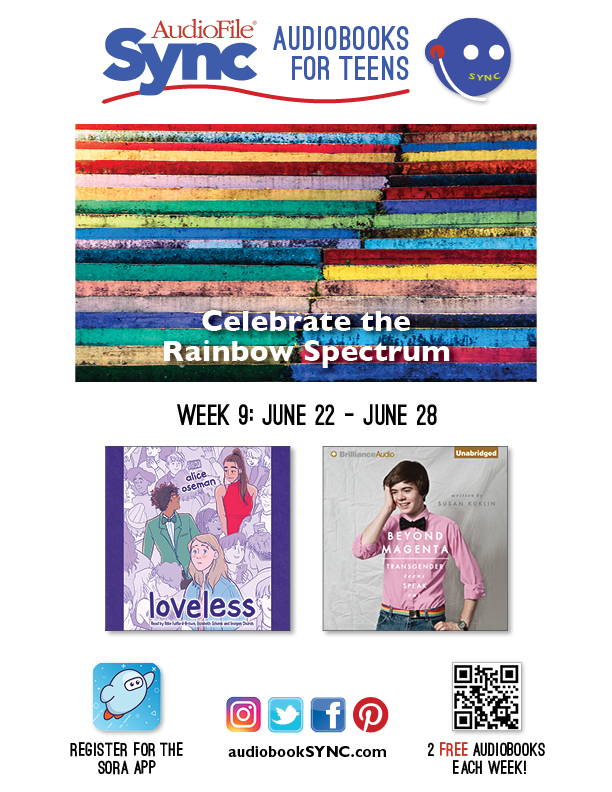
It’s already week nine of AudioFile’s Sync summer program. I just wanted to add a reminder today because Beyond Magenta: Transgender Teens Speak Out is free through this coming Wednesday, June 28. This is one of the books that is a target of the current book banning movement.

At the time we purchased Beyond Magenta for our library, we had a young adult teacher’s aide who was transitioning genders. The students had questions, and this was one of the books that had lots of voices giving answers.

Download for free by signing up for the summer program at https://audiobookSYNC.com . Have a listen for yourself. Grab Loveless for free as well. After that, you’ll get notification for each of the remaining weeks of the fourteen week program.

Poster advertising the AudioFile Sync audiobooks for teens program. Includes text "Celebrate the Rainbow Spectrum" and book cover images for "Loveless" (three teens in a crowd) and "Beyond Magenta" (teen wearing a pink dress shirt with a bow tie and jeans).
Posted in "Banned Book", Biography/Memoir, bullying, Human Rights Issues, Non-fiction, Young Adult Literature | Tagged , , , , , , , , | Leave a comment

Free Audiobooks for Teens!

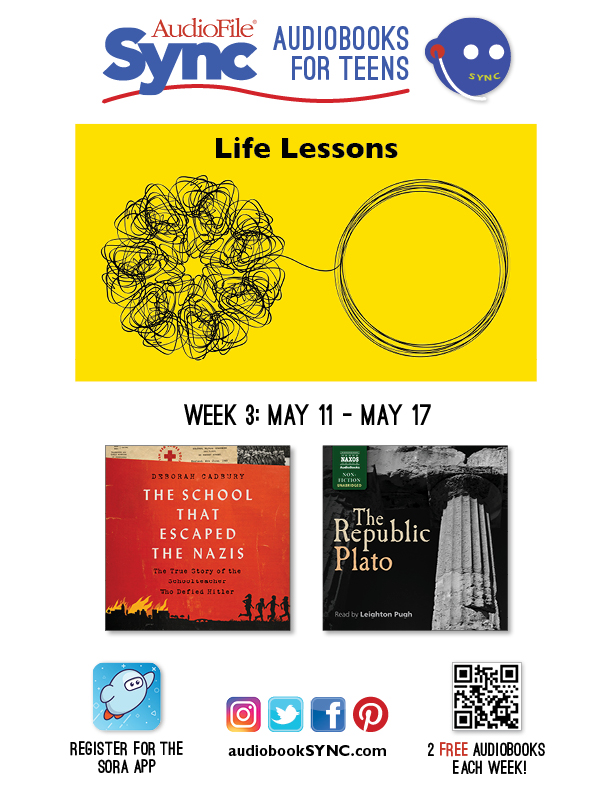
Book cover showing children running away from a burning building.

The AudioFile Sync program is already in its third week! I always wish it started a little later, when it felt like summer, so I wouldn’t miss the beginning. Below are this week’s books. I’m grabbing The School that Escaped the Nazis. It feels like time to be inspired by good people.

Here is the back cover info directly quoted from the publisher:

“In 1933, the same year Hitler came to power, schoolteacher Anna Essinger saved her small, progressive school from Nazi Germany. Anna had read Mein Kampf and knew the terrible danger that Hitler’s hate-fueled ideologies posed to her pupils, so she hatched a courageous and daring plan: to smuggle her school to the safety of England.
 
“As the school she established in Kent, England, flourished despite the many challenges it faced, the news from her home country continued to darken. Anna watched as Europe slid toward war, with devastating consequences for the Jewish children left behind. In time, Anna would take in orphans who had given up all hope: the survivors of unimaginable horrors. Anna’s school offered these scarred children the love and security they needed to rebuild their lives.
 
“Featuring moving firsthand testimony from surviving pupils, and drawing from letters, diaries, and present-day interviews, The School that Escaped the Nazis is a dramatic human tale that offers a unique perspective on Nazi persecution and the Holocaust. It is also the story of one woman’s refusal to allow her belief in a better world to be overtaken by hatred and violence.”

Posted in Non-fiction, Philosophy, Young Adult Literature | Tagged , , , , , , , , | Leave a comment

Upcoming Journal on Librarians and Libraries: Submit Your Story!

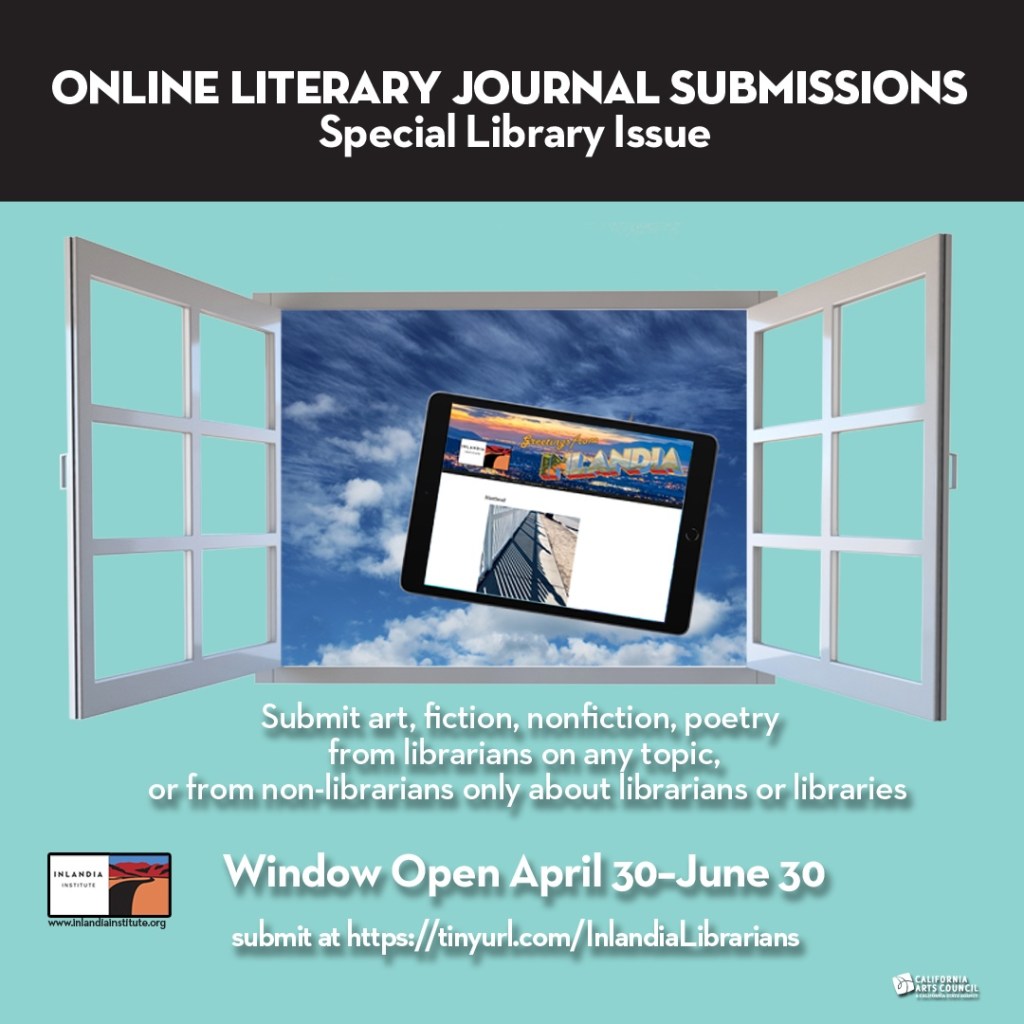
A computer screen floating in clouds as seen through a window.

I’m so excited about this special issue from Inlandia! It’s a celebration of libraries and librarians. As a former high school teacher librarian, I will be guest editing. If you are a librarian and also a writer, we want your creative work on ANY subject (which may include libraries). If you are not a librarian, but have a story to tell/artwork about libraries or librarians, please submit!

Inlandia: A Literary Journey is the online journal of the Inlandia Institute, whose mission is to promote literary culture. While the institute focuses on inland Southern California, the journal has published work from all over the world. The spring issue is teens only, so if you’d like to have a look at a regular issue, check the fall issues. No fee/no pay.

Submit from now until June 30, 2023. Here are links:

Submissions:

Https://tinyurl.com/InlandiaLibrarians

I used to be the managing editor. Here’s the last issue I did: https://inlandiajournal.net/fall-issue-2021/ (Fall issues are general issues. The spring issues are teens only.)

It’s pretty easy to navigate—if you click on the first image, it goes to the table of contents.

Hoping to see your work!

Posted in Uncategorized | Tagged , , , , , | Leave a comment

Alex Stern Books: Ninth House and Hell Bent

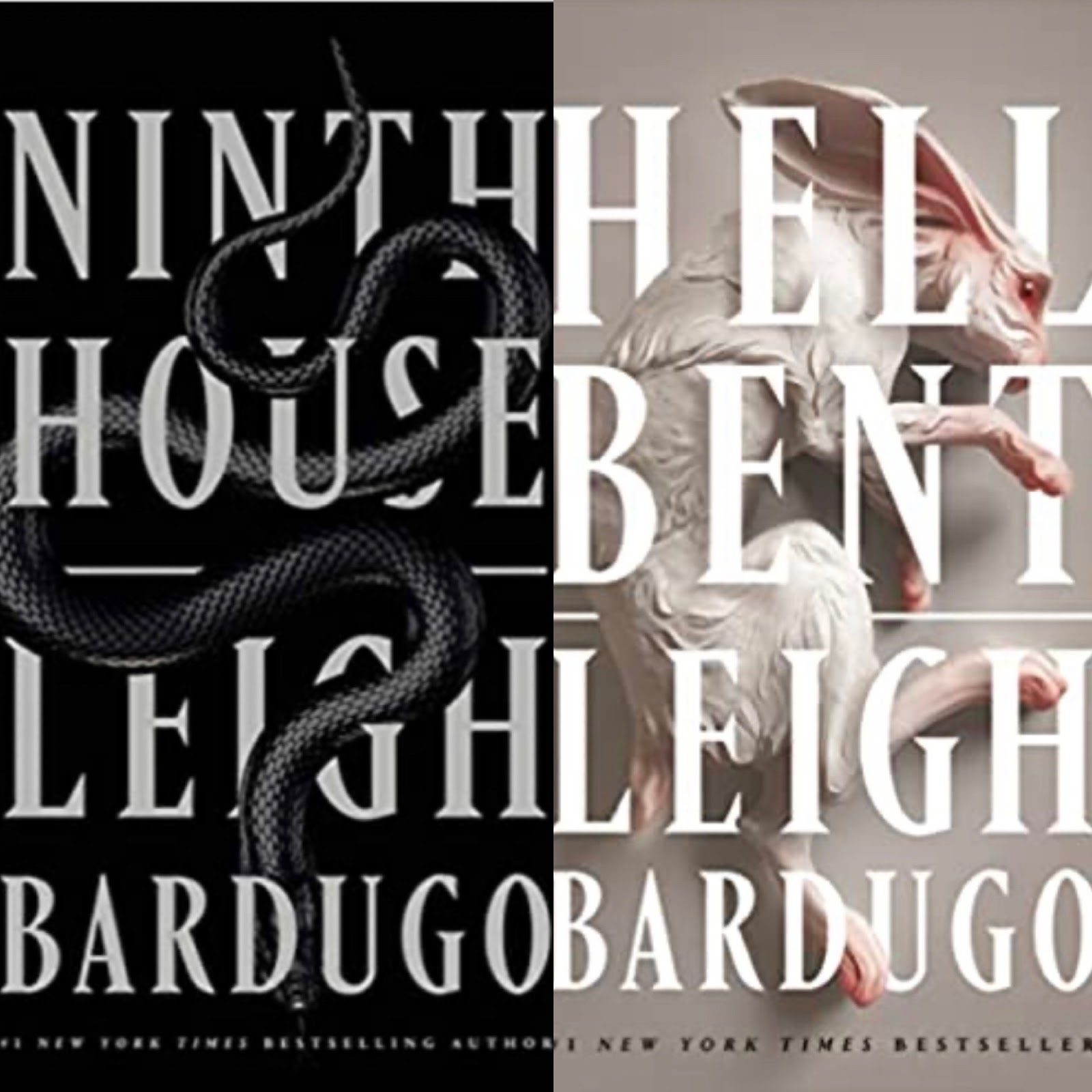
Image is of two book covers. The cover of "Ninth House" has a snake entwined through the title and author's name. The cover of "Hell Bent" has the image of a white rabbit behind the title and author's name.

Ninth House was a Goodreads Best Fantasy Choice 2019.

I picked up Ninth House thinking it was YA fantasy. I only understood it as adult fiction by listening to the author interview at the end of the audiobook. I would have labeled it “new adult” because it deals with many of the same issues we find in YA, but more explicitly, and because the important characters are so young.

I was unaware of the kerfuffle surrounding the call for trigger warnings for Ninth House in 2019 because I don’t pay much attention to Twitter. I looked it up after finishing the second book in the series, Hell Bent

“Her latest novel, her publisher would like you to know, is not YA. Ninth House is an impressive achievement, a book for adults that tackles many of the same themes as her earlier novels—the lingering specter of trauma, the lengths people go to survive, the power unjustly wielded by the wealthy at the expense of the supposedly powerless—but with more grit.” –Angela Lashbrook in Vice

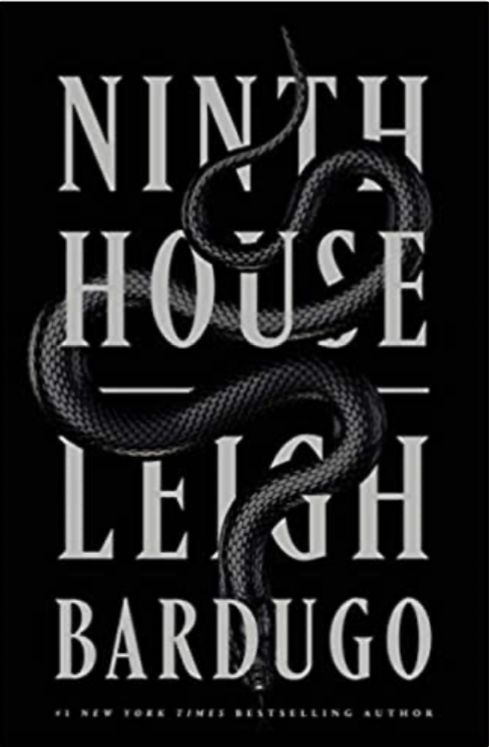
The cover of "Ninth House" has a snake entwined through the title and author's name.

Ninth House

This series takes place at Yale University, where old societies have a dark underbelly. They are the keepers of magic, and they use it to maintain privilege and power. This concept–making a deal with the devil to propel worldly success–is an old one. But placing it on an Ivy League university campus where privilege is a routine aspect of life, and using students to improve the lives of alumni is a fun take on the old trope. (Fun in that way that creepy demonic creatures and behaviors in books are enjoyable. I don’t want to suggest anyone would want to live this narrative.)

Alex (Galaxy) Stern had been a Los Angeles teen adrift in a sea of drugs, a drug-dealing boyfriend and a resistance to rehab. For reasons that become clear early in the book, at twenty, after surviving a multiple homicide, she’s offered a full ride to Yale and a position of power within the House of Lethe. Lethe monitors the activities of Yale’s eight other secret societies. (Thus it is the ninth house.) These societies perform occult rituals to get or to retain power among students and alumni. They do some pretty terrible things like drug and cut up street people in order to use them in rituals to foretell the future.

New Haven, Yale, and Privilege

Alex becomes Lethe’s ‘Dante’ and is learning the ways of magic as well as its history under the tutelage of Darlington, Lethe’s ‘Virgil.’ She’s been selected because she can see ghosts (called grays in the novel). The novel moves back and forth in time, winter to spring. We learn that Darlington is missing after some botched magic, and that Alex blames herself. Her goal is to retrieve him from wherever he might have landed–the borderlands or hell being two strong possibilities.

A girl is murdered in New Haven and her death is written off pretty quickly. She’s not a student, but something of a street girl. Which, of course, reminds Alex of herself. She feels the need to dig into the facts and finds help in the curmudgeonly cop Turner, who also doesn’t want to see the true killer to get away. More and more, it seems that the murder has something to do with the nine secret societies at Yale. More and more, it appears that many murdered/missing girls and young women of New Haven’s past are connected to the existence and rituals of the secret societies.  

As Alex investigates the murder, she uses all sorts of magic available to her. Types of magic conveniently appear as needed. Nevertheless, the experience is hard for Alex because it pulls up PTSD. She flashes back to a number of harrowing experiences during her childhood and then as a young adult. Through her determination, she overcomes some of her past issues. 

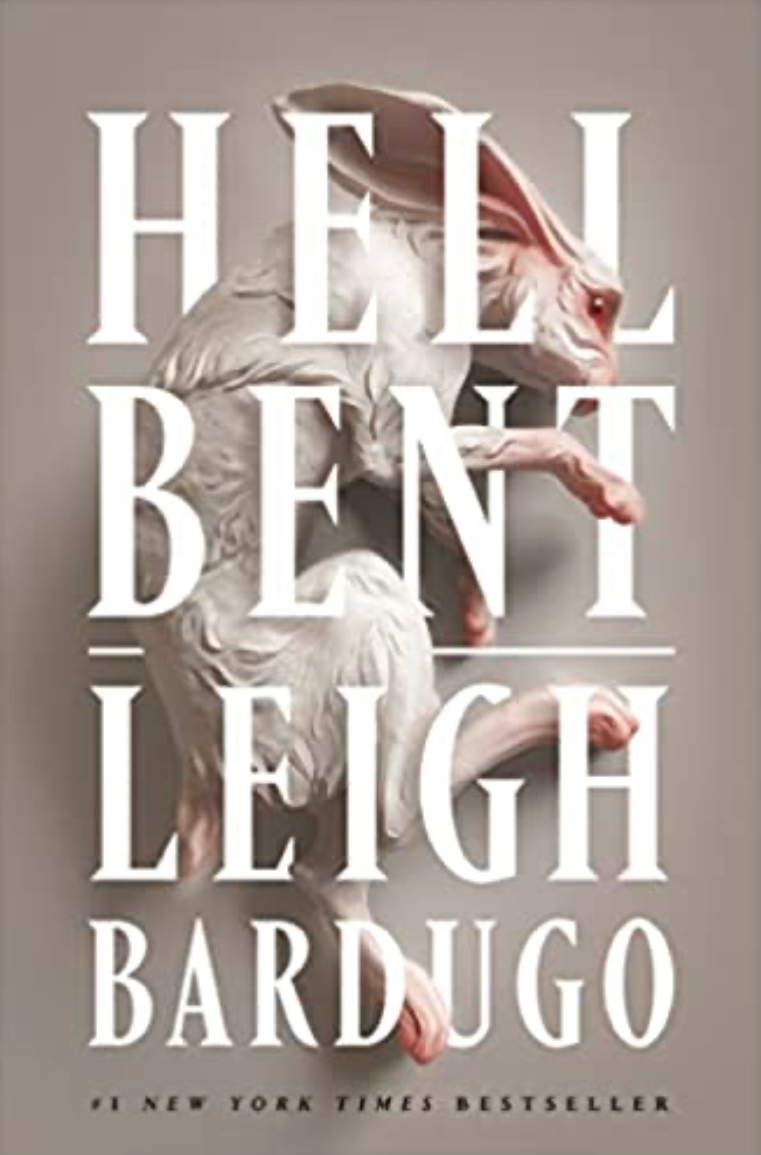
The cover of "Hell Bent" has the image of a white rabbit behind the title and author's name.

Hell Bent

Hell Bent continues where Ninth House leaves off. Alex has to seek help from her friends at Yale. There’s Mercy, her roommate. Pamela Dawes, an introverted grad student working on her PhD, is Lethe’s ‘oculus,’ a research assistant who maintains safehouses. These and others work with Alex to stave off demons, vampires, and more. All while searching for a way to make Darlington whole again. 

What’s great about Alex’s relationships with her friends is that they consistently come through for her. She learns a lot from Darlington, who seeks to protect her from the darker elements of the occult. Dawes saves her life more than once. Mercy trusts her even though some of her behavior is questionable. All this enables Alex to succeed in her missions. She is not the superhero upon whom everyone relies. This was the most enjoyable aspect of both books–that a young woman who had been through incredible trauma can figure out whom to trust and overcome her trauma in doing so. 

Alex Stern Books and Trigger Warnings

With all the outcry about Ninth House needing trigger warnings, does this series belong in the high school library? (NB: I wouldn’t add this series to a collection for students younger than high school age.)

I think it’s fair to say that if you have Stephen King and Dean Koontz in your library, you’ve already got books with similar levels of trauma, violence, and gross stuff. I can see making a case for trigger warnings on the Alex Stern series–this might actually help high school libraries in serving their students–but if the industry decides to put warnings on the books, they should include those of male authors, a point that Bardugo has made herself. 

Yet the Alex Stern series is different from King and Koontz horror novels; it’s about teen and young adult trauma, PTSD, survival and eventual healing. It might lift a teen who has experienced some dark things.  

If You’d Like to Add Your Own Content Warning

Putting content warnings in the inside cover of books isn’t unreasonable, and a librarian might choose to do it. The warnings suggested on Twitter for Ninth House seem endless. But here are several reasonable warnings:

  • A twelve-year-old girl is raped by a ghost in a public restroom.
  • Because of her trauma, Alex has incidents of self harm.
  • In flashbacks, Alex remembers traumatic details of her life with her drug dealer boyfriend.
  • At least one of the very privileged boys is a serial rapist and he uses magical plants to induce compliance in his victims. (Alex uses the same magic against him in a gross punishment that might require a trigger warning itself.)
  • There are mentions of penises and the use of the word ‘cock’ pretty regularly and a detailed description of a naked demon. 
  • Some of the supernatural beings are hell bent on revenge and the violence is described in detail. 

Alex Stern and a Book 3


Hell Bent–which by the way, has a perfect book cover–ends with the call to a new quest. I won’t be reading anymore of the series should it arrive. (Fun fact–though Book 3 does not exist, it has a 4.83 star rating on Goodreads. Oh to be loved!) There is much in the books that encourages traumatized people to work through the darkness. There is success. The idea of an elite school and its wealthy patrons relying on magic and refusing to protect the surrounding community from itself is a great metaphor for the reality of privilege. But the books are overlong. Alex’s unrealistic, repeated opportunities to get things right, to help others and right the wrongs against them have grown wearisome. The repeated trips to hell are starting to feel gratuitous. In short, though I enjoyed much, I’m burnt out.

Posted in Fiction, Mature Readers, Supernatural | Tagged , , , , , | 1 Comment

Happy Book Birthday: Dogs and Humans

Cover images from "The Mortality of Dogs and Humans" including a watercolor of a Labrador retriever.

Happy launch day to my chapbook “The Mortality of Dogs and Humans.”

Happy Birthday To The Mortality of Dogs and Humans

A pink typewriter with pink camellias set on top and the words "Happy Birthday!!!" across it.

Today’s the launch day for my chapbook The Mortality of Dogs and Humans.

I added it here on School Library Lady because I think it will appeal to teens. For many young people, their first experience of grief will be the loss of the family dog. I think this little chapbook will help them get through that and remind them of the beauty that dogs bring to their lives. Since this is a chapbook (70ish pages), it would sit well on a spinner or tabletop display with books for reluctant readers/’quick reads/grab and go.’

I think the two quotes below do a good job of defining it. I hope you enjoy it. It’s time for me to have a piece of cake. 😉

The Core of “Dogs and Humans”

“In her chapbook memoir, The Mortality of Dogs and Humans, Victoria Waddle explores her (our) relationship with dogs, the joy and comfort of their companionship, and the lessons they can teach us about being better humans.  By sharing her memories of Fletcher and Zainy, she shows everyone else what dog people already know:  that dogs are individuals (with specific personalities, quirks, and anxieties, just like the rest of us) and how our relationship with them changes from one dog to the next.  She shows how it is through their interaction with dogs that the truth of a person is revealed.  This book is an examination of our responsibility to those we love, and the (sometimes impossible) difficulty of taking care of them, especially those who are beyond our communication. Waddle captures the pain of deciding when, exactly, a dog is suffering more than living and, in comparison, forces the reader to wonder why we allow our beloved elderly to suffer more than our beloved pets.  Dog people, as they read this book, will instantly get it.  Cat people will get it.  Non pet owners, those poor lost souls, will get it (and they might even be converted).”

—Tim Hatch, poet and author of Wild Embrace

From a Search and Rescue Dog Handler

“Victoria is able to share the realities of the love and loss of our most precious furbabies in an honest way that we can all relate to. Her sharing of her experiences, her devotion, and resilience, are heartfelt and heartbreaking. Also relating to her personal family struggles and loss make this a story that brings home what love really is all about.”

—Randi Lui, former Search and Rescue K9 handler and Dog Unit Leader

The Mortality of Dogs and Humans is available from the publisher, Barnes and Noble, Bookshop, and Amazon.

Posted in Biography/Memoir, Grief, Hi-Low/Quick Read, Non-fiction | Tagged , , , , , , | 1 Comment