“The Meaning of Matthew: My Son’s Murder in Laramie and a World Transformed”

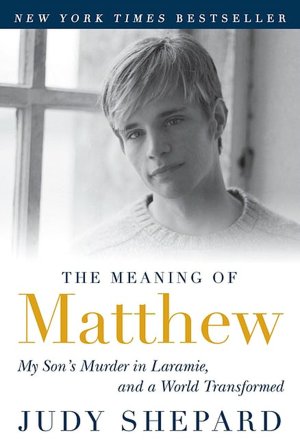
The Meaning of Matthew: My Son’s Murder in Laramie, and a World Transformed by Judy Shepard 

Matthew Shepard was beaten, tied to a split rail fence and brutally murdered in Laramie, Wyoming in October 1998. His death became the focal point for gay rights and federal hate crime legislation. Written by Matthew Shepard’s mom, the story evokes the real Matt.—“Matt’s murder wasn’t horrific because it ended an angelic life but because it ended a very human life riddled with all the complexities and contradictions each of us face.” Judy Shepard also discusses her own journey to becoming a gay rights activist.

Since The Meaning of Matthew really is a story about a guy who was quite human, I think you’ll be able to relate to it better than the original news stories that made him out to be a saint, or the later stories that demonized him. As in my last review (Columbine) this is an argument for taking a longer look at a historically important event.

When Matthew Shepard was gruesomely beaten in Laramie, his parents were in Saudi Arabia as his father worked for an oil company there. It took them awhile to get to his bedside after picking up his brother in Minnesota. When they arrived in Fort Collins, they were shocked by the media coverage of their son’s beating. Only then did they understand that Matt was not going to make it. They had so much to deal with—the death of a child is tragic in any case, but when a child is murdered, it must be incomprehensible. The attention of the media and the needs of well-wishers increased the Shepard family’s pain. It took awhile for Judy Shepard to realize why all these people were stricken, and she felt the extra burden of having to deal with their grief.

Both Matt’s parents knew that he was gay and had pretty easily accepted it. What they couldn’t accept was some of his self-destructive behavior at the end of his teens. Matt’s drinking and other problems hadn’t come from nowhere—he was the victim of a terrible sexual assault in Morocco, where he and some school mates from Switzerland were vacationing together. The attack affected his personality and his behavior. Still, his parents practiced ‘tough love’ with Matt, not allowing him excuses, and by the time he was murdered this seemed to have some positive effects.

Judy Shepard shares why her family accepted plea bargains for Matt’s murderers. Some details of the trial are tough to read, particularly because the defense tried to make its case around the ‘gay panic defense.’ In addition, the crazies from the Westboro Baptist Church (that family that goes to the funerals of military personnel killed in service to the country carrying signs such as “God Hates You,” “God Hates Fags,” etc.) was there with signs such as “Matthew in Hell.” Dennis Shepard, Matt’s father, made a lengthy address to the court after the murders’ sentencing. It alone is very much worth the read.

The murder of Matthew Shepard is a historically significant event that became the rallying point of civil rights groups across the country. This mom’s story about her son is an important read.

Posted in Human Rights Issues, Non-fiction | Tagged , , , | Leave a comment

“Columbine”

Columbine by Dave Cullen 

You’re too young to remember the worst high school shooting in the country’s history, but no doubt you’ve heard of ‘Columbine.’

On April 20, 1999, Eric Harris and Dylan Klebold begin to shoot—indiscriminately—students and teachers at their high school. As the tragedy unfurled, students trapped on the campus called not only 911, but news stations as well. Some of these students had televisions and were looking at the news while they talked. This led to the mythmaking of what we now think of as the Columbine story. Many who were trapped didn’t know what was going on around them—they had to hide for many hours (even after the shooters had killed themselves), waiting for the SWAT teams to secure the school. They saw what news programs said—school shootings are committed by outsiders, loners with no friends, boys who are bullied, goths in trench coats who are often gay. They then repeated these things back to newscasters and the myth was born. (Why these newscasters were endangering the lives of these students by chatting with them while the tragedy unfolded is beyond the scope of this review.)

In Columbine, Dave Cullen tells us what really happened that day. He disproves the myths of aliened and bullied shooters, the Trench Coat Mafia, and of religious martyrs, instead showing the reader how difficult it is to recognize and stop a psychopath. Using the killers’ diaries and videotapes and interviews with survivors, witnesses, family members, school personnel, local police, the SWAT team, FBI psychologists, and more, Cullen details the worst high school shooting in the country’s history. His research took ten years.

The truth starts with the fact that the killers were not targeting people who bullied them. In fact, they had made and planted several bombs, with the intention of blowing up the whole school and everyone in it. And yet they were fairly popular guys who had friends and dates with girls. They worked at a local pizza place. They actually appear pretty normal to others. Only with a closer look, does one see that Eric was a psychopath—and very good at fooling peers and adults alike—and that Dylan was very depressed, even suicidal, and a follower who did what Eric asked.

Eric and Dylan left many clues to their plans although they didn’t discuss them with others. I think this book is important for many reasons, but one is that it shows us that the troubles these two boys had were the same as the troubles of many teens. But they do a few things that should have set off raging alarms in friends who knew. The problem is that friends don’t imagine that people they know—and have known for years—as the type to become killers. Teen should know, without a doubt, that if friends of theirs start wanting help in buying sawed-off shotguns or are making pipe bombs, there’s a reason for that. And someone—maybe more than one someone—is going to get killed. It’s time to call We Tip Anonymous. Now.

Cullen dispels other Columbine myths as well—Danny Rohrbough didn’t die saving other s students. Cassie Bernall didn’t martyr herself by professing her faith in God and then being shot for it. We have deep sympathy for the family of murdered teacher and coach Dave Sanders (who really was saving others), knowing that he was left for hours to bleed to death and might have been saved if the police and SWAT teams had been more organized. We also find out what Patrick Ireland was thinking when, seriously wounded with multiple shoots (including one to the head), he climbed out a window, launching himself when rescuers weren’t ready to catch him. Patrick’s escape is famous because it played on live television.

This was a very difficult book for me to read. Paradoxically, I was riveted at times and couldn’t stop. But once I got to the end of a section, I had to take a break and had a hard time picking it up again. After all, there was no chance of a happy ending. But it’s important for all of us to read books like this. The fact that this book can dispel myths only after so much research is a general argument for reading books, not just instant news reports. I think the move in education away from deep, sustained reading to cursory looks at ‘passages’ from ‘informational texts’ (there’s a little Orwellian Newspeak for you) is a huge mistake. But that’s a story for another day.

I want to make one more comment on Cassie Bernall. We have the book, written by her mother, entitled She Said Yes: The Unlikely Martyrdom of Cassie Bernall in our library. It is now clear that the story of the minutes before Cassie’s death—in which one of the shooters asked her if she believed in God and she answered yes; then, after he asked her why, shot her before she could answer—is not true. Knowing this, do I still think the book is worth reading?

I do think She Said Yes is worth the reading. While many are critical of a segment of the evangelical Christian community for perpetrating the martyr myth, which they knew from the beginning was most likely false, I don’t think Cassie’s last minutes are the real point of the book—or the power of it. Before Cassie became a reborn Christian, she was a pretty messed up teen. Her behavior was strange and the outcomes of her habits and friendships could have been dire. That’s the point that Misty Bernall is making. When kids do strange things, parents have to take action. Cassie’s friend was writing notes suggesting that the two of them kill Cassie’s parents and drawing horrific images of the bloody bodies. Cassie’s parents got a handle on that and helped her to turn her life around. They could only do so by being very involved.

As to what Eric’s parents might have done had they known about his psychopathic nature, it’s hard to say. Cullen argues, citing experts, that psychopaths can’t be helped with therapy; in fact, they learn in therapy how to better fool people, which is something they love to do. Of the ten types of identified psychopaths, two can be murderous, and Eric was one of those—he demonstrated in his secret journals that he was sadistic and had a God complex. All psychopaths think of people as objects and have no empathy. When I discussed this with my husband, who is a psychologist with a Ph.D., he wondered if the book said anything about Eric having been treated as an object himself as a child. I told him no, that the description of Eric’s parents shows them to be pretty normal. He took issue with the idea that a psychopath is just born that way. (I told him he’d have to read the book.)

Sadly, the reader feels that there is one way that the Columbine killings could have been prevented, and that is better police work. The police department knew a good deal about the things Eric and Dylan were doing, knew about website posts with threats etc., but didn’t notify the parents, and later destroyed evidence of their knowledge.

Columbine is an important work that sets the record straight.

Posted in Mature Readers, Non-fiction, Over 375 pages | Tagged , , , | Leave a comment

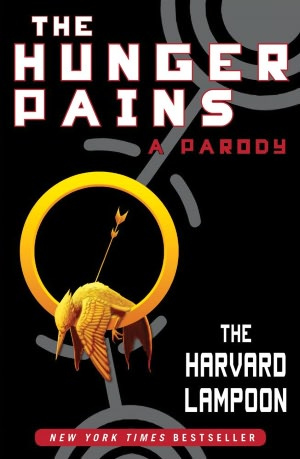
“The Hunger Pains”

The Hunger Games: End of the School Year Fun

If you’ve followed this blog at all, you know that I loved every book in The Hunger Games trilogy as well as the movie. I put a lot of effort into having an event at both my schools to celebrate it. But I also think it’s OK to make fun of the things we love. And Harvard Lampoon, a parody franchise, has provided us HG fans that opportunity.

They have a book out entitled The Hunger Pains. While I haven’t had a chance to read it yet, the online trailer, which closely mimics the HG movie trailer, is pretty darned funny. I’m too cheap to pay WordPress for the option of embedding video here—especially since you can’t view it at school anyway while YouTube is censored. But here is the link to a good laugh: http://youtu.be/GjPTnW7bYUQ.

There’s also a blooper reel to this book trailer, not quite as funny, but a little chuckle: http://youtu.be/lr9LwM9OoQ0.

Study for your finals and then break with this. Good luck with all your tests!


Posted in Uncategorized | Tagged , , , | Leave a comment

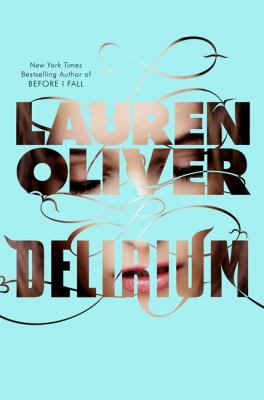
“Delirium”

Delirium by Lauren Oliver

 amor deliria nervosa

It’s what Romeo and Juliet had—that infectious disease that often hits first during the teens and causes people to do crazy things to be with someone. Not sleep, not eat, run away—the list is endless.

But amor deliria is not a problem in the future United States. Everyone is scheduled for the cure, a procedure performed on the eighteenth birthday. If someone is infected before eighteen, s/he will have an early surgery (with possible tragic consequences) and will be kept guarded until the illness is cured. Shakespeare’s drama of young lovers is preserved in schools, but only as a cautionary tale—see what can happen to you if you are infected with amor deliria?

So what does a society without love look like? Oliver does a good job at showing how folks can be rational and do the right thing—take care of relatives, get dinner on the table, go to work—and be immersed in utter meaninglessness. The cure doesn’t just remove romantic love, but rather all love. Parents don’t have any fun with their kids, but they don’t abuse them either. So is this a good way to go? Lena’s mom had the cure performed on her three times, the last without anesthesia. Three times it didn’t work. She commits suicide, so she is evidence of the deeply abnormal nature of love, and, at first, Lena is looking forward to the cure, to being normal, and hoping not to end up like her mom.

But then Lena meets Alex. The two are infected pretty quickly. They hide out from the Regulators and plot. Alex is an ‘invalid,’ one of the uncured. He has connections to the Wilds, the unregulated wilderness outside of society’s control. Can the two escape Portland (Maine) and be together?

A critical look at this novel makes me wonder how any society could invest so much money and energy into making sure no one falls in love. There are impossible numbers of Regulators, border patrols and more—to be honest, it edges toward ludicrous. But when we look at this as just a fun read (great for summer!) and suspend disbelief, it’s a wonderful ride. There are nice bits of irony thrown in (July 4th is no longer Independence Day, but a celebration of the sealing of the borders). And love really does appear to be a disease. The stricken teens are restless, run high fevers, are irrational.

The love between Lena and Alex is one of the best things about the book. Alex is (a bit too) perfect, and any girl would be charmed by him. The couple is very sweet; you have to root for them. The end of this book is a white-knuckler. So enjoy it, bite all your nails off as you get to those last few pages, and then happily await the second book in the trilogy.

Posted in Fiction, Romance, Sci-Fi/Futuristic, Young Adult Literature | Tagged , , , | Leave a comment

That Used to Be Us–looking outward and forward III

That Used to Be Us—Links on looking to the future

Last thoughts on how the book connects to educators

Places to find more information

I’ve created three posts on where to look while we think about how we are changing—guideposts and cool stuff to use along the way. My goal is to have the positive, the negative, and the truth that lies between them. The first of the three posts was about online resources. The second was on books. This, the third, is a counterpoint to the idea (expressed in That Used to Be Us) that poverty has no effect on educational success—I thought it was important to get the other side of this issue.

Are We Really That Far behind other Industrialized Nations in Educating Our Kids and in Reading?

That Used to Be Us cites a study that others claim to debunk. Concerning poverty, there is much research to indicate that it is the overriding factor in student success. Although I didn’t mention the book Brain Rules in my last TUTBU post of recommended reading, it’s a good one, very worthwhile reading for educators. Its author, John Medina (developmental molecular biologist,  affiliate Professor of Bioengineering at the University of Washington School of Medicine,   director of the Brain Center for Applied Learning Research at Seattle Pacific University) comments on how home life affects learning:

Severe and chronic trauma (such as living with an alcoholic parent, or watching in terror as your mom gets beat up) causes toxic stress in kids. Toxic stress damages kids’ brains. When trauma launches kids into flight, fight or fright mode, they cannot learn. It is physiologically impossible.

I realize this isn’t news to most of us–but I think it’s good to remind ourselves that experts do agree with the empirical evidence that we find in teaching every single day.

I asked Stephen Krashen (professor emeritus at the USC, linguist, educational researcher, activist) if I could print this statement of his in my blog, and he said yes. If you are interested in some of the research, it follows the statement.

Against National Standards and National Tests
Stephen Krashen

The movement for national standards and tests is based on these claims: (1)  Our educational system is broken, as revealed by US students’ scores on international tests; (2) We must improve education to improve the economy;  (3) The way to improve education is to have national standards and national tests that enforce the standards.

Each of these claims is false.

(1) Our schools are not broken. The problem is poverty. Test scores of students from middle-class homes who attend well-funded schools are among the best in world. Our unspectacular overall scores are due to the fact that the US has the highest level of child poverty among all industrialized countries (now over 21%, compared to high-scoring Finland’s 5%). Poverty means poor nutrition, inadequate health care, and lack of access to books, among other things. All of these negatively impact school performance.

(2) Existing evidence strongly suggests that improving the economy improves children’s educational outcomes. Yes, a better education can lead to a better job, but only if jobs exist.

(3) There is no evidence that national standards and national tests have improved student learning in the past.

No educator is opposed to assessments that help students to improve their learning. The amount of testing proposed by the US Department of Education in connection to national standards is astonishing, more than we have ever seen on this planet, and much more than the already excessive amount demanded by NCLB: Testing will be expanded to include all subjects that can be tested and more grade levels. There will be “interim” tests given through the year and there may be pretests in the fall to measure growth, defined as increases in standardized test scores, or “value-added” measures.

The cost of implementing standards and electronically delivered national tests will be enormous, bleeding money from legitimate and valuable school activities. New York City is budgeting a half a billion dollars just to connect children to the internet so that they can take the national tests. This extrapolates to about $25 billion nationally for this expense alone.

This money could be spent to protect children from the effects of poverty, i.e. on expanded and improved breakfast and lunch programs, school nurses (at present there are more school nurses per child in low poverty schools than in high poverty schools) and improved school and public libraries, especially in high-poverty areas.

Rather than spend on standards and tests, investing in protecting our children from the effects of poverty would raise test scores. More important, it is the right thing to do.

Some sources:

“Test scores of students from middle class homes …:  Payne, K. and Biddle, B. 1999. Poor school funding, child poverty, and mathematics achievement. Educational Researcher 28 (6): 4-13; Bracey, G. 2009. The Bracey Report on the Condition of Public Education. Boulder and Tempe: Education and the Public Interest Center & Education Policy Research Unit. http://epicpolicy.org/publication/Bracey-Report. Berliner, D.  The Context for Interpreting PISA Results in the USA: Negativism, Chauvinism, Misunderstanding, and the Potential to Distort the Educational Systems of Nations. In Pereyra, M., Kottoff, H-G., & Cowan, R. (Eds.). PISA under examination: Changing knowledge, changing tests, and changing schools. Amsterdam: Sense Publishers. In press. Tienken, C. 2010. Common core state standards: I wonder? Kappa Delta Phi Record 47 (1): 14-17.

“Poverty means poor nutrition, inadequate health care, and lack of access to books”: Berliner, D. 2009. Poverty and Potential:  Out-of-School Factors and School Success.  Boulder and Tempe: Education and the Public Interest Center & Education Policy Research Unit. http://epicpolicy.org/publication/poverty-and-potential;   Krashen, S. 1997. Bridging inequity with books. Educational Leadership  55(4): 18-22.

Improving the economy ….:  Baker, K. 2007. Are international tests worth anything? Phi Delta Kappan, 89(2), 101-104; Zhao, Y. 2009. Catching Up or Leading the Way? American Education in the Age of Globalization. ASCD: Alexandria, VA.; Ananat, E., Gassman-Pines, A., Francis, D., and Gibson-Davis, C. 2011. Children left behind: The effects of statewide job less on student acbievement. NBER (National Bureau of Economic Research) Working Paper No. 17104, JEL No. 12,16. http://www.nber.org/papers/w17104

There is no evidence that national standards and national tests have improved student learning in the past: Nichols, S., Glass, G., and Berliner, D. 2006. High-stakes testing and student achievement: Does accountability increase student learning? Education Policy Archives 14(1). http://epaa.asu.edu/epaa/v14n1/. OECD. Tienken, C., 2011. Common core standards: An example of data-less decision-making. Journal of Scholarship and Practice. American Association of School Administrators [AASA], 7(4): 3-18. http://www.aasa.org/jsp.aspx.

Testing in more subjects: The Blueprint A Blueprint for Reform: The Reauthorization of the Elementary and Secondary Education Act. United States Department of Education  March 2010

In earlier and later grades: PARCC document:  http://www.parcconline.org/sites/parcc/files/PARCC%20MCF%20Response%20to%20Public%20Feedback_%20Fall%202011%20Release.pdf

Interim tests: Duncan, A. September 9, 2010. Beyond the Bubble Tests: The Next Generation of Assessments — Secretary Arne Duncan’s Remarks to State Leaders at Achieve’s American Diploma Project Leadership Team Meeting: http://www.ed.gov/news/speeches/beyond-bubble-tests-next-generation-assessments-secretary-arne-duncans-remarks-state-l. The Blueprint, (op. cit.) p. 11.

Value-added measures:
http://www.ed.gov/news/speeches/secretary-arne-duncans-remarks-statehouse-convention-center-little-rock-arkansas (August 25, 2010). The Blueprint (op.cit.), p. 9.

New York City budget: New York Times, “In city schools, tech spending to rise despite cuts,” March 30, 2011.

School nurses: Berliner, 2009 (op. cit.)

Libraries: Krashen, S. 2011. Protecting students against the effects of poverty: Libraries. New England Reading Association Journal 46 (2): 17-21.
Posted in Non-fiction | Tagged , , , , | Leave a comment

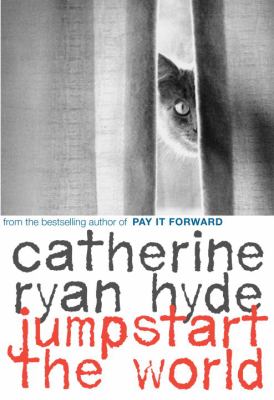
“Jumpstart The World”

Jumpstart the World by Catherine Ryan Hyde

“’I’m taking that cat. I want the black one. You can’t talk me out of it, so don’t even try.’ I was already starting to understand him. To feel for him. Or maybe even to feel with him. He was scared. He was not cuddly. He was not beautiful. If I didn’t take him, he was as good as dead. He was about to be given the death penalty for not being beautiful. Someone had to come along and love him just the way he was. I was that someone.”

Elle’s mom has fallen for her new boyfriend Donald. He’s moving in and Elle’s moving out. Into her own apartment. Just before her sixteenth birthday. Because, after all, Donald doesn’t want her around. So, pretending that she is worried about Elle’s loneliness, her mom wants to buy her a cat. Elle decides to get one from a shelter instead. And then to pick one that’s been through some serious fighting—his eye, a piece of his ear and patches of his fur are missing. He’s broken.

Like Elle.

In a bit of grace, when Elle is moving in to her new apartment, she meets her neighbor Frank. He’s small for a man, but kind and good looking and Elle has an immediate crush on him although he’s living with a woman (also kind) named Molly.

I wouldn’t say that Elle’s lived a sheltered life—her mother is much too self-centered to be nurturing. But Elle is not entirely in tune with others because she hasn’t had that nurturing she needs. Her new friends at her new school—outcasts all—know immediately what Elle hasn’t seen. That Frank is transgendered.

This tightly-written novel is so sweet and compassionate, I want to recommend it to everyone. I know I harp on how much I hate it when young adult books have repetitive scenes or action; when they redescribe all the dialogue by adding tags with adverbs. (The last one I read had something like this: ‘I wish I really was a vampire because at least then I would be understood,’ Helen thought miserably, feeling totally misunderstood.” Really?) I’m trying to stop complaining, but it does bother me because I feel like the authors and editors are disrespecting teens, who they think are so clueless that everything must be repeated. And then repeated.

Catherine Ryan Hyde, the author of Jumpstart the World respects you. She’s a wonderful writer. (Adults will remember her bestseller of a decade ago—Pay It Forward—which was made into a movie.) The breathless pace of Jumpstart the World is perfect. As are Hyde’s protagonists and their respect for one another.

Sweet.

Posted in Controversial Issue/Debate, Family Problems, Fiction, Hi-Low/Quick Read, Mature Readers, Read 180, Young Adult Literature | Tagged , , | 1 Comment

That Used to Be Us–looking outward and forward II: books

That Used to Be Us—Links on looking to the future

Last thoughts on how the book connects to educators

Places to find more information

I want to create three posts on where to look while we think about how we are changing—guideposts and cool stuff to use along the way. My goal is to have the positive, the negative, and the truth that lies between them. The first of the three posts was about online resources. This, the second, is on books. The third will be a counterpoint to the idea (expressed in That Used to Be Us) that poverty has no effect on educational success.

Some Books

One of the main points of these bestselling books on the current state of life is that the IT revolution has changed the way we do business, the way we educate our kids and the way we communicate and connect with each other. The list is for anyone interested in who we are and where we’re going—these run the political/social gambit. Some of these are the publisher’s summary. If it’s hyperlinked, I reviewed it and you can click for a longer look at the book.

Millennials and K-12 Schools

Millennials includes a discussion of Baby Boomers and of Generation Xers as they were when they were students and as they are now as teachers and school administrators. Millennials—the students who are now in our high schools and are just becoming old enough to be teachers themselves—are contrasted against these earlier generations. As their lives and attitudes are different from previous generations, schools that hope to give them the best education need to take into account just how they differ. Millennials also discusses how to cope with their parents.

Readicide: How Schools are Killing Reading and What You Can Do about It

In his introduction, Gallagher, an English teacher, introduces the term ‘readicide’ “because it cuts to the central ironic thesis of this book: rather than helping students, many of the reading practices found in today’s classrooms are actually contributing to the death of reading.” Gallagher discuss how we can turn the trend around. He uses data to show that schools are more interested in nurturing test-taking skills than in nurturing a love of reading. We limit positive reading experiences; we overteach pleasure reading books (which should just be read, not studied!); we underteach classic books (so that they are too confusing–and students hate them and give up).

A Nation of Wimps: The High Cost of Invasive Parenting

Hara Marano, editor-at-large and the former editor-in-chief of Psychology Today, has been watching a disturbing trend: kids are growing up to be wimps. They can’t make their own decisions, cope with anxiety, or handle difficult emotions without going off the deep end. Teens lack leadership skills. College students engage in deadly binge drinking. Graduates can’t even negotiate their own salaries without bringing mom or dad in for a consult. Why? Because hothouse parents raise teacup children–brittle and breakable, instead of strong and resilient. This crisis threatens to destroy the fabric of our society, to undermine both our democracy and economy.

The Post-American World

Zakaria (Time magazine editor-at-large and host of CNN’s “Fareed Zakaria GPS”) updates his discussion of the relative decline of American global power in order to take into account the impact of the economic crisis of the late 2000s and other recent developments, which have only accelerated the transition to the “post-American” world and the rise of new powers in Zakaria’s estimation.

Thinking Fast and Slow

Selected by the New York Times Book Review as one of the best books of 2011,  a Globe and Mail Best Books of the Year 2011,  Title One of The Economist ‘s 2011 Books of the Year,  one of The Wall Steet Journal ‘s Best Nonfiction Books of the Year 2011,  LA Times Best Books (Current Interest)

Daniel Kahneman, recipient of the Nobel Prize in Economic Sciences for his seminal work in psychology that challenged the rational model of judgment and decision making, is one of our most important thinkers. His ideas have had a profound and widely regarded impact on many fields–including economics, medicine, and politics–but until now, he has never brought together his many years of research and thinking in one book. In the highly anticipated Thinking, Fast and Slow , Kahneman takes us on a groundbreaking tour of the mind and explains the two systems that drive the way we think.

A Whole New Mind

Explores how the business world is changing in the twenty-first century, becoming more “right-brain” based and allowing people more creative and artistic than earlier generations succeed more than those with left-brain dominance.

Start Something That Matter

Love your work, work for what you love, and change the world–all at the same time.

Should you focus on earning a living, pursuing your passions, or devoting yourself to the causes that inspire you? The surprising truth is that you don’t have to choose-and that you’ll find more success if you don’t. You don’t have to be rich to give back and you don’t have to retire to spend every day doing what you love. You can find profit, passion, and meaning all at once- right now. In Start Something That Matters, Blake Mycoskie tells the story of TOMS, one of the fastest-growing shoe companies in the world, and combines it with lessons learned from such other innovative organizations as method, charity: water, FEED Projects, and TerraCycle.

Fubarnomics

Taking his title from the slang expression FUBAR, “(f…..) up beyond all recognition,” Wright (political economy, Augustana College, Sioux Falls, SD) presents accessible analyses of the dysfunctional state of the American economy with a bit more blame on the left than the right.

Thrive: Finding Happiness the Blue Zones Way:

What makes us happy? Circling the globe to study the world’s happiest populations, Buettner has spotted several common principles that can unlock the doors to true contentment with our lives. Working with leading researchers, Buettner identifies the happiest region on each of four continents. He explores why these populations say they are happier than anyone else, and what they can teach the rest of us about finding contentment. His conclusions debunk some commonly believed myths.

(Note: I didn’t get a chance to review this one, but it’s an eye-opening read in terms of education and how the U.S. is always being faulted for not doing as well on standardized tests as small northern European countries. Their systems are completely different—and as Thrive shows, they are well-oiled through a Nanny State model. I’m not arguing for or against a Nanny State, but as that is something regarded as anathema to those who criticize public education, we would do well to point out that our citizens are unwilling to pay the taxes that grease education in those countries held up as models–where up to two-thirds of  income goes to taxes. In addition, these countries scoff at our focus on standardized testing and have done very well without turning their schools into cash cows for test creators. We just have a completely different way of doing things.

Posted in Uncategorized | Tagged , , , , , , , , , | Leave a comment

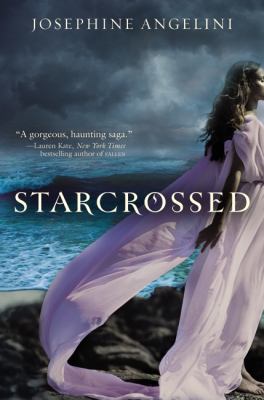
Starcrossed and Teen Book Fest! Tomorrow!

Come to the Teen Book Fest tomorrow–

Saturday, May 5

1-4 PM

Ontario Senior Center

(Just go to the Ovitt Library downtown and folks will point at the building for you!)

Bring your camera and take a photo with one of the five YA authors:

  • Josephine Angelini
  • Anna Carey
  • Tahereh Mafi
  • Alexandra Monir
  • Jay Asher

You can bring your books to be signed, or buy books there and have them signed.  (Prices are very reasonable. You can get a paperback Thirteen Reasons Why for $6.99 plus tax.)

I’m so excited about the Teen Book Fest tomorrow–I’ve been reading just one more of the authors’ books this week–Starcrossed by Josephine Angelini.  I’m not sure if I will finish–I’m three-quarters of the way through it now. Those of you who’ve read other reviews here know that I’m not into paranormal fiction myself, but that I get why so many people are. As to Starcrossed, I get why paranormal fans are going to love it!

Helen doesn’t understand why she is faster and stronger than other kids. All of her life, she’s tried to hide her talents and despairs of being considered a freak. That is until a strange new family moves to Nantucket and peaceful island life is turned upside down.  Helen discovers that the legacy of the Greek gods–who were always having affairs with humans–is alive and well in Massachusetts. Their demi-god children have passed their characteristics and powers down through thousands of years and many generation.

Anyone with just a little background in Greek mythology will immediately recognize that the three Furies are after Helen, but will have to wait to discover why. Add to that new neighbor Luke, demi-god and all around luscious guy, is crushing on Helen while his cousins try to help her control her powers so that she can combat evil demi-gods who want to kill her in order to achieve their goals. Meanwhile, Helen is getting glimpses into the nature of her long-ago disappeared mother.

Starcrossed combines some fun elements–the Greek myths are transformed and the demi-god characters are a lot like the vampires you find in YA fiction these days–but without all that nasty bloodsucking.

Helen is transforming from a meek, hunch-shouldered loner to a kicking powerhouse of electrical energy. This is a romp with a female superhero–and it’s the first in a series, so more fun for paranormal fans is on the way.

See you tomorrow at the Book Fest!

Posted in Fable/Fairy Tale/Fantasy, Fiction, Romance, Supernatural, Young Adult Literature | Tagged , , , , | Leave a comment

The Winner! California Young Reader Medal!

Just announced! This year’s California Young Reader Medal Winner!

The California Young Reader Medal is a special award because unlike most other book awards, students nominate the books through their teachers and/or librarians. Students choose the winner by reading and voting for their favorite book in each category.

This year’s winner is Graceling by Kristin Cashore.

I love to see what teens will choose. I read this novel (review is here) and could immediately see why teens would like it–the protagonist is a very strong girl and the world she lives in is magical–but for my own part, I found it repetitive and an exercise in adverbs-gone-wild. And this is why it’s good to have an award that teens choose themselves. And it’s also why I love the idea that we have a library and the opportunity to choose what we want to read, not just cram for tests.

Exercise your FREADOM right here in our library. I bought multiple copies of Graceling just after I read it–thought it might be a hit!

Posted in Adventure Stories, Fable/Fairy Tale/Fantasy, Family Problems, Fiction, Mature Readers, Over 375 pages, Romance, Supernatural, Uncategorized, Young Adult Literature | 3 Comments

That Used to Be Us–Looking Outward and Forward

That Used to Be Us—Links on looking to the future

Last thoughts on how the book connects to educators

Places to find more information

“Who knew that being an educator meant you needed to be a student of technology?” Gregg W. Downey, Editor & Publisher eSchool News

I want to create three posts on where to look while we think about how we are changing—guideposts and cool stuff to use along the way. My goal is to have the positive, the negative, and the truth that lies between them. This first of the three posts is about online resources. The second will be on books. The third will be a counterpoint to the idea (expressed in That Used to Be Us) that poverty has no effect on educational success.


Online Items of Interest

The following links are all available on Victoria’s Diigo account, tagged with TUTBU: http://www.diigo.com/user/vwaddle

INTRODUCE YOURSELF

If you aren’t tech savvy and feel like the world is changing around you, and you need a place to grab hold as it spins out of control, this is it. It’s also good for students and teachers who do some social networking and use online tools, but would like to broaden their scope.

Introductions to a variety of useful online tools—these self-paced tutorials are available from the California School Library Association and are linked to and used by folks from all over the country.

For students:

Teen Learning 2.0 – An introduction to digital treats and new technologies

For educators:

Classroom Learning 2.0

The Must-Have Guide To Helping Technophobic Educators | Edudemic (Actually, this isn’t just for technophobes—it has ideas on educational use of Twitter, Google, iPads and more.)

READING

As they say, “reading is fundamental.” How will reading change?

What other media will be fundamental?

Apple and iPads

Justice Department investigating e-book pricing – Los Angeles Times

U.S. sues Apple, publishers over eBook prices | eSchool News

Apple iBooks 2 license agreement gets icy reception in higher education | eCampus News

iBooks 2: Reinventing Textbooks Or Lulu on Steroids?

Other eBook thoughts

Are Teens Embracing E-books? (An earlier study said teens didn’t like them. This one says they do, but, ironically, they want to download ebooks for the immediacy of starting the read, but then will buy a hard copy to keep and share with friends. A fun article.)

Digital textbooks get a boost with new offerings | eSchool News

The Googlization of Books (discussion with the author of the book The Googlization of Everything)

Other Media

Media and Information Literacy Curriculum for Teachers | United Nations Educational, Scientific and Cultural Organization

Our Media, Ourselves: Are We Headed For A Matrix? : NPR Perhaps we fear technology because it will remove our stuff, reveling the emptiness of our lives?

CLASSROOMS

What will your classroom look like?

Khan Academy: The future of education? – CBS News

60 Minutes – Interviews, Profiles & Reports – CBS News

Online Teacher of the Year: Individualized instruction is key | eSchool News

Diane Ravitch outlines ed tech’s promise, perils | eSchool News

Gooru – Home Page

Gooru – Online learning

Gain a better understanding of how to use Gooru with these tools. Watch a brief video or view a tutorial. Download a PDF presentation and demo script for a step-by-step guide of Gooru product features.

Panarea Digital Debuts Nearpod For Schools

Ten education blogs worth following | eSchool News (good stuff on flipped classrooms, etc.)

Flipped learning: A response to five common criticisms | eSchool News

MentorMob – Learn What You Want, Teach What You Love – MentorMob

2012 Free Education Technology Resources eBook from EmergingEdTech

Considerations Before Deploying iPads and iPods « Socratech Seminars

Four keys to creating successful eLearning programs | eSchool News

Hyping classroom technology helps tech firms, not students – latimes.com

COOL STUFF We Should All be Using Now

Of course, there’s a plethora of cool stuff for specific content areas, but these links contain fun tools for students that are useful in classes now and will help them in using digital tools in higher education.

Top Web Annotation and Markup Tools

School Systems Blog – Four Ways to Use Pinterest in Education

Free Technology for Teachers: Embed Plus – Clip & Annotate YouTube Videos

STUDYBLUE | Make online flashcards & notes. Study anywhere, anytime.

Must See: A New Web 2.0 App Store Just For Educators | Edudemic

Posted in Non-fiction | Tagged , , | Leave a comment