I’m discussing the top banned books of the 2023-24 school year over at Be A Cactus. These are the top three:
Nineteen Minutes by Jodi Picoult
Looking for Alaska by John Green
The Perks of Being a Wallflower by Stephen Chbosky
You can look back at the post on Perks and at this one on Alaska if you want to see why I think those books belong in the high school library.
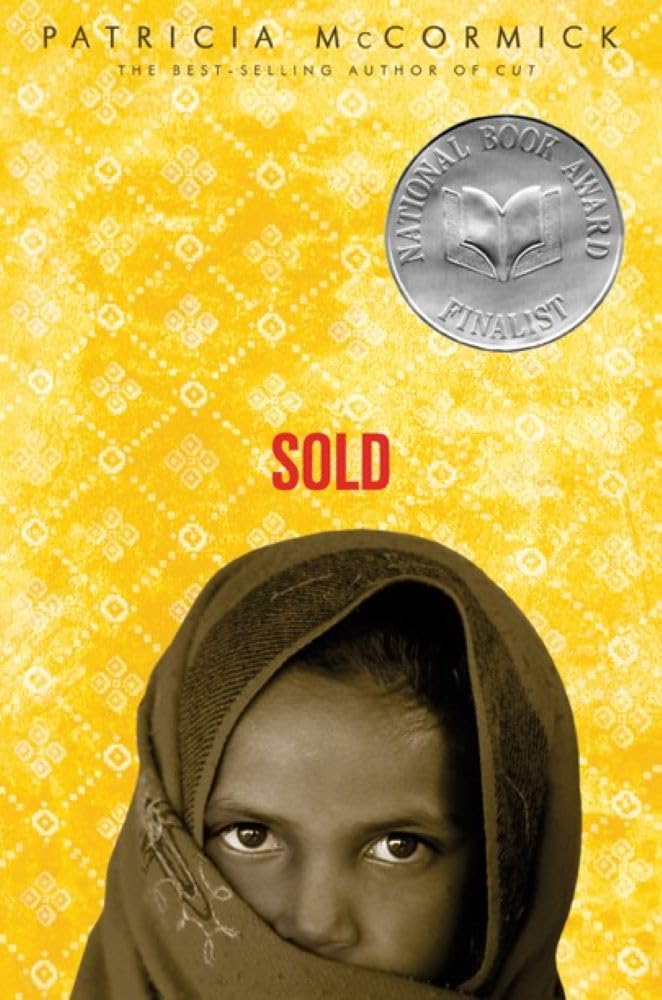
The fourth book on that ‘top banned books’ list is Sold by Patricia McCormick. We had multiple copies in the library and it was pretty popular. A librarian can’t read all the books in her library (we had a big library for a high school—over 40,000 books)—and Sold was one I hadn’t read.
I’ve discussed previously how librarians select books based on reviews and awards. As it happens, I’d read another book (Cut) by the author, Patricia McCormick, and found it very good, realistic, and hopeful about family trauma and therapy. In addition, it had wide appeal to our students and was accessible to all, even those who were reluctant readers. I booktalked it to classes. So when the reviews on Sold came out, it was a must purchase. And then it was a National Book Award Finalist.
With the other books I’ve discussed, I’ve posted my thoughts from years ago—thoughts I had when I first read the books. I thought it would be fun this week to read Sold and discuss it since it’s next on the list. So, read it I did, this Thursday.
Sold is about a thirteen-year-old girl, Lakshmi, who lives in poverty in a small village in the mountains of Nepal. Her stepfather gambles away money the family doesn’t have. He has a crippled arm and does no work of any type because of it. However, he is able to ride a motorcycle, gamble, go to the tea house daily and meet up with friends. Lakshmi’s mother tells her that it is better to have him than no man at all, an assumption the reader knows isn’t true, one based only on the patriarchal rules of the culture.
When a monsoon washes away the family’s crops, they are desperate. Lakshmi is told she is being sent to India to become a maid in a rich woman’s house. She doesn’t object, thinking she can save her family and send her earnings home. She imagines they will be able to buy a tin roof for their hut. Her mother is sad because she wanted Lakshmi to continue with school. But she instructs Lakshmi on how to gain favor as a servant and believes she will see her after a period of separation.
What neither mother nor daughter knows is that Lakshmi’s stepfather has sold her into sexual slavery. (The publisher’s summary says ‘prostitution,’ but that’s not the right description.) When Lakshmi figures out her fate, she hopes to earn her way out. But the old woman who runs the brothel is deeply cruel—perhaps sadistic is a better word—and also makes it impossible for Lakshmi to get ahead by charging for food, clothes, medicine, 50% interest on the money ‘loaned’ to her parents, etc.
When a possible opportunity for escape comes, Lakshmi doesn’t know what to believe as she has been lied to so many times by so many people, always being put in danger.
While this is a novel about a very dark topic, it is full of beauty and hope. The narrative is a novel in verse, very brief and very poetic. In Nepal, Lakshmi has the open heart of a poet, seeing the beauty in nature all around her, eloquently describing it. Even in the brothel, she makes friends with some of the other girls and learns a bit of English and Hindi from the child of one of the women there.
So—as this book is about a very difficult topic, why have it in the high school library?
Trafficking of girls (and boys) is a topic that seems to interest conservatives, a thing they claim to want to put an end to. (Remember the Pizzagate conspiracy theory?)
Information is power. The author interviewed trafficked girls and activists fighting for them to present this realistic portrayal.
Knowledge of these terrible but very real circumstances engenders empathy.
Empathy may engender action. Many high school students form clubs, get a teacher to be their advisor, bring guest speakers, and raise funds to fight for good in the world.
High school activism is a foundation for a life of concern and goodwill for humankind. Even if a student doesn’t get to this step, they’ve done the first step: read the book.
As PEN America has pointed out, 57% of the books banned in the 2023-24 school year had sex or sex-related topics. And, yes, some of them have normal, sexually-active-teen issues. But a good number are like Sold, books that are frank looks at abuse. Which is important for this age group (see bullet points above.)
In an interview, author Patricia McCormick states that her goal is to “tell this heartbreaking story from the point of view of one individual girl. … I believe that young adults want to know what’s happening to their peers on the other side of the world, but that media accounts, by their very nature, cannot usually go beyond the surface. To me, there is nothing more powerful—or permanent—than the impact of a book.”
Now—here’s an ask of you. I usually mention that I’m going to include all the spoilers in discussing banned books because you are most likely an adult and are not going to read the banned book. This time, I didn’t include the most important spoilers. I want you to read Sold. It’s so short—it’ll take about three hours, four if you look back over the lovely descriptions and read them aloud to yourself. It’s the perfect book to use to see for yourself what is going on in these banned books. The time investment is minimal; the reward is great. Think about those 57% of banned books having a sex-related topic. Should we address these topics with teens?
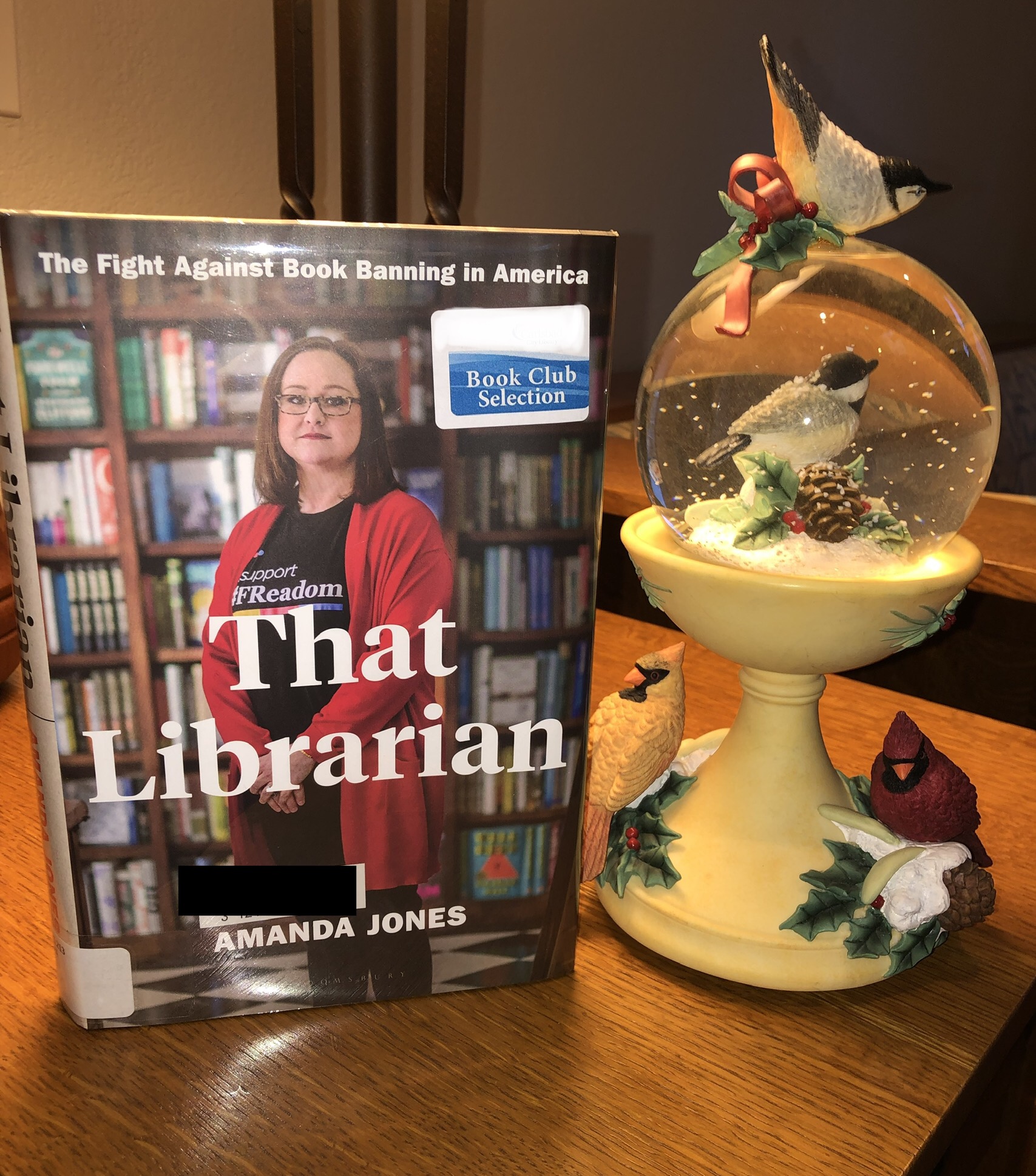
That Librarian is a memoir by Amanda Jones detailing the defamation and death threats she has had to endure after speaking in the public comments portion of a Livingston Public Library meeting in July 2022. She makes clear that her speech was centered on her concern over book bans and not focused on a particular title (she mentions no titles in her speech, the entire transcript of which is in an appendix at the end of the book).
Jones’ mission is three-fold: to prove her detractors have defamed her by lying, repeatedly and in large public forums, about her message and her goals; to show that librarians all over the country are going through similar harassment and threats, even losing their jobs; and to give the reader detailed instructions on how to fight the censors.
Jones has lived in the same small town southeast of Baton Rouge, Louisiana all her life. She is a librarian at the middle school she attended as a child. She has been the president of the Louisiana Association of School Libraries as well as the School Library Journal Librarian of the Year, and has received grants and awards for her work. In 2023, she was awarded the American Association of School Librarians’ Intellectual Freedom Award and the American Library Association’s Paul Howard Award for Courage, which honors “an individual who has exhibited unusual courage for the benefit of library programs or services.”
Yet this nationally recognized school librarian ends up being the target of the two men—Michael Lunsford and Ryan Thames—who started an online campaign against her. They tell their followers that she is a pedophile, a groomer who supports teaching kids about anal sex. That she fights to ”keep sexually erotic and pornographic materials in the kid’s section” of the public library.
Jones’s antagonists are Christian nationalists; Jones is a Christian. While these are very different things, it appears that any mention of Jones’s faith makes reviewers uncomfortable. I’ve read several reviews and none hint at it. Yet any honest discussion of the book should include it. Jones relies on her faith to shape her actions and she discusses this repeatedly. That she fights to include books with LGBTQ+ or BIPOC themes and characters is based on her following Jesus’s instructions to love (value) all people.
Her defense of diverse books leads to a pile-on of haters, people who have no idea who Jones is or what she really stands for. She receives death threats. She feels so unsafe that she purchases a Taser, pepper spray and additional security cameras around her home. Finally, she begins to carry a gun. She has to take anti-anxiety medication. This should be the saddest part of the story, but, no. Though Jones was part of a large group of people who showed up at the meeting in July 2022 to defend the right to read, the next meeting had far fewer defenders. As she states, “Nobody wanted to speak out if it meant becoming the next target.” This is how hate succeeds.
A surprising number of the religious community railing against librarians turn out to be alleged child abusers themselves as in the example of Daryl Stagg, who voiced concern over the picture book Pride Puppy! ¹ “Not long after, [Stagg] was arrested and charged with three counts each of oral sexual battery, first-degree rape, aggravated crimes against nature, and indecent behavior with a juvenile, according to Baptist Press.” ²
Even worse than the many self-righteous strangers who can’t be bothered to learn the truth while they are threatening Jones’s life and patting themselves on the back for ‘saving children’ is the betrayal by people in her own community. These are people she has known for years and whose children she has taught; people who celebrated her awards with her and commended her in public; people whom she had considered close friends. Since the book is so full of Christian arguments and imagery, they appear to be the Judases in the story. What are the thirty pieces of silver they hope to be rewarded with?
It seems each former friend/neighbor/colleague who publicly denounces Jones is running for a public office in their deeply red county, where defaming librarians is a winning narrative. Landing the office is more important than the truth. Thankfully, Jones does have friends who support her as well as one courageous supporter in her district office, whom she doesn’t name for fear of him receiving backlash.
To help the reader understand what really goes on in a librarian’s work, Jones explains that librarians curate collections. They have collection development policies. (Yes, they have to go to school for this, earning master’s degrees and/or teaching credentials in the subject.) And while the censors use BookLooks, a website from Moms for Liberty (identified as a hate group by the Southern Poverty Law Center) to judge books, librarians use reviews from professional journals.
Book censors will often say there are books containing pornographic or sexually explicit material in children’s sections of a library to rile up public fear. They decry the need to protect children from the evil smut they say is next to Dr. Seuss books. As if a kid could be looking for The Very Hungry Caterpillar and whoops, there’s The Joy of Sex or the Kama Sutra right next to it. That’s never the case. Libraries have collection development policies for ordering books, and appropriate books are placed in the appropriate section. Public libraries do not purchase pornography. Adult books are not in the children’s section, and to suggest otherwise is ridiculous.
As the harassment and threats are unending, Jones makes the decision to sue Lunsford and Thames for defamation. The defendants quickly use the court of public opinion to claim that Jones is trying to take away their First Amendment rights by not allowing them to challenge books in the library. Because they do this repeatedly, Jones must repeat that this is a defamation suit, not a question of what books are or are not in the library. And she has the receipts.
Like a good librarian, Jones keeps and catalogues the evidence of her harassment. Nevertheless, she learns through photos online that the judge in her case is friends with some of her detractors. The whole thing is jaw-dropping. I’m old enough that the song “The Night the Lights Went Out in Georgia” started playing in my head as I read. The ‘backwoods Southern lawyer’ for the defendants presents like Foghorn Leghorn; the judge appears to have very little interest in the facts of the case.
Surprisingly, there is fun in this book because Jones engages not only the Southern ‘bless your heart’ method of polite takedowns; she can directly slay her detractors as when she notes that one, an employee of Citizens for a New Louisiana,³ only writes “online snark with the spelling and grammar of a child of ten.”
She says of a fellow educator: “She kept quizzing me like I was a student … . She made comments about ‘agendas’ and things against her religion and kept trying to find some ‘gotcha’ moment with me. It’s a good thing this conversation happened through Messenger, because I almost came unglued and wanted to ask her who was she to quiz me about religion, morals, and agendas when she had a very public affair while she was married, to a police officer who was also married, and both of their marriages just ended in divorce because of it.” While Jones doesn’t name this woman in the book, I’m sure her local supporters know exactly who she’s talking about. What goes around comes around.
Jones details the tribulations of other librarians in other states. Of the censors in general, she writes: “Groups like Moms for Liberty are popping up like zits all over the country … .These people are harming public education, and they’re harming our public library systems. Nobody has ever threatened their parental rights, just like nobody is putting sexually explicit material in the children’s sections of libraries.”
In discussing her own development, Jones covers a lot of ground (Kirk Cameron! From teen crush to adult repulsion!). She’s interesting because she is one of the few people I have encountered who can look at evidence and change her mind. Coming from a very conservative family and community, she was a Republican and voted for Donald Trump in 2016. She now expresses shame in telling this, but she wants to be honest about herself and her formation. She details the events that changed her—the first being reading a book. (Of course!) She acts on her conscience thereafter.
Jones ends with some great ideas for both being aware of what is happening in the local community concerning libraries and of how to fight the censors successfully.
Amanda Jones discusses speaking out against censorship and also has links to many of her interviews on her website here.
High School Housekeeping: That Librarian is a good book for a competent high school reader. I probably wouldn’t add it to a collection for middle grades. Not that Jones does anything wrong, but the people who attack her use very sexualized descriptions.
1
A puppy gets lost at a Pride parade, but, happily, is found by the end of the book.
2
When Louisiana attorney general Jeff Landry was running for governor of Louisiana, he set up a librarian tip line where anyone could report on porn in their library’s children’s section. Instead, he received mostly spam. A list of Catholic Churches and clergy who had been accused of sexual assault was submitted.
3
Michael Lunsford is the leader of Citizens for a New Louisiana. According to Wikipedia, in reporting on Jones’s defamation trial, The New York Times referred to Citizens for a New Louisiana as a 501(c)4dark money group that can push political causes without disclosing its donors.
Rejecting Christian Nationalism, Reclaiming True Faith, and Refounding Democracy
I usually save my ‘high school housekeeping’ for the end of the post. ‘High school housekeeping’ explains why I think the book could work for a high school collection. But The False White Gospel is a bit unusual as a recommendation, so I’ll explain first.
I recently read that some of the folks objecting to library collections just wanted to have their point-of-view represented. I am quite wary of this argument as it applies to book challenges and bans—there is much evidence that books are being removed for racist, misogynistic or political reasons (see my Substack “Be a Cactus” for examples and discussions). However, I’m sure there are people (including parents) who would just like to know the library is considering its religion section and updating it so their teens can find current works there. That’s my reason for posting several books on religion in a row, which I will be doing over the next few weeks. A book that’s subtitled ‘Rejecting Christian Nationalism’ is not going to please the book banners, but it is something that will appeal to Christian students looking for guidance on putting their spirituality into practice.
“Jesus is a victim of identity theft in America.”
In the foreword to The False White Gospel, Eddie S. Glaude, Jr. states that Wallis,
“without mincing his words … understands that white Christian nationalists have clothed their hatreds in the garments of their faith.” And this is at the heart of the book. It seeks to show, through scripture, that Christian nationalism is not Christianity at all, but simply racism with a side of misogyny. Eventually Wallis suggests that Christians reframe themselves as ‘Followers of Jesus’ in order to make a distinction between themselves and those nationalist who have overtaken the public imagination of what Christians represent.
In his own introduction, Wallis suggests this is a “Bonhoeffer moment” for the American church: “They all knew who Dietrich Bonhoeffer was. A young pastor like themselves, he led the ‘confessing church’ movement in opposition to the rise of Nazism in Germany during the 1930s. These were a small minority of churches who dissented from the acquiescence and loyalty of most German churches to Hitler’s rise to power.”
While Wallis isn’t the first to recognize this moment in American history as mirroring the rise of Nazi Germany, he looks through the lens of the church and sees the church as being capable of an effective response to racism and misogyny. What’s refreshing is that he has been a part of that response for decades and has real examples of programs and political activism to back up his ideas. He makes suggestions of groups the reader can turn to to get started.
Much of Wallis’s argument stems from Jesus’s parable of the Good Samaritan, which illustrates that all people are our neighbors and deserve our attention and care. He discusses the white slaveholder religion of early America, and draws a line from it to white Christian nationalism. He also shows that continued racial separation in communities prevents us from seeing the work that needs to be done. “It is proximity that changes us.”
So, as the challenge is laid out, “white Christian nationalism is the single greatest threat to democracy in America and to the integrity of the Christian witness. … White Christian nationalism has now become the principal obstruction to achieving multiracial democracy. But it cannot just be defeated politically. It must be addressed at a deeper level, theologically and spiritually. We need a theology of democracy.”
To achieve a theology of democracy, believers must first understand the new strategy of white supremacy:
“To prevent our changing demography from changing our democracy. It is a commitment to white minority rule by any and all means necessary: covert and overt voter suppression, racial gerrymandering in reshaping representational political districts, restricted immigration, election denial with electoral corruption and manipulation, judicial bias all the way to the Supreme Court, and, when all else fails, the promotion of political violence, as January 6 revealed to us—with the threat of more of all of the above to come.”
To get started in battling Christian nationalists, believers should, “instead of wearing a bracelet that says “What Would Jesus Do?” or WWJD, it’s time to ask what did Jesus say, and what did he do. And to ask ourselves if we are willing to say and do that too.” Christian nationalist don’t do this because “a white ethnicity and patriarchal culture—with the power to keep control—is more important to many or even most white evangelicals than any gospel they allege to proclaim.” So they vote for authoritarian leaders, believing they are agents of God, sent to protect God’s chosen land and chosen people.
This is fundamentally wrong both spiritually and politically: the Judeo-Christian Bible instructs that humankind is made in the image of God. Our Declaration of Independence declares that all men are equal.
“Will we dehumanize the ‘other,’ those who are not like us, or will we embrace the image of God (imago dei in Latin) in the equal humanity of all people, of all humankind? This is not just a theological question but a very practical one. Therefore, any strategy to make it harder for Black and brown, low-income people, and young people to vote is nothing less than an assault on the imago dei. That is why our spirituality is at stake here, far more than just politics.”
Wallis’s call for change centers on the gospel of Matthew, chapter 25 (Matthew 25: 44-45: “They also will answer, ‘Lord, when did we see you hungry or thirsty or a stranger or needing clothes or sick or in prison, and did not help you?’ “He will reply, ‘Truly I tell you, whatever you did not do for one of the least of these, you did not do for me.’”) This, he says, “is also the message at the core of the Black Lives Matter (BLM) movement that so many miss, refuse to acknowledge, or reject outright.”
Several examples of ‘doing for the least of these’ fortify Wallis’s argument that it can be done. A few:
A grassroots campaign called the Catholic Nonviolence Initiative is gaining the attention of Pope Francis at the Vatican. It is a movement, especially from the global South—in Africa, South America, and southern Asia—and is mostly led by women who are engaging local conflicts in the midst of national conflicts. They are moving beyond the narrow language of “pacifism” and “just war” to actually working hard to find answers to violence.
Barrios Unidos, Spanish for “neighborhoods united,” recognized that exposure to education, arts, and technology had the power to transform the lives of young people whose circumstances deprived them of the opportunities many others take for granted. Barrios Unidos also offered former and current gang members the tools of conflict resolution that many came to embrace—practical behaviors and ways of proceeding they could bring to the street level.
Other movements that are working for change:
A broad circle of churches and faith organizations whose church bodies together represent almost one hundred million members has the mission of calling upon our elected political leaders to make a circle of protection around the least of these. They often call themselves the Matthew 25 coalition (circleofprotection.us).
Hopeful ideas:
After the mass shooting of children more than a decade ago at Sandy Hook, author Garry Wills wrote: “Few crimes are more harshly forbidden in the Old Testament than sacrifice to the god Moloch (for which see Leviticus 18:21, 20:1–5). The sacrifice referred to was of living children consumed in the fires of offering to Moloch. Ever since then, worship of Moloch has been the sign of a deeply degraded culture. … I suggest we instigate boycotts of the National Rifle Association and any company involved in gun manufacturing—in all our denominational and educational institutions.
Finally, Wallis identifies “ten commitments we all can make.” The book includes several questions for readers to ask themselves, “maybe even together in a small book group, Bible study, prayer fellowship, or a community group.” There is a sequence of steps for organizing. And something I love and don’t see often in non-academic/non-research books—an index, handy for students who are studying or writing reports.
High school housekeeping
One more housekeeping detail: While this is not a particularly difficult book to read, teens younger than high school age may get lost in the weeds, so it’s probably not a good choice for under 14 years old.
Just as the Great War—World War I—is heating up, colder-than-usual temperatures in the Antarctic leave the expedition ship, The Resolute, locked in sea ice. When the ship sinks and communication is lost with the outside world, it is presumed that all the crew is dead. And blame is laid on the fact that a woman was on board, something that is considered bad luck.
A Suffragist’s Guide to the Antarctic is a fictional work that takes inspiration from the adventures of Sir Ernest Shackleton and his crew on the Endurance. Its protagonist is Clara Ketterling-Dunbar, an eighteen-year-old American suffragist, who is passing as twenty-one years old and Canadian. This because the English currently have a low opinion of the United States, which has not entered the Great War.
Clara has been living in England with her mother (and periodically, her mostly absent father). Her upbringing includes lots of camping and learning outdoor skills, such as hunting. Without much influence from her old-fashioned sexist father, Clara becomes a feminist. She yearns for enfranchisement and joins the suffragist movement the Women’s Social and Political Union, considered by some a terrorist organization. There, she learns fighting techniques, including jiu-jitsu.
At one point, frustrated that her hard work is not gaining her any status with her crew mates, Clara writes:
“I can do anything, I want to tell them. At least let me try. If only they knew of the things I had been a part of in London! If only they knew just who on this crew had cut the telegraph wires, who on this crew had stood in front of Parliament to ask for the vote.”
Being the only woman among the shipwrecked crew, Clara experiences a lot of sexism. She keeps a diary, as do all the crew members, not only for themselves but as a record of their journey for its investors. Clara decides that her record will be a guide to the Antarctic for women.
Even those men who wish Clara well—and there are several—don’t understand her needs or desires. Primarily because they don’t ask or, when she tells them about herself, they don’t always listen, but rather fall back on female stereotypes to figure her out.
Left to survive in packed ice near the Antarctic until the weather warms, the entire crew is in extreme jeopardy. Nature is harsh. Not only is there terrific cold, but the lack of food and appropriate shelter haunt them. Some of the animals they might hunt—if those animals are in the vicinity, which isn’t a sure thing—are dangerous. Knowing when to hunt and when to keep away is a skill.
While everyone is in jeopardy from nature, Clara has the added danger of a predator crewmate, Hotchkiss. He is a wealthy Englishman who flaunts his privilege. He’s demeaning to others in the crew and self-interested, the worst sort of person in a situation where the castaways must band together. In addition, he has it out for Clara simply because she’s female. She must defend herself against him while staying in the good graces of the other crew members. It’s a difficult and frightening line to walk, leading to one of the most scary events on a regularly hair-raising journey.
While this is a story of survival, details about the ship and its contents are also interesting. Clara loses lumps of sugar and chocolate in games of poker. The ship has the equivalent of a small farm on board—chickens for eggs and pigs—before it sinks. There are dozens of sled dogs, who must be fed and kenneled (and loved by Clara!). Storms create whiteouts, so rope must be attached among all the tents to prevent death by getting lost mere feet from shelter. The crew read to pass the long hours and exchange books.
High school housekeeping
There’s a lot to love in A Suffragist’s Guide to the Antarctic. Clara is a heroine teens will root for. Many interesting details about life in the arctic region and life on a ship in the early twentieth century are woven between the intense scenes of the fight for survival. A pen and ink map of the area is included as are some notes on the real life expedition of Shackleton and the crew of the Endurance. I highly recommend A Suffragist’s Guide for high school libraries.
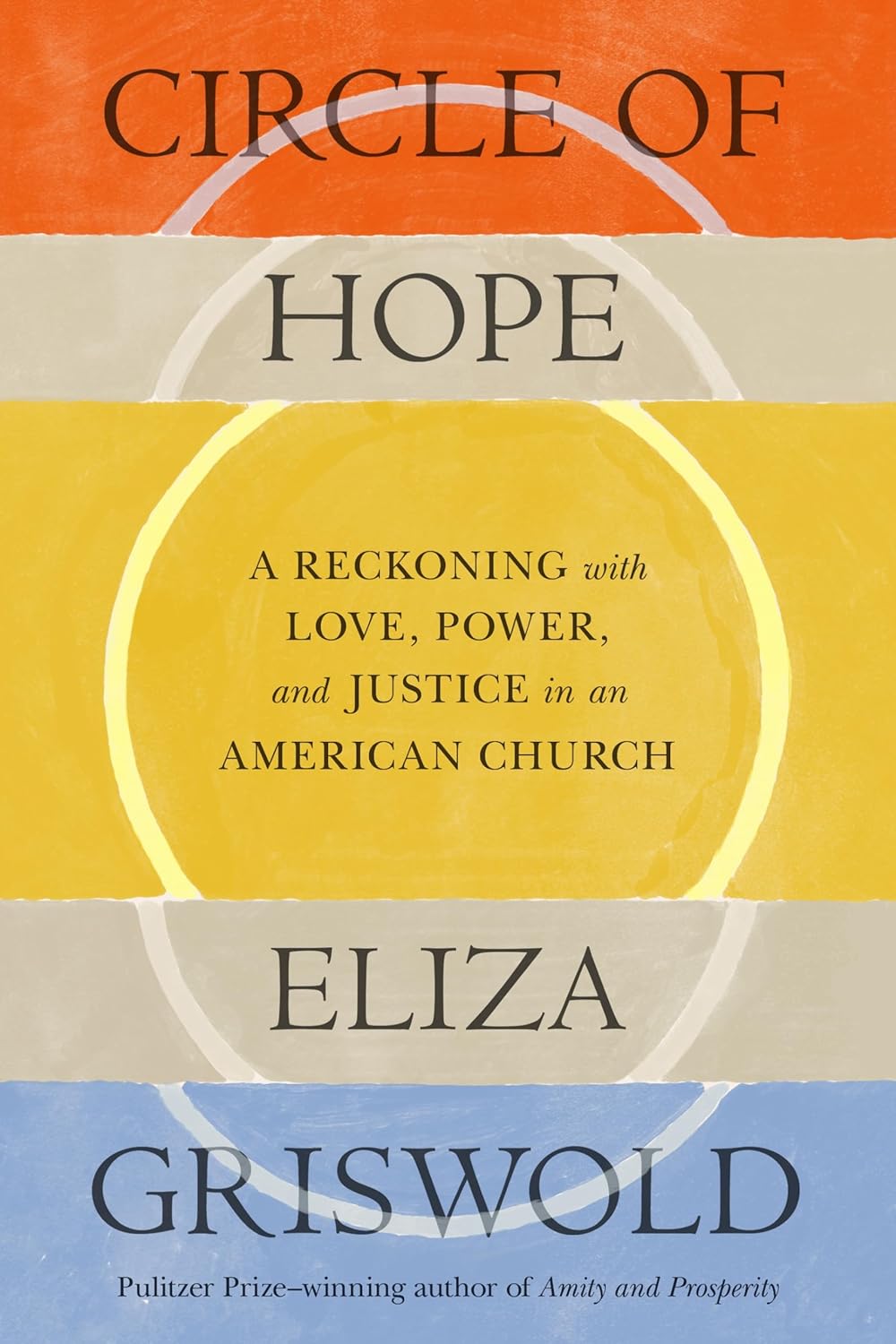
A church whose mission is to ‘love one another as Christ loves us’ is called to do the nearly impossible.
Circle of Hope
The Circle of Hope was just such a church in Philadelphia, a descendant of the Jesus movement of 1970s America. An older person might remember the words of Bernie Taupin/Elton John in the song Tiny Dancer: “Jesus freaks/Out in the street/Handing tickets out for God.” To see ‘Jesus Freaks’ was common, their ebullient conduct, on fire with the Spirit. The Circle of Hope is an updated version of this, with a desire and mission to bring the message of the Sermon on the Mount, the radical call of Christ’s love, to action. This meant caring for the neighborhoods where the circles met as well as for the peoples who resided in them.
Author and journalist Eliza Griswold embeds herself with the Circle’s four pastors: Ben White (a son of founders Gwen and Rod White), Julie Hoke, Jonny Rashid and Rachel Sensenig. The Circle leaders are a welcome reprieve from the megachurch/ mega millions pastors that feel more like con men than spiritual leaders. They live humble lives in service to the community. They start two thrift shops, profits from which enable them to help others. They plant community gardens and help undocumented people. To Circle leaders, ‘the least of these’ matters.
While Griswold maintains her narrative distance in this tale and gives each of the main players equal time and a narrative voice, I felt that the self-regard of one particular person made it impossible for the ministers to continue to hold the church together. Nevertheless, there is some element of blame—and of grace—in each of them.
Hope meets reality
What happens? During the pandemic, as meetings move online, the Circle leaders feel they must deal with the important issue of racism. What does it mean for a church to be anti-racist? Is it simply to follow the example of Christ as founder Rod White believed? Is it to explicitly work against racism by protesting police brutality (this is the period of George Floyd’s murder) and exploring the reasons behind the largely White makeup of the congregation?
By exploring who they are and what they are called to do, the leaders bring up other issues that are bothering them: the male pastors often dominate discussions and there is a sense of sexism. In the congregation at large, parishioners begin to feel they’ve failed LGBT+ community members even though the leadership professes (and desires) to be welcoming. As a part of the larger Anabaptist Church that does not approve of gay marriage, they try to stay silent on the subject. To endorse or preside over gay marriage would mean that they would be kicked out of the Anabaptist Church. And that larger church owned their buildings, so they would need to surrender their assets, have what they had worked to establish stripped away.
The circle is broken
Some well-intentioned efforts go awry (i.e., Church leaders move into the poor neighborhoods where they serve, but this drives up property costs). The more the leaders dig into the importance of social justice to the mission of the church, the more the center cannot hold. Ultimately, their differences about how to live out the message of Jesus pulls them apart. Attendance in the church is down. Circle of Hope finally decides to separate from the Anabaptists and perform gay marriage. This causes monetary contributions to plummet as members are unsure that their money won’t land in the greater Anabaptist Church while the separation is being worked out. In early 2024, the Circle disbands.
I was sorry to see this happen although the four pastors seem to move on to lives that serve in other ways. But it left me to worry about how we can live in service to one another when even these goodhearted people can’t agree. Everything they had hoped for and worked to do resonates with current social and justice issues. The end of the book leaves the reader with the larger questions: How do we move forward in radical acts of love? How do we care for one another? At the same time, it’s a comfort to see that people are trying, that the work moves into other forms. That the grace and hope of the Circle continues.
High school housekeeping
For those looking to add updated books on religion to their collection, this is a good choice. Eliza Griswold is a journalist (New Yorker) and originally intended to write a book about a church that practiced the opposite of Christian Nationalism. (She had written about that in the past.) This is a very even handed look at the Circle, without any proselytizing, so it works for public schools. For Christian religious/parochial schools it feels like a must purchase.
The four pastors each have strong narrative voices and there are also some church members who comment on the action. The narrative feels very close and personal, but the author stays above the fray, leaving the reader to evaluate the issues.
A primary reason this is a good choice for all high schools is that it confronts important social issues and issues of justice that are in the forefront of today’s world. It’s great food for thought.
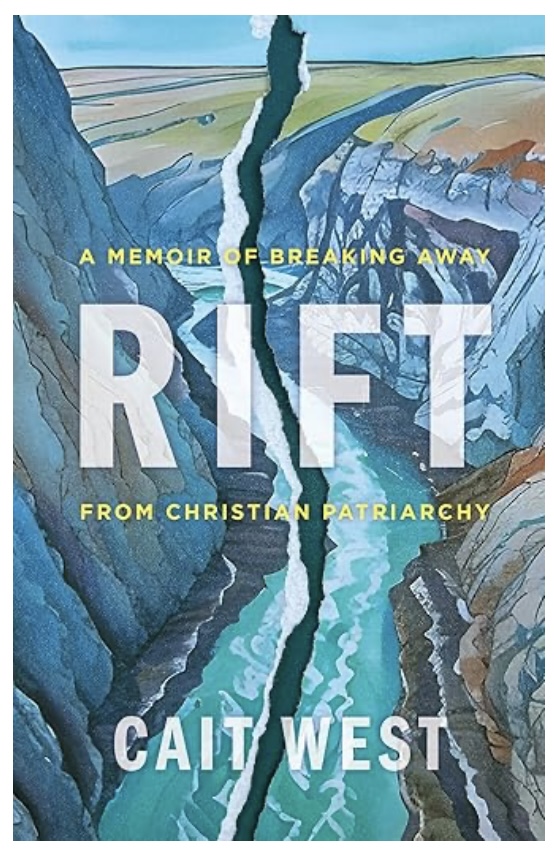
The title Rift is a nod to the author’s break from Christian patriarchy’s stay-at-home daughter movement, but it also refers to the meditations throughout the memoir about the geology of the land she lives on in the Midwest, West, and Hawai’i. The author wishes to show that the land forms the individual. Ultimately though, this is a story of:
…loss and separation.This is a story of chaos, of fragmentation, hidden beneath the facade of a happy family. This is a story of escape and risk and making it all worth it. This is a story of psychological, emotional, financial, and spiritual abuse. This is my story of survival.
Christian Patriarchy and the Stay-at-Home Daughter Movement
West is raised in Christian patriarchy, and her father joins more and more repressive churches. He becomes an adherent of the stay-at-home daughter movement. In this movement, there is no dating. Men decide who their daughters will spend time with and whether those men will ultimately make good husbands. Ironically, Mr. West and his wife met, immediately became engaged and married. That is, they controlled their own lives, futures, and marriage. Yet, he decides to oversee and have a hand in all the decisions his children make about their futures.
At five years old, West is told her two piece swimsuit is too revealing. “I didn’t know what modesty meant. I only knew I had done something wrong, that something must be wrong with the small band of skin showing at my middle. I remember feeling ashamed. I remember trying to put the guilt into the swimsuit, as if it were evil somehow, as if it had tainted me, those flimsy pieces of stretchy fabric.”
During family worship, West’s father reminds his children that all human beings are “born depraved and deserving of hell. … ‘What are people who aren’t saved?’ He would say. ‘Dead,’ we’d respond with confidence.”
Reading is Thinking
An interesting structural element of the memoir is the frequent placement of quotes from various literature that affected West’s formation. These include ads from Patriarch magazine, didactic Christian novels for children, adult books about how to be a subservient Christian wife, but also (less frequently) books like The True Confessions of Charlotte Doyle by Avi, which shows a girl breaking the rules of a restrictive society.
Patriarch magazine (tagline: equipping men to be godly leaders in family, church, and society) has an outsized influence over the way West is raised. West notes some article titles such as “The Loving Art of Spanking” and “My Child Does Not Belong to the State.”
Patriarch magazine also has a series of articles called “God’s Design for Scriptural Romance.” The author, John Thompson, gives detailed instructions for a father-controlled courtship process. These include “five fundamental principles of scriptural romance.” These are piety, patriarchy, purity, preparedness and patience. The four stages to marriage are friendship, courtship, betrothal, and wedding. None of these include falling in love. Having any sort of romantic feelings (much less any physical contact, including holding hands) before betrothal is considered a sin and a failure. West’s father will follow this courtship process in selecting mates for his kids.
Ignorance Doesn’t Result in Bliss
West’s parents hope to keep her from sex, drugs, and non-Christian media. She doesn’t have an email account. She learns general knowledge in homeschool (not evolution, of course) as well as sewing and cooking. She is more isolated than protected. A fellow homeschooler sets up activities to help her get out of the house, seeing how unhealthy her life is. At one point, West’s father conducts ‘church’ at home because he is unhappy about his elder daughter almost eloping with a man she worked with. After the period of home church, the family attends Reformation Church (an Orthodox Presbyterian Church) under the direction of Kevin Swanson.
He said women who didn’t submit to their husbands were disobeying God. He said homosexuality was an abomination. He said women’s calling was to be helpers to their husbands, that self-serving careers would be sinful. He said the ‘homosexuals’ were on the march with an aggressive agenda. He said it was okay for children to be bruised during spanking because bruises don’t last forever.
West’s worry that she is not a real Christian and her fear of displeasing her father leads to an obsessive-compulsive disorder and an eating disorder. She worries about how her dress and actions might appear to men. She is raised to consider one future: wife and mother. Thus, she needn’t go to college. While she and her brother (who is a closeted gay young man) express doubts about their belief, when they come of age, they join the church.
Out of Control Controlling Behavior
When she is an adult, West’s father reads her letters and emails to and from potential future husbands to make sure there’s nothing romantic or overly emotional in them. In fact, West is not allowed to feel any kind of love or affection for potential mates as they are auditioning (the best way I can describe it). Her father picks and then decides against more than one guy. One is too Baptist and doesn’t believe in infant baptism, but West has no feelings for him anyway. One is a closeted gay man that West feels love for. Her father tells her it’s disobedient to allow her emotions to be out of control. The young man moves away and the courtship is ended. It appears to West that her father will never find her the right mate. It appears to the reader that he is only playing a game and that his real intention is to keep her in his home permanently as a cook and house cleaner, as a caretaker. The only thing that West is allowed to do to make her own money is teach piano lessons. She is an adult with no more authority over herself than a small child.
Eventually, West decides to take action and asks David, a man she sees in church, to hang out. David asks West’s father if he may court her. At first the answer is yes and then it is no. But West is smitten. She finally defies her father, creating her own happiness. At that point, she is 25 years old. (Yes—yikes!!)
This, of course, isn’t the end of West’s troubles. Her father is angry and they become estranged. Her own mental health issues, now including PTSD, are ongoing. The memoir continues to detail how she manages a life on her own, outside of the church.
High school housekeeping
There’s a good deal in Rift that would benefit any student who has experienced trauma through high-control situations, especially high-control religions. However, while the beginning of the book is beautiful and much admired by the adult reader, it might be off-putting for some teens as it discusses the geology of West’s landscape. This gives the book a slow, literary vibe. If students want to read about escape from Christian patriarchy and the ‘stay-at-home daughter’ movement but aren’t yet the readers to appreciate this opening, they can skip the beginning pages and still get the story they are looking for.
Something avid readers will love are the discussions of books that are interspersed with West’s Story. They show how her parents were controlling her reading in order to control her thinking. But when she has the chance to read books with female protagonists escaping their confining environments, she takes lessons for her own life. Avi’s The True Confessions of Charlotte Doyle is one of the first to help her imagine freedom.
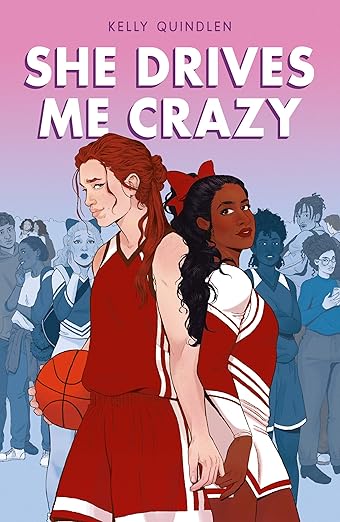
She Drives Me Crazy by Kelly Quindlen came to my attention through an article in the Sojourners newsletter. Sojourners is a left-of-center interdenominational Christian organization that works towards social and racial justice.
I’m reading books with religious elements because of my upcoming YA novel Keep Sweet
I have a YA novel about spiritual abuse that launches this June, so I’m very interested in reading books that intersect with religious practice, both positive and negative. (1) Here’s how Sojo describes She Drives Me Crazy:
In the queer, young adult novel She Drives Me Crazy, author Kelly Quindlen employs a couple of my favorite romance tropes: A fake-dating scenario and an enemies-to-lovers story arc. But when I first read the novel a few years back, I was also delighted by all the plotlines and character traits I’d never encountered in a sapphic YA romance: The two main characters — high schoolers Scottie (star of the girls’ basketball team) and Irene (captain of the cheerleading squad) — are both Catholic, and, most significantly, their Catholicism is not in conflict with their sexuality. Both Scottie and Irene’s parents are affirming; their queerness is a nonissue for their families and their church.
“THE AUTHOR WRITING YOUNG ADULT FICTION FULL OF QUEER FAITH STORIES” includes an interview of author Kelly Quindlen, and you can find it here.
She Drives Me Crazy
Religion is in no way central to the novel, but its presence in a story where it is not the main issue or driver of the plot is a nice nod to the idea that queer kids have spiritual lives.
Scottie Zajac is a high school basketball player whose ex-girlfriend used to go to the same school and play on the same team. They are openly gay. But the ex seems to be more interested in social climbing than in love and friendship. As part of her campaign for attention, she changes schools to play on a more winning team.
When the two schools come together in a pre-season game, Scottie is humiliated by the loss, but also by her ex’s treatment of her as insignificant. As she leaves after a post-game conversation with the ex, she is distracted. A girl she loathes, Irene Abraham, backs into her, damaging her own car. Their moms get involved and the next thing Scottie knows, she has to drive Irene to school while her car is being repaired. Yes, this is an enemies-to-lovers romance.
The two girls will battle but also come to value each other’s sports and the sort of competition that includes collaboration and team spirit. Irene (and others) help Scottie to see how toxic her past relationship was.
High School Housekeeping
This romance is refreshing in its focus on what a healthy relationship looks like and the family support of both girls as they work to understand what that means. If you are looking for a sweet sapphic romance that doesn’t include underlying issues of family or classmate rejection, She Drives Me Crazy is a good choice. I also enjoyed the discussion of cheerleading. I was never a cheerleader (far too uncoordinated), but I was once a cheerleading advisor for my school. The work and athletic talent rings true
Footnote
1 Keep Sweet is about sexual abuse and violence toward girls. I’ve mention in previous posts that books with sexual violence are now being deemed pornographic and have been removed from many school districts and public libraries. I particularly highlighted this in the post “Whatever is Mentionable is Manageable”and I hope you’ll read that for more details.
It’s alsoabout spiritual abuse and questioning religious authority, another topic that upsets the book ban folks. However, allowing people to read about things like sexual and spiritual abuse doesn’t promote those things. It gives readers knowledge and helps them to talk about it.
I thought you’d be interested in my most recent Substack post concerning Utah’s statewide ban of A Court of Thorns and Roses by Sarah J. Maas. Below, I’m excerpting the part of that post discussing this topic. I also always discuss the week’s library and banned/challenged book news there. Please subscribe if these are topics of interest at: Be a Cactus
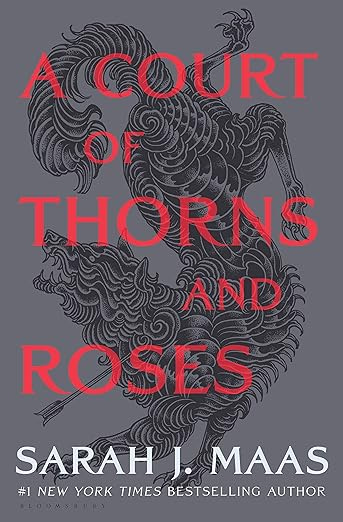
A Court of Thorns and Roses
Last week I mentioned that Utah was banning thirteen titles in schools statewide and provided a list of those titles. Six of them are from one fantasy series—Sarah J. Maas’ A Court of Thorns and Roses. I hadn’t read any of them, but, of course, I became curious. I saw quotes from reviews, some of which deemed the book “sexy.” Its target reader is thirteen years old and up.
I decided I would listen to the audiobook of the first novel in the series this week and find out what was up. I’m following with some info about it. Please understand that this isn’t a book review. It’s a sixteen-hour audiobook and, often, I was listening at double speed, not the best way to follow subplots, systems of magic, or evil faerie machinations. I just wanted to find out (within a week/in a hurry) why nearly half of the first group of books to be banned in Utah schools statewide were from this series. Add to this that I read fantasy when I want books to recommend to teens, but not often otherwise. So—I’m not always your go-to for fantasy recommendations. 1
Thorns in brief
So—A Court of Thorns and Roses is about 19-year-old human Feyre. (Her age is important—she’s an adult.) She hunts for her family, who would starve without her skills. When she kills a wolf, a beast arrives to demand retribution and takes her to faerie land. As it turns out that creature is actually Tamlin, stunningly gorgeous/ripped immortal faerie lord. The two quickly grow passionate about one another. Trouble brews and Feyre tries to sort out what the danger is. Things are magically hidden from her and, despite her being told otherwise, she learns that the fae can lie. Feyre is in constant danger and Tamlin is trying to battle epic evil in his world. The larger question is whether they and their love for one another can save them and all who depend on them in two worlds.
The novel feels like a mashup of The Hunger Games, Cinderella, and Beauty and the Beast. The reason it is banned is not because it’s pornographic. It’s because the protagonist teen is a sexual being.
Teens as sexual beings
Feyre fantasizes about Tamlin. While she hopes to keep some of these fantasies to herself, through magic, a evil faerie knows her thoughts and presents them to others: she wouldn’t mind Tamlin’s hand between her thighs; she wonders what it would feel like if he were to bite her nipple the same way he has bitten her shoulder.
There’s not a whole lot of this relative to the length of the book, but it’s there. Plus Feyre and Tamlin have sexual intercourse, which is briefly described. It’s definitely on the mature end for YA fiction. Does that mean it should be banned?
People could save a lot of time and money if they took my advice: banning books about girls wishing they had hot sex with faeries or humans is not going to stop teen girls from wanting to have hot sex. They are curious about it and reading Feyre’s fantasies probably assures teens that their own fantasies are right in there with normal behaviors.
The only thing I’d want to discuss with teens about the novel is one incident where Tamlin bites Feyre’s shoulder. It’s during a particular cultural festival where he, as faerie lord, has all his intellect stripped away and is to seek a woman to mate with. This ritual mating will replenish/make their lands fertile for the following year. Tamlin tells Feyre to hide in her room all night, but, as she never pays attention to what she is told, he catches her in the hall and bites her shoulder. She makes an escape and is later both angry and turned on. So, the attack takes place under a circumstance where Tamlin has no control over his behavior. I don’t like scenes where males have no responsibility for their sexual behavior toward women. This isn’t a reason to ban the book, but I hope the society of the novel moves forward to eliminate any thought that this is okay.
Footnote
1 I have read and enjoyed some fantasy. I needed to dip into the popular genre as a school librarian. Leigh Bardugo’s Ninth House and Hell Bent as well as Shadow and Bone; Daughter of Smoke and Boneby Laini Taylor; Beautiful Creaturesby Kami Garcia and Margaret Stohl; A Long, Long Sleep by Anna Sheehan; Wither by Lauren DeStefano; Graceling by Kristin Cashore; a lot of the Ranger’s Apprentice series and many more (search ‘fantasy’ on this website and all the titles/reviews will pop up).
I’ve loved, loved one fantasy: The Buried Giant by Kazuo Ishiguro
I don’t want to get you the idea that I’m totally unfamiliar with fantasy. But I have a hard time with it when it’s too long, too repetitive. It reminds me of being told a story by Uncle Colm in Derry Girls.
The following is part of my post for this week over at “Be a Cactus” on Substack. LulaDean’s Little Library of Banned Books is not a YA book. However, it does have some teen characters, one of whom incites the action of the book. Since it’s about a topic near and dear to librarians and readers alike, I thought I’d add it here.
Lula Dean’s Little Library of Banned Books
A few weeks back I found Lula Dean’s Little Library of Banned Books. I don’t know where I saw this—it wasn’t a review. I knew nothing about the novel, but I bought it just for the topic. Reading it, I realized it was very different from what I’m trying to do in writing about book bans. When I read the publisher’s blurbs, I found that it’s advertised as a hilarious summer read.
The novel is set in the present day in the small town of Troy, Georgia which is full of racism and has a statue of one of the town’s principal men, Augustus Wainwright, a Confederate Army general who owned a plantation and accumulated wealth on the backs of enslaved people. A few Gen X women have a longstanding feud based on their oppositional worldviews. One of them is Lula Dean, whose argument with the world is that she isn’t getting the attention she deserves. Decades after she was cut from the cheerleading squad in favor of a girl who was raped at a party while drunk (thus, Lula thinks the girl is a whore and not worthy of representing the squad), Lula still holds a grudge.
Lula finds that she can get the attention she craves through challenging books in the public library. Books are removed from the library but kept in storage while the battle is active. The argument is one based on the reality of book bans: the book banners feel young people shouldn’t be exposed to books with sensitive topics as they say these aren’t age appropriate. Lula goes even further suggesting that no one should have these books available. So nothing about queer people (specifically gay and transgender here), nothing about human bodies or their functions, nothing about violent crimes like rape, and nothing factual about history that makes (White) people feel bad.
In a fit of self-righteousness, Lula decides to place a little free library in her yard. She purchases discarded books from a charity shop very cheaply. These are not titles anyone is interested in, things about how Southern ladies should conduct themselves and the like. Out of date and out of touch—like Lula.
Major spoilers ahead
Early on, a college-aged woman, the daughter of one of Lula’s ‘enemies,’ replaces all the books in the little library with some of the books that were removed from the public library. She leaves the original book jackets on the replacement books. So now instead of books on Southern life or decor, there are books like Are You There, God? It’s Me, Margaret and The Diary of Anne Frank as well as a spell-casting instructional, books on gay romance, etc.
Being who I am—a librarian with practical experience in processing books—when I read this, the first thing I thought was: how fortunate that all the books were hardcovers with book jackets and that all the replacement books were exactly the same size. (I’m guessing no one but a librarian would pause over this.) That bothered me until I read further and realized the novel isn’t supposed to be realistic. It aims to have a crisis and an ending much like the final fun in The Maid—everything works out splendidly in the present for the good guys and they will go on to have fabulous futures. The bad guys get their comeuppance. Its goal is to poke fun at a certain element of society.
When I finished Lula Dean, I found it to be very much a morality play. The characters each represent one dimension or characteristic. There is the sexual predator town mayor, the innocent man who’s been criminalized, the activist college student, etc. Lula herself is a villain.
Book lessons
When the townspeople pick up books from Lula’s little library, each happens upon the perfect book to change their life. It seems no one knows anything about any of the books. (Did no one ever check any of them out of the public library while they were there on the shelves?) This gives the author the opportunity to tell her readers about each book and why it matters. Still, it makes most of the townspeople look pretty ignorant. That there is a woman whose husband is a White supremacist and who doesn’t understand the meaning of the flags he has around the house feels implausible. That she doesn’t know anything about Anne Frank before reading her diary is truly strange. The fact that she missed the last semester of high school because she was pregnant is meant to account for this.
Some variation of the above scenario repeats with multiple books. For each of these books, we receive a summary lesson about that book (e.g., Are You There, God? = a young boy learns that menstrual periods exist, they are normal, most women have them at some point, and that’s why his mom has those large cotton pads in her bathroom cabinet).
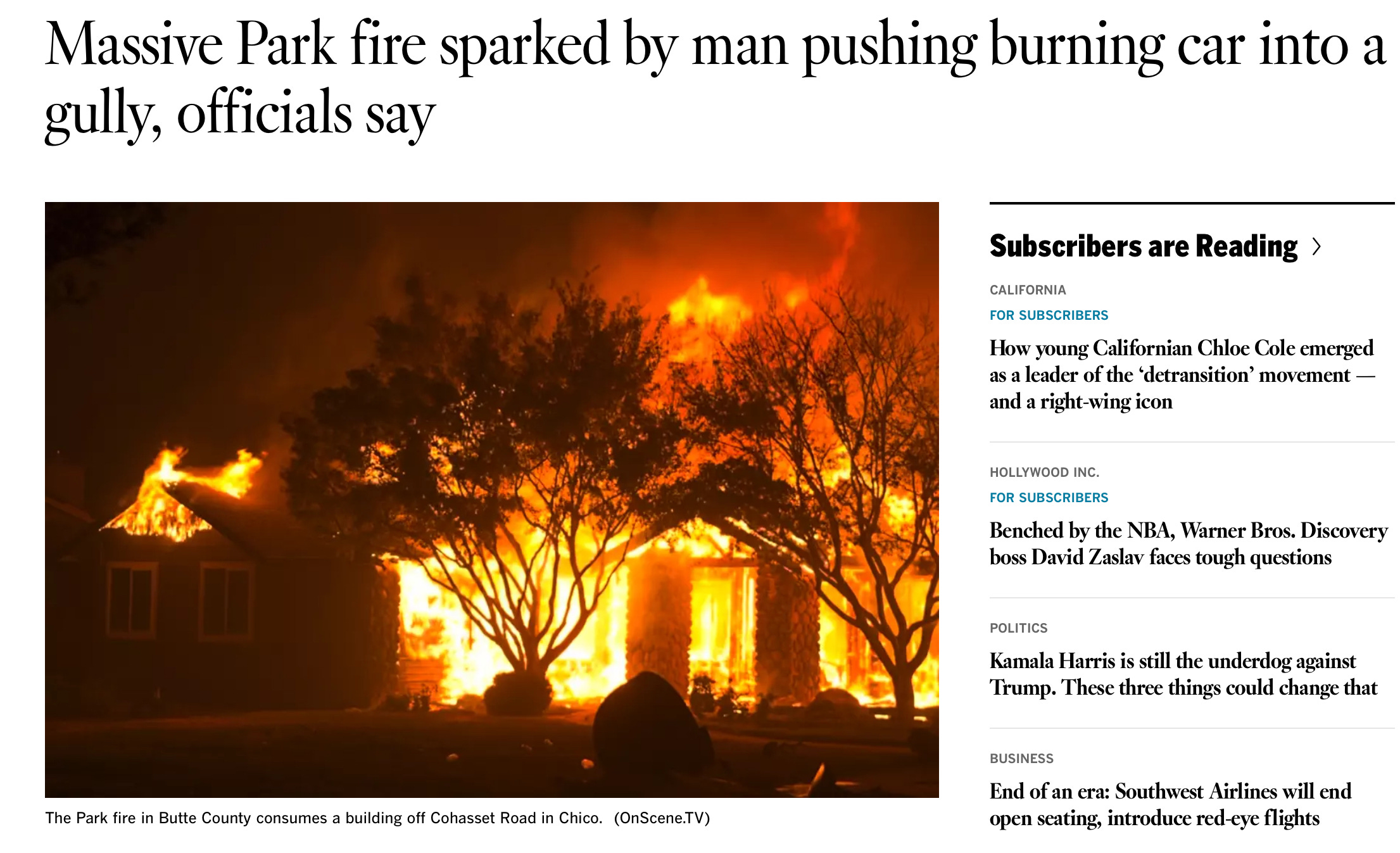
This came in my email the other day, reminding me that I might be giving people too much credit for basic knowledge and common sense. Lest we in California get cocky, as I write this, one of the largest fires the state has ever seen is burning. How was it started? It appeared that a man pushed a burning car into a wilderness gully. So, yeah. Bad ideas know no geographical bounds. (Image from LA Times website)
Lula the loser
Ultimately Lula loses her battle to ban books. She is publicly humiliated and proven to be a hypocrite whose own taste in reading materials tends to pornography. (To be clear, there’s no pornography in this book. It’s a fun read for teens as well as adults.) And once she loses, all the good guys win big, transforming their town, removing the Confederate statue, and setting racial relationships on a better path.
So, yes, it’s a feel-good read with an abundance of joy at the end. Which, I believe is the mission of the book—to spread joy and teach a bit about some iconic titles in the process. It achieves its goal.
A review of “The Well-trained Wife” and book challenge/ban news
I fell out of my decades-long practice of giving blood every three months when I moved 18 months ago. Depression has had a pretty solid hold on me, but I’m starting to do better and getting back to the ‘helper’ in me.
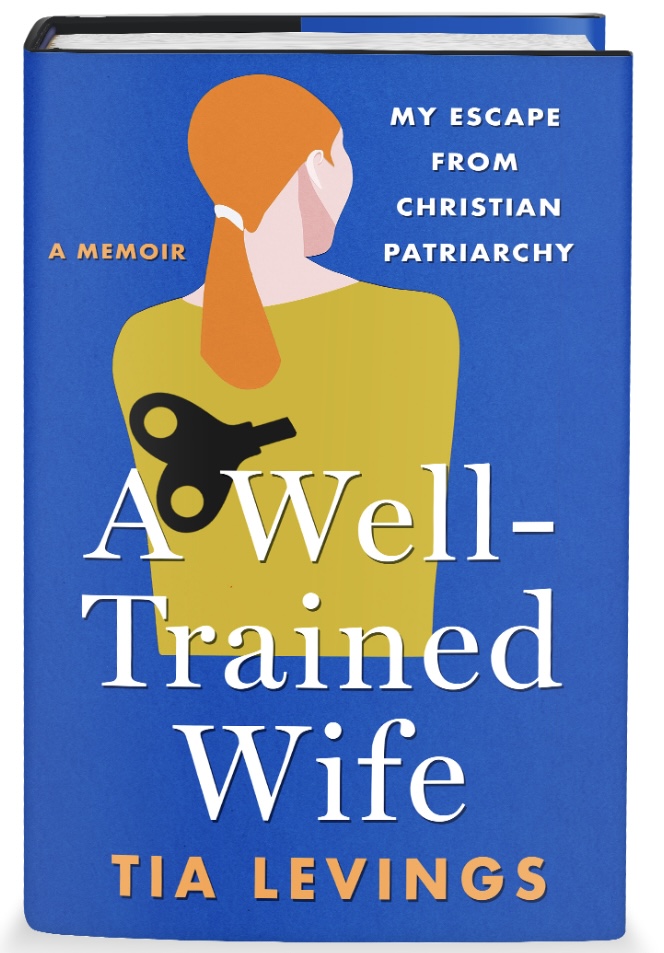
A Well-trained Wife
A Well-trained Wife details Levings’ descent from strict Baptist to Gothard woman (think the Duggars) to Calvinist following the model of Puritan Jonathan Edwards. Levings quotes “Sinners in the Hands of an Angry God,”(1) a sermon I know because we taught it in high school junior English (American Literature) to give the students a sense of Puritan beliefs. Edwards (1703-1758) was a Great Awakening (1730–1755) minister, so he came after the earliest American Puritans, after the Salem witch trials (1692-3). But his fire and brimstone homilies drove some believers to suicide.
It’s hard for a modern secularist to imagine why anyone would find themselves in a position to think this sort of spirituality could be righteous or in any way helpful. Levings’ narrative of her experiences show the reader exactly how this happens.
Before I go on, I want to note that I’m adding this book review to my School Library Lady blog as well as to Substack. With all the craziness going on right now in the book challenge/ban arena, there will be those who believe, considering what happens to Levings, that a book like this has no place in a high school library. Clearly I’m not one of them. As I’ve said often, terrible things happen to adolescents and pretending they don’t puts them in danger. Levings was very young when making her life-altering decisions based on her understanding of God and God’s plan for her. Some teens, particularly girls, will see themselves in Levings. So, I’m going there. If we can teach the origins of American Calvinism in high school English, we can also have a look at how it plays out hundreds of years later.
From Baptist
Levings grew up in a strict Baptist household, albeit one that was within the norms of conservative evangelism/Christian patriarchy. Not fulfilling for a girl with ambition, but not physically dangerous moment to moment.
In her desire to serve God as that mission is granted in Christian patriarchy (subservient wife/dutiful mother), Levings falls further into unhealthy religious views and depends on her (seriously unwell) husband for guidance, ultimately landing in two cults. Out of fear, she looks for a “new mentor to help me solve my personal ambition, before I headed for hell and took my babies with me. I knew I needed more help—books and Bible verses weren’t enough to prevent dents beneath the wallpaper when Allan slammed my head.”
To Gothard woman
She finds her first cult through Gothard women at her church, followers of Bill Gothard and the Institute in Basic Life Principles (IBLP) which holds that women should obey men in every way in all of life’s forums: home, school, workplace, and marriage. TV’s “Nineteen Kids and Counting” Duggars are IBLP followers/Gothard folks.(2)
“I’d asked Judith if I could sit at her feet and learn, like it said about older women teaching the younger in Titus. I got to join the mother club of Gothard women spreading through First Baptist. We sat together and nursed our babies, discussing Scripture, child training, recipes, and household rules.”
Levings learns that the group follows “biblical principles, not instincts.” By this, they mean to have ‘quiverful families’—that is, lots of kids (a quiverful). They don’t use birth control, ever. They practice blanket training, which is basically child abuse of infants. (Putting them on a blanket with a toy out of reach and then hitting them if they try to crawl off the blanket to get it.) Levings is even told that she can’t wear jeans, not only because it’s tempting to men, but is even tempting to her two-year-old toddler.
When Levings refuses to blanket train her kids, Judith nodded. “‘That’s fine. But setting up your child to be rebellious puts them in danger of hell. Is that what you want?’ Hot acid rose in my throat, triggering an old and familiar stomachache. What if my children were left behind? What if they burned in hell, and it was my fault? What if Y2K came and the clocks never rolled over and everything exploded, and we died? Was I being the kind of mother who could bring her children to salvation? Maybe I should try one more time.’”
Levings has babies in rapid succession, with one particularly tragic result. (3)
To Calvinist
Levings’ husband isn’t satisfied with their relationship and seems to need to degrade his wife further. He loses jobs through his temper, removes the family from support systems, and physically abuses Levings. He decides to become a Calvinist.
”Our new pastor explained. Humans are depraved worms in need of a savior but we’re such filthy sinners—insects, really—that we don’t deserve to be saved. Thankfully, a limited few are elected for heaven. Christ and His grace are irresistible to the chosen—we’re unable to say no to God. Even if we try, it’s only a matter of time and suffering until we’re broken and returned to Him. This is why Christianity hurts. Suffering aligns us with Christ, and it’s a good thing when love hurts—that’s how you know it’s real.”(4)
At this point, the abusive relationship becomes bizarre, unthinkable. Allan has determined that it’s okay for women to have sexual pleasure, so he will command Levings to have orgasms. But women also need direction and that means they need “spankings.” I’m using the quotes because there is serious physical abuse involved.
“‘They have threads on what constitutes spankable offenses. How to conduct a spanking, how to use time-outs and the corner, and what happens afterward.’
“‘You want to put me in time-out?’
“‘It’s often used in conjunction with physical discipline.’ He hurried to his next point. ‘CDD repairs problems in the marriage. And it’s done in love. Every spanking resolves with intercourse.’
“‘So, it’s sexual.’ My stomach clenched. Wife-spanking was kink in church clothes.
Levings believes that a good wife protects the family image more than her own safety. She goes along.
To seeker
The reader wonders how Levings will find her way out of this. She quotes Fred Rogers on looking for the helpers. But Rogers was quoting his mother telling him what to do in scary situations. Normal scary situations, where there would be helpers in the environment. As we know, the helpers don’t come from inside the cult. The abused have to look outside. Levings is able to do this online, through a community called Trapdoor. “The topics we studied there taught me women supporting women led to ideas. To underground networks and whispers that led to freedom and change.”
Levings starts to have two lives and her husband doesn’t know about her experiments with freedom. She marvels at the hypocrisy of her church fellows during the aughts.
“The Christians we knew were angry about the burkas we saw on the news. It was un-Christian, they said, to force women to be invisible and uniform. But I silently laughed at that. American Christians had burkas too. I wore one. The denim jumper was the American burka.”
Even religious instruction is out of bounds if it is conducted by women. “Leah shared she also wanted a woman’s Bible study or book group, but she’d been cautioned to stop asking. ‘The elders feel that women getting together is dangerous, because of our propensity to stray from spiritual topics into gossip when unattended by a head of household.’”
Levings reminds the reader that patriarchy isn’t actually good for many men. (My feeling is that it generally exists to feed one ego, that of the ‘prophet,’ church leader, etc.) “Winning didn’t feel like having won. At the end of his religious quest for covenantal belonging, Allan appeared more whipped and exhausted than triumphant patriarch, without spark or fight, without spirit or zeal. His shoulders bent with burden and regret, like an ox caught belly-deep in mud.”
To finder (of the helpers!)
Levings finally comes to the most important questions about her cult.
“What was I getting from this faith? Peace, love, joy? No—that’s not how I felt at church. Reassurance of eternal security? No—I still begged God to save me anytime the intersection of death felt close. A sense of belonging with Special Christians doing life right? I belonged, alright. I belonged too much. But what if we weren’t ‘doing it right’?”
Levings does step outside the cult on a very dangerous night when it appears her husband is about to kill her. She finds the helpers.
“Every day it was as if the more I made choices that saved me, the more others showed up to help save me too. The world, actually, was beautiful.”
And that is an excellent lesson for teens to learn.
Footnotes
1) The basic idea is that God is doing all he can to hold back from sending man into the pit of a literally fiery hell. Not only is he not that into you; he loathes you. Some images that struck me when I first read it were God about to open the floodgates upon man; man dangling as a spider over the fiery pit. It is also a call to seek forgiveness in Christ, who can save mankind from its deserved fate. (But only the few elect will receive that salvation, so be afraid anyway.)
2) Of course, now we know how well that worked out, with oldest son Josh incarcerated for child pornography. He also molested his sisters, but the statute of limitations ran out on that.
3) She stops for a beat to show how mean medical professionals can be to postpartum women, another bit of info I can vouch for and that it might be good for teens to read and prepare themselves for when the time comes.
4) I happened to read this the same day I read: “Beloved, let us love one another, because love is from God; everyone who loves is born of God and knows God.” – 1 John 4:7 Just thought you might want a counterpoint.
Library and book challenge/ban news: what I found interesting this week
Ban This Book, a children’s book written by Alan Gratz, will no longer be available in the Indian River county school district since the school board voted to remove the book last month.
Gratz’s book, which came out in 2017, follows fourth-grader Amy Anne Ollinger as she tries to check out her favorite book. Ollinger is told by the librarian she cannot, because it was banned after a classmate’s parent thought it was inappropriate. She then creates a secret banned-books library, entering into “an unexpected battle over book banning, censorship, and who has the right to decide what she and her fellow students can read”, according to the book’s description on Gratz’s website.
In a peculiar case of life imitating art, Jennifer Pippin, a parent in the coastal community, challenged the book.
… Pippin is also the chair of the local Moms for Liberty chapter, … Besides Pippin, two of the school board members who voted in favor of banning the book, Jacqueline Rosario and Gene Posca, had support from Moms for Liberty during their campaigns.
This LA Times High School Insider article from Corona Del Mar High School doesn’t have new information, but is a nice overview that can be shared with students. The author also discusses their reading of Looking for Alaskaby John Green, an often challenged and removed (banned) book.
The work is long. It is tiring. It is at a high personal cost. We’ve got enough awareness campaigns and resources. We know that in the last four years, how to fight book bans and challenges hasn’t changed — you need to vote, you need to show up to board meetings (and/or be involved on the board if possible), you have to get into your elected officials’ ears, you need to stay on top of the news, and then, choose one more thing if time and energy permit. One of those choice things might be getting involved with groups who can collaborate on a bigger mission than can be accomplished by an individual alone.
That way forward is most likely through legal and legislative actions.
If you are interested in book challenge/ban news, please subscribe to my Substack, Be a Cactus, where I include information each week.
What I’m Reading
Although I haven’t read Looking for Alaska by John Green in a looong time, it’s the often challenged book discussed in the high school article above, so here’s the link from the review I wrote back in the day. I had many copies and book-talked Alaska regularly. It was super popular with students. For many, it was their introduction to the author. They became fans. When The Fault in Our Stars, also by Green, came out, I got a grant to buy fifty copies for my two libraries (hello, budget cuts, double that job!). We had a poster contest. It was so much fun.
The Alternatives by Caoilinn Hughes Four Irish sisters are left to struggle as teens when their parents die tragically. The novel is about how that pulls them together and apart, and—hopefully—together again. A bit of philosophy. A lot of sisterhood.
A Well-trained Wife by Tia Levings (reviewed above).





 School Library Lady