“Ball Don’t Lie”

Ball Don’t Lie by Matt de la Pena   ball don't lie

“Real life always comes whipping back around at you like a boomerang. But right now there’s one last game to play. And Stickey’s right here. In the zone. Flowing. Every shot ripping through a nylon net and playing the same song. And it’s almost mean the way he does it, making people look so bad. So sad. So human. But this game is Stickey’s drug. It’s his stage. This court is Strickey’s home.”

Stickey plays basketball at Lincoln Rec in Venice (Los Angeles). And he’s a star on his high school basketball team. He is such a great player that he really does make other ballers look like fools. So he should be set, right? Set for a college scholarship and later the NBA.

But Stickey’s got more problems than any kid should have. His friend, Dante tells him,  “‘That means three of em [foster homes/parents], plus your real momma, didn’t want your ass no more. They straight up gave you away like you was nothin. . . .All these people, Stick, they decided you wasn’t worth a damn thing.’” Add to this that Stickey has OCD and will do an action repeatedly until he senses that it ‘feels’ right.

Although he’s only seventeen, Stickey has acted the part of the troubled kid, even when people try to help him. He’s in trouble with the law, commits stupid and petty crimes. His mother was an addict and a prostitute. He’s tossed out of one foster home for his behavior, loses other placements through no fault of his own. A bright spot in his life is his bookish girlfriend Anh-thu. Although there’s no fake ‘she fixes him’ story here (Stickey maintains his thievery), she does believe in Stickey. And that’s the beginning of him wondering if there really is something worthwhile at the heart of him.

High school housekeeping: Ball Don’t Lie is a great book for seeing what it’s like to be ‘in the zone’ in a sport, “No more sunlight-glare sneaking through the open doors. No more waiting on a sorry sideline, watching. No more cleaning out a cut or coming up with a birthday game plan. No more thinking.”

It’s also a good book for following a kid who is trying to make it out of a troubled life. Because it is realistic, Stickey is not always sympathetic. He claims to care for his girlfriend, but is not the sort of boyfriend a girl would dream about. He has a very hard time talking about his emotions as well as showing them. He is often on the wrong side of the law, and this is going to cost him. The one thing that he can pour everything into is basketball. He just has to learn to be a contender in life.

I recommend this book to any teen as Stickey’s story is compelling and the writing is very good. For sports fans, this is a great choice. For basketball players, it’s an excellent read.


Posted in bullying, Family Problems, Fiction, Multicultural, Romance, Sports, Young Adult Literature | Tagged , , , , , , , , , , , , , , | Leave a comment

Quick Reads: “Dead End in Norvelt”

Dead End in Norvelt by Jack Gantos   dead end in Norvelt

What an entertaining mix of fact and fiction about growing up in a small town. Founded by First Lady Eleanor Roosevelt during the Great Depression, by the early 1960’s, Norvelt is dying off. Literally.

Many of the men who helped settle the town have already died, years ago. Their lives were tragic–hard work in coal mines and steel mills hurried them off to meet their maker. But a number of the settling women survived. And then suddenly, in the summer of 1962, the women start dropping like flies. One of those first residents of the town–Miss Volker–is a nurse and had been charged with the duty of ‘medical examiner’ by Eleanor Roosevelt herself. When young Jack is called to her house, he is happy to go only because he needs to escape being grounded all summer. He’d fired a ‘souvenir’ Japanese rifle that his dad brought home from World War II service. he was goofing off, pointing at a drive-in movie screen when the gun discharges a bullet. A bullet that Jack swears he did not load into the gun.

And so begins the two mysteries–who put that bullet in the gun and why? And is it possible that all these old ladies are dying of natural causes within days of one another?

The reader will enjoy the bit of mystery, but mostly this little novel is full of the fun that comes with getting to know the weird, eccentric characters who live in Norvelt. Jack is so young and naive that his perception of the world leads to some very funny scenes. Very early in the novel, when Jack goes over to Miss Volker’s house and she is boiling her hands and pulling the stump of her arms out of the pot of wax, you’ll be hooked. Jack’s constant bloody noses and Miss Volker’s kitchen-table cure with what appears to Jack as a hot poker are wacky good fun.

Dead End in Norvelt helps the reader to glimpse some 20th-century history in a way that’s also entertaining–it’s incorporated into each one of the town obituaries, the writing of which is another task of Miss Volker’s–and now, of Jack’s. You’ll also get some up-close views of the undertaking business (and, thus, a number of dead bodies), a town scare from the Hell’s Angels, a search for an arsonist and more. Through it all, Jack is constantly trying to get out of his grounding punishment so that he can hang out with his friends. He tries to play his parents against one another, and often it works. He is tasked with driving although he’s eleven, and hopes to have a chance to fly the plane that his dad is secretly building.

High school housekeeping: Dead End in Norvelt is geared to a ‘tween’ audience, a bit younger than you are. But as an adult, I found it very sweetly comic and entertaining. It’s a fun, fast read. A teen can learn a lot very easily about major events in the 20th-century and even pick up some facts about ancient civilizations. There’s also good characterization that gives a sense of the difference between people whose politics lean left and right. There’s just so much packed into this book that I highly recommend it to teens. However, if you want to read something similar, but at an adult level, try the books of Fannie Flagg like Fried Green Tomatoes at the Whistle Stop Cafe or Daisy Fay and the Miracle Man. If you want adult nonfiction with murder and quirky characters, try Midnight in the Garden of Good and Evil. And if you just want some adult nonfiction about the undertaking business and other aspects of dealing with dead bodies, try Stiff. If you want to read adult nonfiction about another seriously crazy part of author Jack Gantos’s life (drug smuggling, addiction, prison, reform) read A Hole in My Life.

Posted in Adventure Stories, Family Problems, Horror/Mystery/Suspense, Young Adult Literature | Tagged , , , , , , , , , , , , , , | Leave a comment

Quick Reads: “Marty’s Diary”

Marty's DiaryMarty’s Diary by Frances Cross

Marty’s parents are divorced from one another and both are remarried. Although Marty’s mom has moved to Mexico City and had a new baby boy, Marty is not angry at her. She feels that her mom is an adventurous soul.

The person she is really mad at is her father’s new wife, Linda. Marty lives with her dad and Linda. Her feeling is that  Linda exists to wreck her life. She keeps a diary in her senior year of high school and documents everything that Linda does to make her angry.

Linda keeps her own documentation of her relationship with Marty through letters to a friend named Paula. they irritate one another over disagreements on sloppiness and responsibility. They have completely different taste in clothes and lifestyles. Even when they are trying to be kind to one another, they misread each other’s motivations, leading to more anger. Linda confesses that she doesn’t have life all worked out despite being an adult.

The situation is sad. As Linda points out, “‘Marty doesn’t know me any better than I know her, and that’s a tragedy.’”

High school housekeeping: Marty’s Diary is part of the Cutting Edge series, a series for struggling teen readers. The Lexile level is 710–so about the fifth grade reading level. It’s a good book about step-relationships for its intended audience as it shows the drama from both sides. However, if you are not struggling with reading, try something with a bit more texture and detail.

Posted in Family Problems, Fiction, Hi-Low/Quick Read, Young Adult Literature | Tagged , , , , , , , , , , | Leave a comment

YALSA’s Teens’ Top Ten Nominees are here!

Posted in Fiction, Young Adult Literature | Tagged , , , , , | Leave a comment

“Send”

Send by Patty Blount  send

“A punch to the jaw wasn’t how I imagined starting my first day at another new school, but fate had a warped sense of humor.”

So begins Send, with Daniel (and/or Ken) making the decision to intervene in what looks like a smaller student about to be beaten by a bigger guy.

Dan doesn’t make the decision lightly. He sees a girl watching–he later learns that it’s Julie–and thinks that she will say something to the bully (Jeff). But she refuses to intervene. Dan, who has had to move from school to school, is supposed to be flying under the radar, not getting involved in anything, certainly not making enemies out of tough guys. But how can he stand by and watch?

Ironic, this. Because Dan has a secret that he hopes to keep from the entire school, the thing that has kept him on the move, fleeing from a man who wants revenge. At thirteen, Dan–when he was Ken–cyberbullied a twelve-year-old boy by posting online a picture of him in babyish underwear. The consequences are the worst possible. Justice is swift. Dan finds himself not only locked up, but labeled as a sexual predator and more. He is bullied in juvenile detention and is a terrible mess–physically and mentally and emotionally–when he comes out.

Dan breaks into two personalities–he is also still Ken, but Ken remains a thirteen year old. Dan is consumed with guilt and considers himself a murderer. So when Julie takes an interest in him, he’s not sure that he should get involved. After all, he can’t tell her the truth about himself.

What Dan doesn’t realize is that a lot of people have something to hide. All the major characters in this story are a hot mess. No one really knows the motivation for anyone else’s actions. And that can cause a lot of trouble, even deadly trouble.

High school housekeeping: Send is a thoughtful book about the consequences of impulsive actions and whether people have a ‘duty to respond’ when they see something that isn’t right. It’s also a suspenseful ride through a crazy senior year for a guy who is trying to redeem himself. It includes some interesting views of friendship and romance as well. While the writing is not ‘literary quality,’ and the book has too many coincidences, the reader doesn’t mind. As a whole, the novel is satisfying, Combine all that with a movie-like white-knuckler ending, and you have a book that just about any teen would love. I think Send would make a great teen book club choice. Luckily, it includes some discussion questions at the end for those interested in doing so. Altogether, a very satisfying read. Enjoy

Posted in bullying, Controversial Issue/Debate, Family Problems, Fiction, Human Rights Issues, Romance, Young Adult Literature | Tagged , , , , , , , , , , , , , , , , , , | 1 Comment

Adult Books for Teens: Autobiography: “Lone Survivor”

This slideshow requires JavaScript.

Lone Survivor by Marcus Luttrell and Patrick Robinson

Marcus Luttrell has trained his entire life to arrive at the moment when he and three fellow members of Navy SEAL Team 10 creep along the Afghanistan-Pakistan border in search of a top-level Al Qaeda warlord. But he could never have anticipated the firefight Team 10 would be involved in or the resulting loss of his three fellow SEALs.

As boys, Marcus and his brother live a country life. Their parents raise horses. The kids wrestle alligators. Marcus knows that he wants to serve his country, and he happens to live in a place where a local man, Billy Shelton, pre-trains young men to be ready for military service, including service in the Special Forces.

If Marcus thinks that Shelton’s grueling training schedule is tough, he has much to learn in Navy boot camp. He takes to heart the motto Honor, Courage, Commitment. After boot camp, Luttrell moves directly into Navy SEAL Indoctrination, which is its own bit of hell. The pain recruits experience is equally physical–from all of the swimming (near drowning), running, and climbing–emotional and psychological. Most guys quit. A few of the photos included in the book give the reader a general sense of why. (What it means to ‘get wet and sandy’ is one example.) Yet, the very detailed narrative of the ‘Indoc’ brings it all home.

Luttrell is trained as a sniper. He becomes “supremely confident, because we’re indoctrinated with a belief in victory at all costs. . .  We’re invincible, right? Unstoppable. That’s what I believed to the depths of my spirit on the day they pinned the Trident on my chest. I still believe it. And I always will.”

Luttrell has many tests of his resolve, but, of course, the greatest is Operation Redwing. To say too much about what happens would be to ruin the intense suspense of the firefights. Suffice it to say that I never knew people could be shot so many times and continue to fight. For awhile, the four men do seem to be invincible–not as a Navy SEAL unit or mission, but on an individual, mortal level. But they are so outnumbered that, eventually, three fall. Luttrell feels strongly that several miracles–genuine acts of God–play into his survival. His being unreachable by the enemy and the fact that no matter how many times he has to leap down the side of a cliff, his gun always lands within his reach, are two.

Although Luttrell survives the firefights, he is wounded. Bleeding profusely and tormented by thirst, he tries to crawl to safety. He is met by friendly Afghans, and here another chapter of his survival begins. He tells the reader that he didn’t know whether these Afghans were going to help him or kill him–and they can’t communicate their intentions because of the language barrier. But Luttrell is so badly injured and near death that he has no choice but to be carried away. Fortunately, he learns of Lokhay, a tribal law that demands that the entire village will risk all lives–is honor-bound–to save the individual they have invited to share their hospitality.This promise leads to its own suspense as the Taliban leans on the village and its leaders to give Luttrell up.

In general, the narration of the memoir is exciting and the reader feels deep compassion as well as genuine respect for Luttrell and all Navy SEALs. At times, I found myself in tears and had to put the book down for a bit. Exceptions to the overall power of the narrative were the digressions on Texans being the best people on the planet and on then-sitting President George W. Bush being a near God. Luttrell also blasts the ‘liberal media’ at any opportunity, and, in fact, blames it (and I believe liberal thinkers in general) for the deaths of his fellow warriors. I’m a fairly liberal thinker, so I’ve ruminated on this a lot since I’ve read the book. It might be too much of a spoiler to give details on the event that leads to the later firefights. But Luttrell feels that a critical decision SEAL Team 10 made that day was based on how their actions would be reported in the liberal media. He is sure that this choice led to the deaths of the men. He’s right–it did. It seems to me that any choice would have led to the same end. They were in a situation that was impossible to get out of. Fate handed them a no-win moment. No matter what they action they decided on, the Taliban would have been alerted and found them.

High school housekeeping: This memoir is highly engaging and deeply suspenseful despite the fact that the reader knows the outcome from the title. Teens will be engrossed by the narrative and by the smart-mouthed folksy humor that dots the story. Anyone thinking of going into military service should read it. Perhaps it should be required reading for anyone who wants to be a member of Special Forces. As an adult working with teens, I infrequently come across those who aren’t doing their work,but seem to be lounging their way through school. When I ask them to sit up straight and start working, they reply, “I don’t need to do this. I’m going to be a –(fill in the blank here–Marine, Navy SEAL, etc.)” Yeah–right. Read Lone Survivor and see what it really means to have that sort of dedication, will and the determination to never give up.

Posted in Adventure Stories, Biography/Memoir, Faith-Based/Religious Element, Movie Tie-In, Non-fiction, Over 375 pages | Tagged , , , , , , , , , , , , , , , , , , , , , | Leave a comment

“School Spirits”

School Spirits by Rachel Hawkins   school spirits

Related to the Hex Hall series

Izzy Brannick hunts monsters of all types. However, she finds tracking and binding ghosts to be less than challenging. So when her mom (Aislinn) tells her that they are moving to Ideal, Mississippi to stifle a ghost that has been haunting a high school, Izzy is at first unenthusiastic. However, she goes along, partly because she thinks her mom has another reason for making Ideal their new (but temporary) home. Her mom is doing some secret research. Though she won’t say what it is, Izzy believes that Aislinn is hunting down clues to the disappearance of Finn, Izzy’s older sister.

Izzy’s enthusiasm for ghost hunting picks up after she dislocates a bully’s shoulder in dodge ball and consequently meets the members of PMS—Paranormal Management Society (yes—ha!). It’s not so good when ordinary people dabble in magic as the PMS members—Romy, Anderson, and Dex—are doing. They can sometimes unleash the fury of the supernatural on a town. And maybe that’s what’s happening here. But how? Izzy feels electric sparks when she accidentally touches Dex. Is it love? It feels like it. Or is he Prodigium? That is, is Dex an evil warlock?

High school housekeeping: This novel is so much fun. The ghost hunting is good, but I love that it is peppered with comedy and a few silly puns. Of course, it has the necessary romance, but it is very sweet and innocent—a nice change from what I’ve been reading lately. It’s an easy read and I found myself quickly pulled into the story. Now I’d like to go back and read the Hex Hall books as I imagine that they are equally as entertaining. I recommend School Spirits to anyone interested in stories about the paranormal, including teens working on their reading skills.

On a personal note, I want to thank an anonymous friend who donated thirty copies of School Spirits to me so that I could read it with my Bookies Book Club. We are going to talk about the novel over the next few weeks. So excited anytime I get to talk story with teens!

Posted in Adventure Stories, Family Problems, Fiction, Hi-Low/Quick Read, Horror/Mystery/Suspense, Supernatural, Young Adult Literature | Tagged , , , , , , , , , , , , , | 1 Comment

“Criminal”

Criminal by Terra Elan McVoy  criminal

Nikki is absolutely crazy for her boyfriend Dee. Though he often seems distant, she rationalizes his behavior. After all, among his many tattoos is the one she is can’t help bringing her lips to–N–for Nikki.

As Criminal opens, Dee and Nikki are getting out of bed to head to the police station for questioning–and getting their stories to line up as they drive. The reader doesn’t know what has happened, but it’s clear that Dee has done something, and Nikki is involved. She thinks about wigs and clothes and wonders what to do with them. Nikki knows that she heard gunshots, but Dee won’t say what that was about. When she asks, he tells her, “‘You don’t need to think. What you need to do is shut up and just sit tight. Do what I tell you.’”

Blinded by love, she is willing to obey. She hasn’t known real love in her life. Her mother is a drug addict who tries to sell her in exchange for drugs. So, Nikki must stick by Dee no matter what he’s done. But by lunchtime, she sees that a man–a retired deputy–was killed the day before at a house where Dee had jumped out of the car, telling her to wait for him around the corner.

Nikki tries to help Dee by cleaning fingerprints off of her friend Bird’s Mustang–the car that Dee and Nikki used without permission. What Nikki doesn’t realize is how much trouble she is in. The police are going to find the killer. And Nikki is an accessory to murder—she aided the murderer by driving the car. She doesn’t seem to have a clue that she is headed to prison, or that by using Bird’s car, Dee has Implicated Bird, Nikki’s only friend, in the murder.

What Nikki does learn during her first round of police questioning is that Dee has a girlfriend named Nicole, and he has been in contact with her, writing her love letters. So who is that N tattoo for?

Nikki has time to sort it out in prison, to think about Dee and his other girlfriend, Nicole. Even though she’s given Dee everything, he expects her to stay quiet about what he’s done. But if Nikki expects to survive, she’s going to have to face the truth. About Dee. About herself.

High school housekeeping: Nikki is such a hot mess. She is needy, needy because she hasn’t gotten the love that helps a person to have a bit of self-esteem. But, boy, does she pick the wrong guy to give her heart to. Dee plays her for his own secret purposes. You’ll be fully engaged in her story, because you can see how she’s been fooled. But Criminal has more to show you. About how to finally grow up, how to become self-reliant.

Early on, Nikki feels that Dee completes her. “[M]e just wanting him to take it all for himself.To give him comfort. And to fill me up so that I wouldn’t have any more room for stupid, ugly, disappointing me. . . . I was something of worth then. I had given to him, and he had taken, and we were both complete.” To keep this feeling, she betrays her friend. And as Bird tells Nikki when she tries to explain, “‘It don’t matter what you meant. What matters is what you did.’”

That’s an important lesson for anyone to learn. And, hopefully, much sooner and more easily than Nikki learns it.

Posted in Family Problems, Fiction, Mature Readers, Multicultural, Young Adult Literature | Tagged , , , , , , , , , , , , , , , | Leave a comment

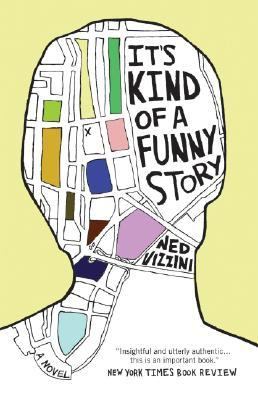
“It’s Kind of a Funny Story”

it's kind of a funny   It’s Kind of a Funny Story by Ned Vizzini

When he’s only fifteen years old, Craig Gilner is so depressed that he makes a plan to kill himself–he’s going to throw himself off the Brooklyn Bridge.

Thankfully, Craig  has the presence of mind to call a suicide hotline. He ends up checking himself into a mental hospital–all at night, while his parents are sleeping. The hospital’s adolescent ward is full to bursting, so Craig is housed with the adult patients.

Thus begins Craig’s strange road to recovery. At first, he has a hard time understanding why he is so deeply depressed and wanting to take his own life. He has super supportive, loving parents. He lives in a safe environment. He goes to one of the best high schools in the country. He hasn’t had the horrible things happen to him that other patients have had. A girl Craig is very interested in, Noelle, is one example. She has deeply cut and scarred her face–and not for no reason.

The reader can see quickly that Craig’s single-minded drive to attend a super-competitive prep school is going to be a problem. Executive Pre-Professional High School in Manhattan is the school to go to for people who want to rise to the tops of their professions. Because Craig sees it as the only key to his future success, he drills incessantly and studies endlessly, until he really has no other life.

Only after he gets into this elite school does he realize that he is not super smart. He has been depressed in the past, but has felt better with the antidepressant drug Zoloft. Unfortunately, when he’s feeling better, he thinks he should stop taking his medicine. He plummets back into a depressive state. He can’t seem to force himself to do his school work and gets farther and farther behind. He smokes a lot of pot, desires his best friend’s girlfriend, and can’t see how his life could be made better.

Craig’s five days in the hospital help him in numerous ways. He knows he has to be on medication; he realizes that the ‘flawed’ Noelle is a very good person and one whom he wants to spend time with; he feels deep empathy for the several eccentric adults he meets in the mental hospital. The most important outcome of Craig’s hospital stay is his understanding that his choice of Executive Pre-Professional High School wasn’t a good one for him. He explores his wonderful and off-beat creativity and knows that it is there where he will find his happiness.

High school housekeeping: An easy criticism of It’s Kind of a Funny Story is that all these things–these cures, if you will–don’t happen to deeply depressed people within five days of hospitalization. True enough, but I think this works in the fictive world of the novel. For teens, the whirlwind of activity is engaging and the story moves at a good pace. One very realistic aspect of the story is that Craig stops taking his medication when he starts feeling better. Many people with various mental illnesses do this, and sometimes the results are tragic. I think this happens because society still stigmatizes mental illnesses. When others feel that all a depressed person has to do is ‘pull himself out of it,’ he will believe this. In It’s Kind of a Funny Story, this is shown very well with the voice of the Army sergeant who spins through Craig’s head, calling him ‘soldier’ and telling him he’s just lazy. But current research is showing that depression is biologically based, and someone isn’t going to pull himself out of it anymore than he is going to pull himself out of cancer.

Craig’s creative outlet is wonderfully quirky as well as artistic. You’ll like him. You’ll enjoy the way he learns more about himself and comes to terms with who he is. Some of the books I’ve been reading lately (I’ll Give You the Sun is a good example) have, at their heart, a meditation on the need to be creative, to be an artist. For anyone who feels a compulsion to focus on something that none of his or her friends enjoy, this is a great read. That thing could be an art or writing, but it could be biological research as well. It could be anything that the heart yearns to do. The point is to recognize your truest self and engage with that person.

Posted in Family Problems, Fiction, Over 375 pages, Romance, Young Adult Literature | Tagged , , , , , , , , , , , , , | 2 Comments

Nonfiction: Common Core: “The Sociopath Next Door”

The Sociopath Next Door by Martha Stout  sociopath next door

Something that has always interested me about people who are charismatic is how often they turn out to be evil. In school, we all learn this about dictators–watch film of them mesmerizing crowds with their fiery speeches, leading ordinary folks to do extraordinary things, often foolish or downright horrifying. Why does this happen? And how are we all so blinded by these leaders?

In her book The Sociopath Next Door, Martha Stout, who has a Ph.D. in clinical psychology, provides her readers with an answer. Equally interesting is her proposition that the type of brain that leads someone to be a megalomaniacal leader or a serial killer is also the type of brain that makes someone with lesser goals use others to serve their own purposes. In fact, she contends that one in every twenty-five people is a sociopath.

A sociopath (someone with ‘antisocial personality disorder’), as defined here, is someone without a conscience. S/he has no empathy or feelings for any living thing. So–there’s no way to shame that person or make her feel guilty. But like the exciting political leader, these seemingly ordinary men and women have ‘leadership’ traits. They are charming–as long as you don’t know them too well. They are also so spontaneous and sexy that others are easily attracted to them. But once they have others under their spell, they use and abuse them–sometimes physically, often emotionally and psychologically. Because they start out being so charming, it takes the victim a long time to realize the kind of person she is dealing with. No one wants to believe that someone they know is completely unscrupulous.

Coming to terms with a sociopath is strange for other reasons as well. Stout discusses how their brains are unlike the average person’s–and that they are born with their inability to feel anything (except, for some reason, glee at harming others). With this being so, are they responsible for their behavior? Nurturing–or lack of nurturing–appears to have some effect on their behavior. Loving parents and friends can’t make a sociopath care about others, but lack of care and structure can make their behaviors worse. Stout tells us we should be grateful that we are born with empathy and shows how much it adds to our daily life and happiness.

High school housekeeping: This is a quick read of a few hundred pages. Although an adult book, The Sociopath Next Door has great appeal to high school students. It’s a good nonfiction choice (Common Core) because Stout gives the reader several examples of sociopaths in everyday life and work places as well as examples of behaviors that indicate antisocial personality disorder (tortures animals or did so as a child; demands sadistic, torturous sex; throws decent coworkers under the bus for the pleasure of doing so; and many more). She has thirteen rules for defending yourself against a sociopath. Her ‘rule of threes’ is a good life skill to practice even if the people you are dealing with are not sociopaths, but merely narcissistic. Someone can lie or hurt you once and be forgiven, But if someone messes with you three times–and when a sociopath does this, s/he will ask you for pity (it’s all about him or her!)–you are done with that person. Trust your instincts even if the other person has authority. And read this book for a clear picture of how to keep someone without a conscience from messing with your well being.

Posted in bullying, Family Problems, Non-fiction | Tagged , , , , , , , , , , , | 3 Comments