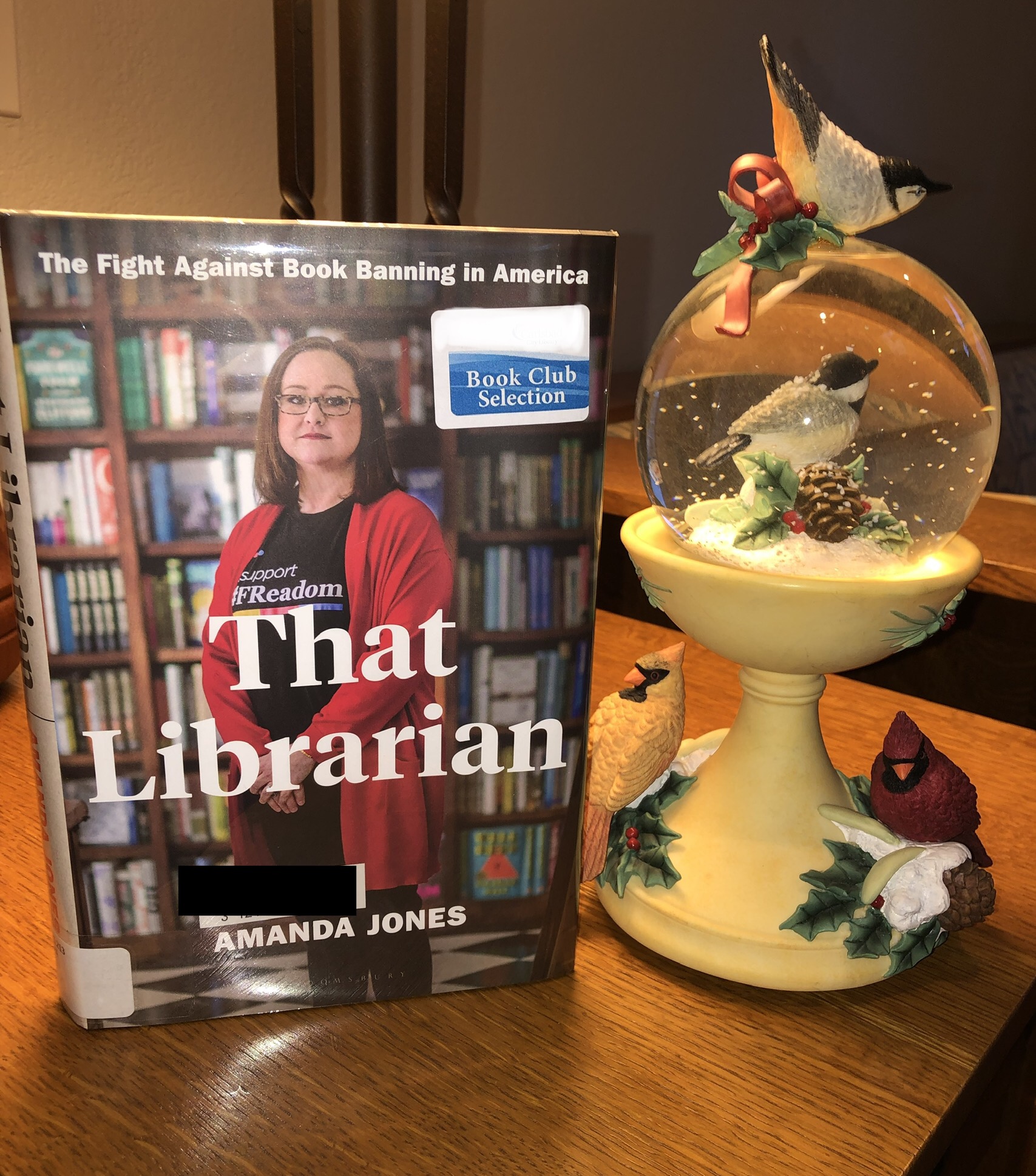
That Librarian is a memoir by Amanda Jones detailing the defamation and death threats she has had to endure after speaking in the public comments portion of a Livingston Public Library meeting in July 2022. She makes clear that her speech was centered on her concern over book bans and not focused on a particular title (she mentions no titles in her speech, the entire transcript of which is in an appendix at the end of the book).
Jones’ mission is three-fold: to prove her detractors have defamed her by lying, repeatedly and in large public forums, about her message and her goals; to show that librarians all over the country are going through similar harassment and threats, even losing their jobs; and to give the reader detailed instructions on how to fight the censors.
Jones has lived in the same small town southeast of Baton Rouge, Louisiana all her life. She is a librarian at the middle school she attended as a child. She has been the president of the Louisiana Association of School Libraries as well as the School Library Journal Librarian of the Year, and has received grants and awards for her work. In 2023, she was awarded the American Association of School Librarians’ Intellectual Freedom Award and the American Library Association’s Paul Howard Award for Courage, which honors “an individual who has exhibited unusual courage for the benefit of library programs or services.”
Yet this nationally recognized school librarian ends up being the target of the two men—Michael Lunsford and Ryan Thames—who started an online campaign against her. They tell their followers that she is a pedophile, a groomer who supports teaching kids about anal sex. That she fights to ”keep sexually erotic and pornographic materials in the kid’s section” of the public library.
Jones’s antagonists are Christian nationalists; Jones is a Christian. While these are very different things, it appears that any mention of Jones’s faith makes reviewers uncomfortable. I’ve read several reviews and none hint at it. Yet any honest discussion of the book should include it. Jones relies on her faith to shape her actions and she discusses this repeatedly. That she fights to include books with LGBTQ+ or BIPOC themes and characters is based on her following Jesus’s instructions to love (value) all people.
Her defense of diverse books leads to a pile-on of haters, people who have no idea who Jones is or what she really stands for. She receives death threats. She feels so unsafe that she purchases a Taser, pepper spray and additional security cameras around her home. Finally, she begins to carry a gun. She has to take anti-anxiety medication. This should be the saddest part of the story, but, no. Though Jones was part of a large group of people who showed up at the meeting in July 2022 to defend the right to read, the next meeting had far fewer defenders. As she states, “Nobody wanted to speak out if it meant becoming the next target.” This is how hate succeeds.
A surprising number of the religious community railing against librarians turn out to be alleged child abusers themselves as in the example of Daryl Stagg, who voiced concern over the picture book Pride Puppy! ¹ “Not long after, [Stagg] was arrested and charged with three counts each of oral sexual battery, first-degree rape, aggravated crimes against nature, and indecent behavior with a juvenile, according to Baptist Press.” ²
Even worse than the many self-righteous strangers who can’t be bothered to learn the truth while they are threatening Jones’s life and patting themselves on the back for ‘saving children’ is the betrayal by people in her own community. These are people she has known for years and whose children she has taught; people who celebrated her awards with her and commended her in public; people whom she had considered close friends. Since the book is so full of Christian arguments and imagery, they appear to be the Judases in the story. What are the thirty pieces of silver they hope to be rewarded with?
It seems each former friend/neighbor/colleague who publicly denounces Jones is running for a public office in their deeply red county, where defaming librarians is a winning narrative. Landing the office is more important than the truth. Thankfully, Jones does have friends who support her as well as one courageous supporter in her district office, whom she doesn’t name for fear of him receiving backlash.
To help the reader understand what really goes on in a librarian’s work, Jones explains that librarians curate collections. They have collection development policies. (Yes, they have to go to school for this, earning master’s degrees and/or teaching credentials in the subject.) And while the censors use BookLooks, a website from Moms for Liberty (identified as a hate group by the Southern Poverty Law Center) to judge books, librarians use reviews from professional journals.
Book censors will often say there are books containing pornographic or sexually explicit material in children’s sections of a library to rile up public fear. They decry the need to protect children from the evil smut they say is next to Dr. Seuss books. As if a kid could be looking for The Very Hungry Caterpillar and whoops, there’s The Joy of Sex or the Kama Sutra right next to it. That’s never the case. Libraries have collection development policies for ordering books, and appropriate books are placed in the appropriate section. Public libraries do not purchase pornography. Adult books are not in the children’s section, and to suggest otherwise is ridiculous.
As the harassment and threats are unending, Jones makes the decision to sue Lunsford and Thames for defamation. The defendants quickly use the court of public opinion to claim that Jones is trying to take away their First Amendment rights by not allowing them to challenge books in the library. Because they do this repeatedly, Jones must repeat that this is a defamation suit, not a question of what books are or are not in the library. And she has the receipts.
Like a good librarian, Jones keeps and catalogues the evidence of her harassment. Nevertheless, she learns through photos online that the judge in her case is friends with some of her detractors. The whole thing is jaw-dropping. I’m old enough that the song “The Night the Lights Went Out in Georgia” started playing in my head as I read. The ‘backwoods Southern lawyer’ for the defendants presents like Foghorn Leghorn; the judge appears to have very little interest in the facts of the case.
Surprisingly, there is fun in this book because Jones engages not only the Southern ‘bless your heart’ method of polite takedowns; she can directly slay her detractors as when she notes that one, an employee of Citizens for a New Louisiana,³ only writes “online snark with the spelling and grammar of a child of ten.”
She says of a fellow educator: “She kept quizzing me like I was a student … . She made comments about ‘agendas’ and things against her religion and kept trying to find some ‘gotcha’ moment with me. It’s a good thing this conversation happened through Messenger, because I almost came unglued and wanted to ask her who was she to quiz me about religion, morals, and agendas when she had a very public affair while she was married, to a police officer who was also married, and both of their marriages just ended in divorce because of it.” While Jones doesn’t name this woman in the book, I’m sure her local supporters know exactly who she’s talking about. What goes around comes around.
Jones details the tribulations of other librarians in other states. Of the censors in general, she writes: “Groups like Moms for Liberty are popping up like zits all over the country … .These people are harming public education, and they’re harming our public library systems. Nobody has ever threatened their parental rights, just like nobody is putting sexually explicit material in the children’s sections of libraries.”
In discussing her own development, Jones covers a lot of ground (Kirk Cameron! From teen crush to adult repulsion!). She’s interesting because she is one of the few people I have encountered who can look at evidence and change her mind. Coming from a very conservative family and community, she was a Republican and voted for Donald Trump in 2016. She now expresses shame in telling this, but she wants to be honest about herself and her formation. She details the events that changed her—the first being reading a book. (Of course!) She acts on her conscience thereafter.
Jones ends with some great ideas for both being aware of what is happening in the local community concerning libraries and of how to fight the censors successfully.
Here she is in a brief interview with Ali Velshi for Velshi Banned Book Club: ‘That Librarian’ stands up to censorship.
Amanda Jones discusses speaking out against censorship and also has links to many of her interviews on her website here.
High School Housekeeping: That Librarian is a good book for a competent high school reader. I probably wouldn’t add it to a collection for middle grades. Not that Jones does anything wrong, but the people who attack her use very sexualized descriptions.
1
A puppy gets lost at a Pride parade, but, happily, is found by the end of the book.
2
When Louisiana attorney general Jeff Landry was running for governor of Louisiana, he set up a librarian tip line where anyone could report on porn in their library’s children’s section. Instead, he received mostly spam. A list of Catholic Churches and clergy who had been accused of sexual assault was submitted.
3
Michael Lunsford is the leader of Citizens for a New Louisiana. According to Wikipedia, in reporting on Jones’s defamation trial, The New York Times referred to Citizens for a New Louisiana as a 501(c)4dark money group that can push political causes without disclosing its donors.

 School Library Lady