by Jo Scott Coe
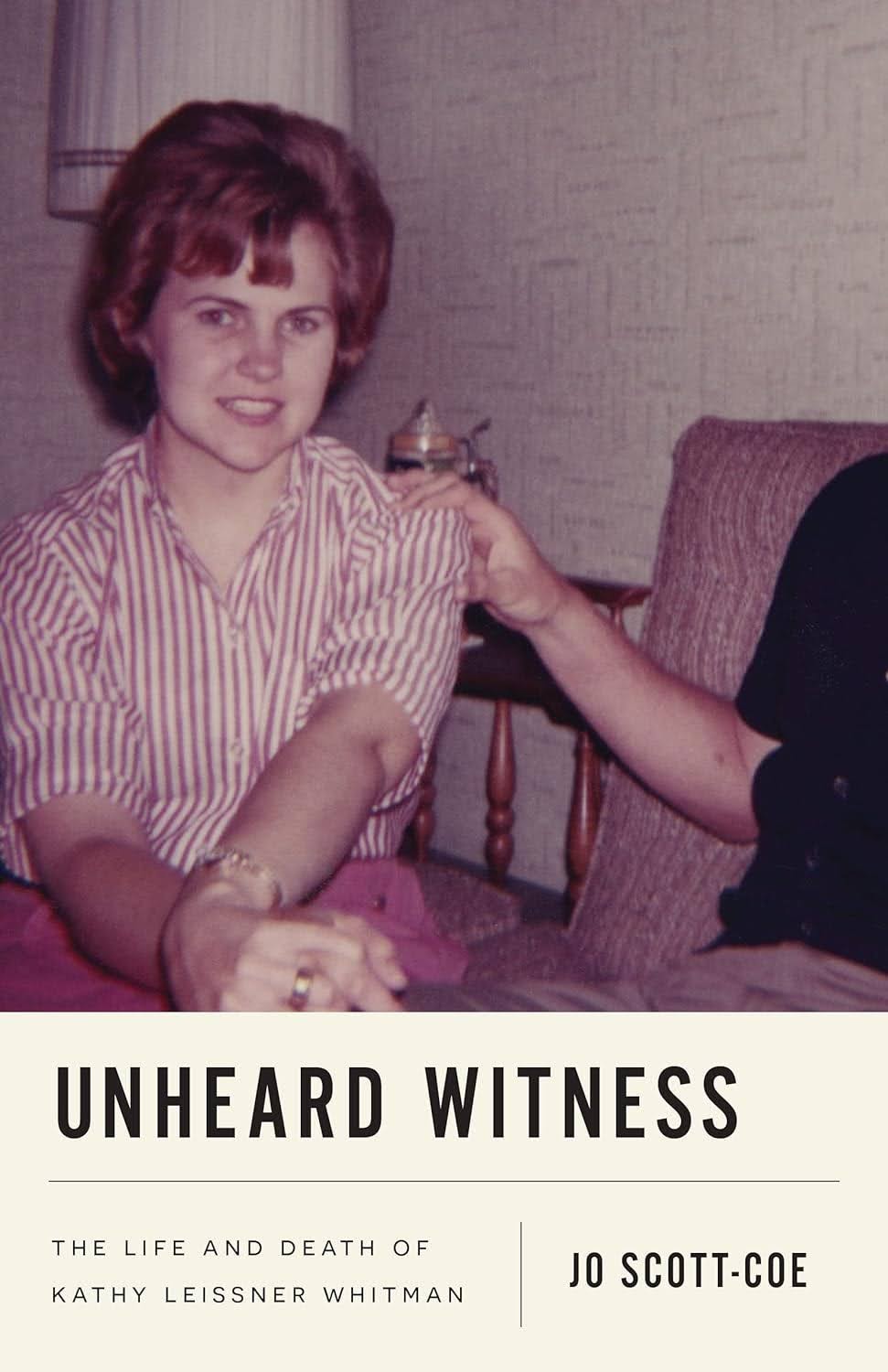
Five years after she graduated from high school, Kathy Leissner Whitman was stabbed to death by her husband Charles Whitman after he killed his mother and before he committed a mass shooting from the tower at the University of Texas, Austin. Unheard Witness, which is framed by Hurricane Carla (1961) and the Texas tower shootings (1966) that left 15 dead and 31 injured, is the story of how Kathy became a victim of domestic violence and then murder.
From Ideal Childhood to Nightmare
Reading about Kathy’s childhood and teen years, one might envy her. Her mother, a teacher, records her babyhood milestones in minute details, including the outfit she wore for her first outing to a doctor’s appointment. As a teen, Kathy is involved in so many high school clubs and service organizations that it would be easier to list those in which she is not a member. She is voted most “Ideal Girl” by her classmates. She has boyfriends and an active social life. Younger girls look at her example as something to aspire to.
Kathy leaves for college and new adventures a single day after Hurricane Carla. Less than a year later, she marries Whitman, also a UT Austin student. While he publicly appears to be a catch (good looking, one-time Eagle Scout and Catholic Church altar boy), privately he has a history of violence and misdeeds for which he is not held accountable. His father is also a domestic abuser. After the wedding, Kathy’s brother, Nelson, stays with Kathy’s in-laws and witnesses constant fighting, dishes hurled across the room at dinner time, and more. He understands that Kathy has made a mistake in marrying Charles.
A Life of Abuse and Uncertainty
The marriage quickly turns ugly with Charles constantly trying to exert control over Kathy (he goes so far as to dictate what her fingernails/manicures should look like). He wants to have a baby although Kathy knows their relationship is too unstable for that. He is on a military scholarship at UT Austin, which he loses due to poor grades. This upends Kathy’s life as she leaves school with him. Nevertheless, she is determined to finish college in four years and does so despite being abused and in a constant state of uncertainty.
Author Jo Scott Coe has carefully researched Kathy’s story. Kathy’s brother Nelson preserved over 600 letters concerning Kathy (her own letters to her parents, siblings, and Charles; their letters to her; Charles’ letters to Kathy’s parents) and he gave Scott Coe access to them. In her letters, Kathy’s dreams and daily life, her issues with Charles and her efforts to correct them are voiced. In some letters, it appears Charles, who writes addendums, is monitoring what Kathy writes.
Particularly poignant is a letter from Kathy’s mother, Frances, to Charlies, where she argues that Kathy doesn’t need psychiatric treatment as he has suggested. That, in fact, Charles should understand that she was a happy, vibrant girl before marrying him. Reading this letter, we can see how careful Frances is in her writing—trying to get Kathy help while not provoking the explosive Charles into more violence. Frances suggests marriage counseling, probably feeling that a third party could show Charles that the cause of his problems was himself.
Scott Coe previously wrote about Charles Whitman in MASS: A Sniper, a Father, and a Priest (2018). In her introduction to Unheard Witness, she states: “That sobering work well-prepared me to comprehend the milieu wherein Kathy, like so many women, faced unspeakable cruelty and dysfunction in places where they were supposedly most safe—in their churches, in their families, and in their closest relationships. Kathy’s humanity was threatened immediately by a relationship with a man whose notions of ‘love’ had been warped by childhood trauma and profoundly twisted by ideologies of ownership, objectification, and abuse. Unlike most victims, he perpetuated the damage.”
High School Housekeeping
While this well-researched nonfiction book is directed at adults, high school students will benefit from reading it. It’s a good book to recommend to students tasked with finding the deeper story behind a historical event. More importantly, it shows how young people are often unprepared to recognize dangerous relationships and how social bias and norms can blind girls to dangerous boys and men. I’ve noted many times on this blog that allowing teens to read widely and about difficult subjects is a safe way to introduce them to the unfamiliar. It also helps them to understand the dangers that threaten them without actually exposing them to that danger. Like The Sociopath Next Door, which I reviewed here, Unheard Witness details how ordinary bullies are and how easy it is to be caught in their web. In addition, it brings the story of one individual to life with empathy, correcting the false narrative of the last half century. Its importance to teens lies in helping them to understand the world.

 School Library Lady