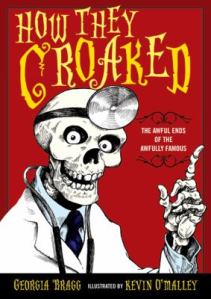
 How They Croaked: The Awful Ends of the Awfully Famous by Georgia Bragg; illustrated by Kevin O’Malley
This wacky book is alternatelty gross and funny. It is always fascinating.
Bragg looks at the terrible suffering involved in the deaths of nineteen famous people in history, starting with King Tut of Egypt (a Pharoah about 3,000 years ago) and ending with Albert Einstein (a Nobel Prize-winning scientist who developed the Theory of Relativity). What amazed me is how often in history the cure for an illness was really the cause of the death. Poor President Garfield was shot in an assassination attempt. The bullet didn’t touch any vitals organs, and he probably would have lived, but the doctors killed him (slowly and painfully over 80 days) by searching for the bullet with dirty fingers (causing infection) and drilling holes to find it. In fact, a number of these famous folks had dirty doctors and unsanitary conditions to thank for their excruciating deaths. Or, as in the case of George Washington, they just kept emptying their bodies of blood until the sick man was too weak to live.
How They Croaked also takes on the weird: it seems that the body of King Henry VIII of England was so toxic that it blew up in its coffin and leaked out. Other bodies suffered the removal of various parts as souveniers for survivors. Edgar Allen Poe might have died of rabies. In each case, Bragg discusses the evidence that points to the real cause of death, which wasn’t understood until recently. It’s amazing how long it took people to understand the effects of lead poisoning and what caused it. Deaths by lead poisoning, as described in the cases of Galileo and Beethoven, are horrific.
Much is made of the personalities of these famous folks. Charles Dickens seems to have suffered from bipolar disorder and was simply vicious to his family; Charles Darwin was so afraid of interacting with other people that he couldn’t attend his parents’ funerals.
This is a strange book, both creepy and entertaining. What’s great about it is that in a short read, you can learn a lot about famous people and why they were important, about medical knowledge (or, really, the lack of it) in different eras, and about cultural beliefs surrounding dead. You’ll come away with some truly interesting information.

 School Library Lady